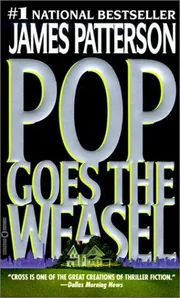
Pop Goes the Weasel
by James Patterson · 1999
Suits adult readers of crime thrillers.
418 pages, about 6.5 to 10 hours.
Cross hunts a diplomat killer who fights back in court. 52% taste match
The story
Pop Goes the Weasel is a police procedural and psychological thriller by James Patterson, first published in 1999. It is the fifth novel in the Alex Cross series, set in Washington, D.C., and it runs to roughly 418 pages in its median edition. The book has appeared in 45 editions.
Alex Cross, a psychologist and police detective, is newly in love when a run of serial murders begins in the city. The killings follow a pattern that baffles those working the case. Cross takes up the hunt, and his efforts lead to a suspect named Geoffrey Shafer, a British diplomat who moves through the world of embassies and expensive tailoring and who drives a black Jaguar. Shafer's connection to the crimes is hard to establish, and the effort to prove his guilt carries real danger. The contest plays out on the streets and also in court, where a murder trial becomes part of the struggle. Cross and his fiancee are drawn deeper into a conflict with a killer who answers each move against him with one of his own. Readers who follow Cross from book to book will find the personal and the professional intertwined here.
Geoffrey shafer, dashingly outfitted in a single-breasted blue blazer, white shirt, striped tie, and narrow gray trousers from h. huntsman & sons, walked out of his town house at seven-thirty in the morning and climbed into a black jaguar xj12.
Setting
Washington (D.C.)
Themes
PsychologistsBritish Diplomatic and consular serviceSerial murdersPsychopathsTaxicab driversTrials (Murder)Alex Cross (Fictitious character)Suspense
- Want to read 112
- Reading now 8
- Read 38
Most people shelving it are saving it for later.
Of 158 readers who put it on a shelf, 71% want to read it, 5% are reading it now, 24% have finished it and 0% stopped before the end.
By the numbers
- The median edition runs 418 pages. Counting about 275 words a page and an adult reading pace of 250 words a minute, that is about 7.7 hours of reading.
- Open Library tracks 45 editions from 32 publishers, the earliest dated 1999 and the latest 2021, across 5 languages.
- On reader demand it ranks in the top 6% of the modern books in our catalog (15,152 of them).
- Libraries shelve it under Dewey 813.54 and Library of Congress class PS-3566.00000000.A822 P66 1999b.
 BookWard’s take
Cross hunts a diplomat killer who fights back in court
Pop Goes the Weasel is the fifth Alex Cross novel, and it plays to the series' strengths. The hook is immediate and the pace stays brisk across 418 pages, which suits a reader who wants a thriller that moves. The pursuit of British diplomat Geoffrey Shafer runs through streets and a courtroom, so the middle never sags. Where it falls short for me is in its reliance on familiar tropes: the brilliant killer and the detective with a new love sit in well-worn territory, and the originality is modest. Cross himself is drawn with real depth, but the characters around him are thinner. Expect an ending that closes its threads, and while knowing the earlier books helps, it isn't required.
At 418 pages it is mid-length for a thriller, longer than BookWard's taste for tight books but quick to read.
Short chapters and a steady chase keep the story moving, close to BookWard's fast-paced preference.
The diplomat-killer and courtroom turn add something, but the overall shape is a familiar series thriller, below BookWard's bar.
The prose is plain and functional, close to BookWard's slightly plain-leaning taste.
Plot drives this one, though Cross's personal life is woven into it, leaning away from BookWard's character-driven lean.
The book carries a love story and a determined detective, but the killer's menace keeps it from turning cheerful.
The structure is conventional, a hunt followed by a trial, in line with BookWard's slightly conventional lean.
This is a serious thriller with little comedy, below BookWard's mild liking for humor.
Serial murders and a chilling villain make it dark, close to BookWard's mid-range.
Fear and affection both carry weight, a little more intense than BookWard's mid-range.
See all 50 dialsEvery position, side by side with this book
Where it lines up
- Sagging middleBookWard 8 · book 8
- OpeningBookWard 10 · book 9
- PaceBookWard 8 · book 9
Where it pulls apart
- Familiar tropesBookWard 10 · book 3
- Internal logicBookWard 10 · book 6
- OriginalityBookWard 9 · book 4
At 418 pages it is mid-length for a thriller, longer than BookWard's taste for tight books but quick to read.
The murders and Cross's new love set the stakes early, matching BookWard's wish for an opening that grabs at once.
The cat-and-mouse between Cross and Shafer holds together as a contest, though BookWard wants tighter plotting than genre thrillers usually offer.
Short chapters and a steady chase keep the story moving, close to BookWard's fast-paced preference.
The diplomat-killer and courtroom turn add something, but the overall shape is a familiar series thriller, below BookWard's bar.
Cross is drawn with care and his private life matters, though the supporting figures are lighter than BookWard likes.
The trial and pursuit push toward a clear resolution, in line with BookWard's taste for closure.
The love story brings some warmth, but the book stays mostly in thriller mode, a little softer than BookWard's restraint.
The killings are central, and they serve the hunt more than they exist for pure effect, somewhat short of BookWard's bar for earned darkness.
This is fiction, so rigor does not apply.
Patterson's plain, propulsive style is recognizable, though less distinctive than BookWard prefers.
This is firmly story-led, built around the chase and the trial rather than any argument.
The action is mostly shown in scene, with some explaining of the case, near BookWard's preference for showing.
The chase moves into the courtroom, which keeps the middle active and in line with BookWard's taste.
The prose is plain and functional, close to BookWard's slightly plain-leaning taste.
Plot drives this one, though Cross's personal life is woven into it, leaning away from BookWard's character-driven lean.
The book carries a love story and a determined detective, but the killer's menace keeps it from turning cheerful.
The structure is conventional, a hunt followed by a trial, in line with BookWard's slightly conventional lean.
This is a serious thriller with little comedy, below BookWard's mild liking for humor.
Short, clear chapters make it an easy read, a little lighter than BookWard's slightly demanding taste.
The story moves between Cross and the killer's side, broadly matching BookWard's liking for multiple viewpoints.
Events run mostly in order, close to BookWard's mildly linear preference.
The world is grounded in Washington, D.C. and real institutions, a bit more realistic than BookWard's middle position.
The core cast is manageable with a few key players, in line with BookWard's smaller-cast preference.
The stakes stay close to Cross, his fiancee and one killer, fitting BookWard's intimate lean.
Action in the streets and courtroom outweighs inner reflection, tilting outward against BookWard's inner lean.
Courtroom scenes and tense exchanges give it a good deal of dialogue, matching BookWard's liking for talk.
Cross's engagement matters to the plot, giving romance a real but secondary role, close to BookWard's middle.
Washington police work and embassy life are familiar thriller ground, less unfamiliar than BookWard likes.
A series thriller tied to its genre moment, with less staying power than BookWard seeks.
Cross is clearly the good guy and the killer clearly the villain, more clear-cut than BookWard prefers.
Description serves the action and stays economical, a little sparser than BookWard's middle.
It is the fifth Alex Cross novel, so series knowledge helps, though this is a heavier series lean than BookWard's standalone preference.
The killer answers each move with a countermove, delivering the turns BookWard enjoys.
It is a straightforward thriller meant to entertain, more comforting than BookWard's challenging lean.
Serial murders and a chilling villain make it dark, close to BookWard's mid-range.
Fear and affection both carry weight, a little more intense than BookWard's mid-range.
Humor is minor and dry when it appears, in line with BookWard's middle.
Serial killings are central to the plot, which puts violence at a clear level, near BookWard's middle.
A diplomat villain brings embassy matters in but politics is not the point, below BookWard's middle.
The language is plain and accessible, easier than BookWard's middle.
Narration mostly stays neutral, with Cross's perspective coloring events, a little below BookWard's lean.
It looks at present danger and immediate resolution more than the future, somewhat backward of BookWard's lean.
Cross's persistence suggests belief in justice, but the book is not especially idealistic, near BookWard's middle.
Review written by BookWard, dial version 1, November 2026.
Who is Pop Goes the Weasel right for?
Suits adult readers of crime thrillers. It deals with serial murder and a menacing villain, so it is not for younger readers.
Short, clear chapters make it an easy read, a little lighter than BookWard's slightly demanding taste.
Serial murders and a chilling villain make it dark, close to BookWard's mid-range.
Fear and affection both carry weight, a little more intense than BookWard's mid-range.
Serial killings are central to the plot, which puts violence at a clear level, near BookWard's middle.
Book CompanionPop Goes the Weasel: ideas, characters, themes
Alex Cross must prove a charming British diplomat is a serial killer while protecting the people he loves.
- A new love. Cross starts the book happy and engaged, which raises what the killer can threaten.
- A pattern in the killings. The murders follow a twisted pattern that baffles investigators and drives the hunt.
- The suspect. Geoffrey Shafer is a British diplomat moving through embassies and expensive tailoring, with a black Jaguar.
- Proof is the problem. Connecting Shafer to the crimes is hard and dangerous work.
- The courtroom. A murder trial turns the contest from the streets into a legal fight.
Characters
Alex Cross
Psychologist and police detective
The series lead, newly in love and leading the hunt.
Geoffrey Shafer
British diplomat and suspect
The polished antagonist who answers each move against him with one of his own.
Cross's fiancee
Cross's partner
Drawn into the conflict as it deepens.
Themes
Personal happiness is put at risk by the work Cross does.
A polished public figure may hide something monstrous.
Knowing someone is guilty is not the same as proving it.
Detective and killer test each other move by move.
Discussion questions
- Why does Shafer's polish make him a more unsettling villain?
- How does Cross's new love change the stakes of the hunt?
- What does the courtroom add that the street chase could not?
- How much does it matter that this is the fifth Cross book?
- Does the pattern in the killings make the story feel more clever or more formulaic?
Personalize your Book Companion
This is the general edition. In BookWard, the Companion is written for you: your reading profile, your notes, and spoiler-safe to the page you are on.
Buy, listen or borrow Pop Goes the Weasel
Each link opens a search for this book on that store, in a new tab.
Read on a device
Borrow
Reviews and community
If you liked Pop Goes the Weasel
A fast, familiar kidnapping thriller that launched the Alex Cross series
The SurgeonTess GerritsenA fast, grim Boston serial-killer thriller that opens the Rizzoli series
2Nd ChanceJames PattersonA fast San Francisco thriller where short chapters do the heavy lifting
Cat & MouseJames PattersonAlex Cross returns, hunted by Soneji and a second killer
Sources: Open Library.
Track Pop Goes the Weasel and find your next favorite
Add it to your shelf, rate what you have read, and BookWard will recommend what fits you.
Free to start. No credit card needed.