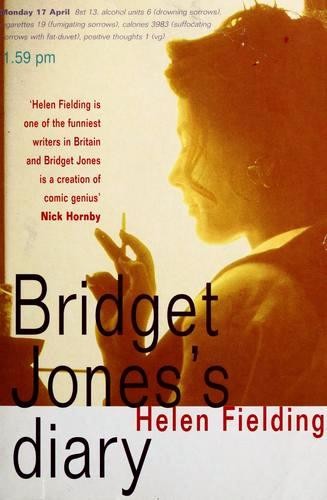
Bridget Jones's Diary
by Helen Fielding
★ Top 25 book of 1996 · #15 on Best Books of 1996
Told as a personal diary, this novel follows a year in the life of Bridget Jones, a single thirty-something working in London. She records her thoughts on her career, body image, bad habits, family, friends and love life.
Best for: Readers who enjoy a funny, confessional take on single life in London
Bridget Jones's Diary is #15 on BookWard's Best Books of 1996, out of 39 1996 books that cleared our data bar.
What Bridget Jones's Diary is about
Bridget Jones is thirty-something, single, working in London, and keeping a diary of one very eventful year. Helen Fielding's 1996 novel takes the form of those daily entries, where Bridget tallies her weight, her drinking, her cigarettes and her job worries with unsparing honesty, along with her hopes for love.
As the months pass, she gets tangled up with her charming, handsome boss, Daniel Cleaver, and crosses paths with Mark Darcy, a stuffy human-rights barrister she is quite sure she dislikes. The two were childhood playmates, reintroduced at a New Year's party by her mother, who is forever hoping to see her daughter married off to someone rich and handsome. Around her, a loyal circle of friends serves as the family she chooses, while awkward relatives, including a groping 'Uncle Geoffrey', supply the embarrassments. Funny and self-mocking, it is a portrait of modern single life that many readers see in themselves. Critics have credited it as the "urtext" of the contemporary chick lit movement, and it had sold over two million copies worldwide by 2006.
Bridget Jones's Diary on the Best Books of 1996
Bridget Jones's Diary came out in 1996. Of the 39 books first published in 1996 that met BookWard's data bar, it ranks #15 on our Best Books of 1996 list.
Why it made the list: 413 readers have shelved it on Open Library; readers rate it 3.6 out of 5 (54 ratings). The list ranks each year’s books on how many readers have picked them up, how highly readers rate them, and how many are reading them right now.
Nearby on the 1996 list
- 100 Ways to Motivate Yourself Steve Chandler, #13
- Crash Jerry Spinelli, #14
- The Highly Sensitive Person Elaine N. Aron, #16
- Vampire Breath Robert Lawrence Stine, #17
See all Best Books of 1996 Best books by year
More years: Best Books of 1995 Best Books of 1997.
The numbers behind it
- Readers: 312 want to read it, 17 are reading it now and 84 have read it, according to Open Library.
- Ratings: 3.6 out of 5 from 54 Open Library ratings.
| Signal | This book (0 to 100) | Weight |
|---|---|---|
| Reach | 77 | 55% |
| Reader love | 5 | 25% |
| Being read right now | 64 | 20% |
Questions about Bridget Jones's Diary
When was Bridget Jones's Diary published?
Bridget Jones's Diary by Helen Fielding was first published in 1996.
Was Bridget Jones's Diary one of the best books of 1996?
Bridget Jones's Diary is #15 on BookWard's Best Books of 1996, out of 39 1996 books that cleared our data bar. 413 readers have shelved it on Open Library; readers rate it 3.6 out of 5 (54 ratings).
Why is Bridget Jones's Diary on the Best Books of 1996 list?
413 readers have shelved it on Open Library; readers rate it 3.6 out of 5 (54 ratings).
More of the best books of 1996
- A Game of Thrones George R. R. Martin, #1
- The Green Mile Stephen King, #2
- Forbidden Knowledge Roger Shattuck, #3
- Fight Club Chuck Palahniuk, #4
- Push Sapphire, #5
- Neverwhere Neil Gaiman, #6
See the full Best Books of 1996, the Top 100, or new books on Rising.
How we know
This page uses public data: Open Library reader counts and ratings, and Wikipedia page views for recent years. The description is paraphrased from real source text. Rankings reflect reading interest, not quality or sales, and can be affected by data gaps. Lists update monthly.
Best suited to adult and older teen readers comfortable with frank talk about relationships, drinking, smoking and body image.
Depends on the edition you pick.
A year of vices and crushes, told in diary entries. 60% taste match
 BookWard’s take
A year of vices and crushes, told in diary entries
Helen Fielding's 1996 novel follows a year in the life of Bridget Jones, a thirty-something single woman in London, through diary entries about work, weight, drink, family and love. The voice is the draw: confessional, funny and instantly recognisable, and the opening hooks you almost at once. Because the diary form keeps entries short, the pace stays brisk, and the structure is lightly unconventional without ever becoming hard work. The tone is funny throughout, and the sentiment is more restrained than the premise would suggest. Where I part company with it is on familiar tropes: the romantic setup is the template for so much that followed, so its originality now reads as influence rather than surprise. Think of it as a sharp comic character study more than a plot machine.
Diary entries keep it compact and episodic, close to BookWard's preference for tight books.
Short dated entries move quickly from one scrape or crush to the next, close to BookWard's fast preference.
The diary-as-confession approach felt fresh in 1996, but its many imitators dilute that now.
Plain, chatty and conversational, deliberately unornamented, which lands near BookWard's slightly plain-leaning taste.
Bridget's inner life and romantic muddles drive things more than any external plot.
Despite her worries, the book is warm and optimistic about love and friendship, aligning with BookWard.
The dated diary format is a light formal choice but easy to follow.
Comic self-observation runs through nearly every entry, pushing it above BookWard's humor preference.
Worries about dying alone are played for laughs, so the book stays gentle.
Feelings are real but lightly handled, with comedy keeping intensity moderate.
See all 50 dialsEvery position, side by side with this book
Where it lines up
- PaceBookWard 8 · book 8
- Character depthBookWard 8 · book 8
- EndingBookWard 8 · book 8
Where it pulls apart
- Familiar tropesBookWard 10 · book 3
- Internal logicBookWard 10 · book 7
- LengthBookWard 1 · book 3
Diary entries keep it compact and episodic, close to BookWard's preference for tight books.
Bridget's voice grabs you from the first entries, which suits BookWard's taste for an immediate opening.
The romantic setup became a genre template, so it leans on recognisable beats, which sits below BookWard's ideal.
The year unfolds coherently and cause follows effect, though a comic diary does not demand airtight mechanics.
Short dated entries move quickly from one scrape or crush to the next, close to BookWard's fast preference.
The diary-as-confession approach felt fresh in 1996, but its many imitators dilute that now.
Bridget's insecurities and self-deceptions are drawn in layered, human detail, which BookWard rates highly.
The year closes out its romantic threads in a satisfying way, matching BookWard's liking for resolution.
Warm and sometimes tender, but undercut by humor, so it is only moderately restrained.
It relies on embarrassment and comic mishap rather than shock, so nothing feels cheaply dark.
Not applicable to a novel.
Bridget's self-mocking, list-keeping diary voice is the book's signature and as distinctive as BookWard wants.
This is firmly story and character, with its pleasures in incident rather than argument.
Everything comes through Bridget's own entries and scenes, close to BookWard's show-don't-tell preference.
The episodic format mostly keeps momentum, though some stretches repeat familiar anxieties.
Plain, chatty and conversational, deliberately unornamented, which lands near BookWard's slightly plain-leaning taste.
Bridget's inner life and romantic muddles drive things more than any external plot.
Despite her worries, the book is warm and optimistic about love and friendship, aligning with BookWard.
The dated diary format is a light formal choice but easy to follow.
Comic self-observation runs through nearly every entry, pushing it above BookWard's humor preference.
Quick, breezy entries make it very easy reading, which is more relaxed than BookWard's middle setting.
Everything is filtered through Bridget alone, narrower than BookWard's taste for multiple viewpoints.
Entries run in straight chronological order across one year.
Grounded in ordinary London working life with nothing fantastical.
Friends, family and two love interests form a modest but memorable circle.
The stakes are personal and domestic, far from epic in scope.
Most of the action is Bridget's thoughts, worries and self-commentary.
Conversations appear within entries but the narration carries more weight than the dialogue.
Her love life is the central thread, with two relationships shaping the year.
A familiar contemporary city and everyday office, family and social life.
Set in the mid-1990s, so it reads as a recent past rather than the present day.
Its worries about love, weight and self-image still resonate, even if details date it.
Bridget is candid but often misjudges herself and others, which gives mild unreliability.
Right and wrong are fairly clear, with the men and choices easy to read.
Setting and surroundings are sketched lightly because the voice does the work.
A first-person diary, as personal as perspective gets.
Part of a longer run of Bridget Jones books and adaptations, so far from standalone.
A late link between the two men adds a surprise, but the story is mostly predictable by design.
A comfort read overall, easing you in rather than pushing back.
Worries about dying alone are played for laughs, so the book stays gentle.
Feelings are real but lightly handled, with comedy keeping intensity moderate.
Self-deprecating and observational humor with some broad comic mishaps.
Essentially none appears on the page.
Romantic and sexual relationships feature but are treated lightly and conversationally.
Mostly personal concerns, with little political content in focus.
Plain, colloquial British English that is easy to follow.
Bridget's views on everything are on constant display, as BookWard enjoys.
Rooted in its present moment, with an eye on how life might improve next year.
It holds onto the hope that love and self-acceptance are within reach.
Review written by BookWard, dial version 1, November 2026.
Who is Bridget Jones's Diary right for?
Best suited to adult and older teen readers comfortable with frank talk about relationships, drinking, smoking and body image. Romantic and sexual themes are present but handled lightly and comically.
Quick, breezy entries make it very easy reading, which is more relaxed than BookWard's middle setting.
Worries about dying alone are played for laughs, so the book stays gentle.
Feelings are real but lightly handled, with comedy keeping intensity moderate.
Essentially none appears on the page.
Book CompanionBridget Jones's Diary: ideas, characters, themes
A year of a single woman's diary entries turns everyday embarrassments and romantic muddles into a warm, funny portrait of self-acceptance.
- Diary form. The dated entries give the novel its intimacy, speed and comic rhythm.
- Self-image. Bridget's weight, vices and resolutions drive much of the humor and the heart.
- Two romances. Her involvements with Daniel Cleaver and Mark Darcy shape the year and test her judgment.
- Friends as family. Her London friends give her unconditional support and act as a surrogate family.
- Parents in the background. Her mother's matchmaking and her father's steadiness add a second layer of pressure and comedy.
Characters
Bridget Jones
Narrator and protagonist
A thirty-something single woman in London who records her career, vices, family and romantic life.
Daniel Cleaver
Her charming boss
A handsome, charismatic man whose relationship with Bridget takes a painful turn.
Mark Darcy
Human-rights barrister
A stuffy lawyer Bridget initially dislikes, reintroduced at a New Year's party.
Bridget's mother
Overconfident matchmaker
A doting woman constantly trying to marry Bridget off to a rich, handsome man.
Bridget's father
Down-to-earth parent
A steadier presence who is sometimes unsettled by his wife.
Themes
How Bridget judges her body, habits and worth against what she thinks she should be.
The pressure and fear around being unpartnered, played for comedy and truth.
Chosen family that offers advice, comfort and loyalty.
First impressions and charm can mislead, and the right person may not look it at first.
Parents' hopes and meddling shape how Bridget sees her choices.
Discussion questions
- Why does the diary format make Bridget so easy to like?
- How do Bridget's resolutions and failures reveal what she really wants?
- What separates Daniel Cleaver's appeal from Mark Darcy's?
- How much do her friends shape her decisions compared with her family?
- Which parts of the book feel dated, and which still ring true?
Personalize your Book Companion
This is the general edition. In BookWard, the Companion is written for you: your reading profile, your notes, and spoiler-safe to the page you are on.
Buy, listen or borrow Bridget Jones's Diary
Each link opens a search for this book on that store, in a new tab.
Read on a device
Borrow
Reviews and community
If you liked Bridget Jones's Diary
A diary-form teen comedy about a reluctant, flat-chested, algebra-failing princess
CrashJerry SpinelliA bully's own story, told with humor and real heart
The Rosie ProjectGraeme SimsionA rule-bound geneticist hunts for a wife by questionnaire
I Capture the CastleDodie SmithA diary-form charmer that opens in a kitchen sink
Find your own best books
Add what you have read, rate it, and BookWard will recommend what to read next.
Free to start. No credit card needed.