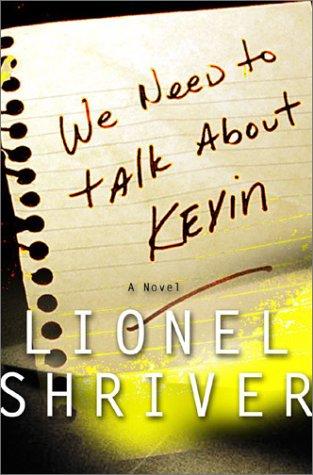
We Need to Talk About Kevin
by Lionel Shriver
★ Top 25 book of 2003 · #11 on Best Books of 2003
An international bestseller about motherhood gone awry. Eva never really wanted to be a mother, and certainly not the mother of the boy who murdered seven of his fellow high school students, a cafeteria worker and a teacher.
Best for: Readers who can handle a dark, unsettling novel about family.
We Need to Talk About Kevin is #11 on BookWard's Best Books of 2003, out of 52 2003 books that cleared our data bar.
What We Need to Talk About Kevin is about
Eva Khatchadourian writes letters to her husband, Franklin, trying to understand how their son Kevin came to commit a school massacre at fifteen. Looking back, she describes a mother who was never sure she wanted children, who gave up her work as a writer to raise him, and who could not bond with a boy she felt disliked her. Franklin refused to see any problem. Their younger child, Celia, was the affectionate one.
The novel moves between the years before and the aftermath, in which Eva stays in her town, is shunned, and visits Kevin in prison. Lionel Shriver's 2003 book won the 2005 Orange Prize and was filmed in 2011. It is dark and unsettling, and it asks hard questions about motherhood, blame, and nature versus nurture. Readers should be ready for difficult subject matter.
We Need to Talk About Kevin on the Best Books of 2003
We Need to Talk About Kevin came out in 2003. Of the 52 books first published in 2003 that met BookWard's data bar, it ranks #11 on our Best Books of 2003 list.
Why it made the list: 397 readers have shelved it on Open Library; readers rate it 4.2 out of 5 (26 ratings); 22 are reading it right now. The list ranks each year’s books on how many readers have picked them up, how highly readers rate them, and how many are reading them right now.
Nearby on the 2003 list
- The Time Traveler's Wife Audrey Niffenegger, #9
- How to Train Your Dragon Cressida Cowell, #10
- The Devil in the White City Erik Larson, #12
- Thomas and Friends Reverend W. Awdry, #13
See all Best Books of 2003 Best books by year
More years: Best Books of 2002 Best Books of 2004.
The numbers behind it
- Readers: 329 want to read it, 22 are reading it now and 46 have read it, according to Open Library.
- Ratings: 4.2 out of 5 from 26 Open Library ratings.
| Signal | This book (0 to 100) | Weight |
|---|---|---|
| Reach | 73 | 55% |
| Reader love | 65 | 25% |
| Being read right now | 67 | 20% |
Questions about We Need to Talk About Kevin
When was We Need to Talk About Kevin published?
We Need to Talk About Kevin by Lionel Shriver was first published in 2003.
Was We Need to Talk About Kevin one of the best books of 2003?
We Need to Talk About Kevin is #11 on BookWard's Best Books of 2003, out of 52 2003 books that cleared our data bar. 397 readers have shelved it on Open Library; readers rate it 4.2 out of 5 (26 ratings); 22 are reading it right now.
Why is We Need to Talk About Kevin on the Best Books of 2003 list?
397 readers have shelved it on Open Library; readers rate it 4.2 out of 5 (26 ratings); 22 are reading it right now.
More of the best books of 2003
- Harry Potter and the Order of the Phoenix J. K. Rowling, #1
- Into the Wild Erin Hunter, #2
- The Kite Runner Khaled Hosseini, #3
- Don't Let the Pigeon Drive the Bus! Mo Willems, #4
- A Short History of Nearly Everything Bill Bryson, #5
- The Da Vinci Code Dan Brown, #6
See the full Best Books of 2003, the Top 100, or new books on Rising.
How we know
This page uses public data: Open Library reader counts and ratings, and Wikipedia page views for recent years. The description is paraphrased from real source text. Rankings reflect reading interest, not quality or sales, and can be affected by data gaps. Lists update monthly.
Best suited to adult readers and mature older teens who can handle a sustained, dark psychological story.
Depends on the edition you pick.
A mother's letters about the son who murdered his classmates. 53% taste match
 BookWard’s take
A mother's letters about the son who murdered his classmates
Told entirely through letters from Eva Khatchadourian to her husband, this novel is a cold, controlled study of motherhood and blame. It hooks at once, because the massacre is known from the start and the pull is in how Eva got there. The voice is the real draw: sharp, self-lacerating, and unmistakably Eva's, which gives the character real depth and weight. It matters, too, that Eva is both our only guide and a woman with every reason to shade her own account. The prose runs ornate and the ideas about parenting press hard against the story. It earns its darkness rather than leaning on shock, though it is demanding and never comforting. Expect to feel unsettled and to keep arguing with Eva long after the last page.
A full-sized novel built from a long run of letters, so it runs well beyond the tight and short that BookWard prefers.
The letter format favors reflection over momentum, so it moves steadily rather than fast, a little slower than BookWard likes.
A school massacre seen through the killer's mother, in letters to her husband, is a fresh angle that BookWard values.
The language is rich, formal and heavily worked, more ornate than BookWard usually likes, though it fits Eva.
The events are known early, so the book is driven by Eva's psychology and her relationship with Kevin.
The mood is bleak and unforgiving, with little warmth, which sits well below BookWard's mildly hopeful outlook.
The story is told as letters moving between the past and the aftermath, a mildly inventive arrangement.
Eva's bitter observations carry a trace of dry wit, but the book is grave throughout.
A school massacre and a hostile parent-child bond make this among the darkest territory in fiction.
Eva's guilt, dread and anger run high through every letter.
See all 50 dialsEvery position, side by side with this book
Where it lines up
- OpeningBookWard 10 · book 9
- Familiar tropesBookWard 10 · book 9
- OriginalityBookWard 9 · book 8
Where it pulls apart
- LengthBookWard 1 · book 6
- ExpositionBookWard 2 · book 6
- Internal logicBookWard 10 · book 8
A full-sized novel built from a long run of letters, so it runs well beyond the tight and short that BookWard prefers.
The massacre is stated up front and Eva's voice pulls you in at once, which suits BookWard's love of a fast start.
It sidesteps the usual thriller and domestic-drama tropes by staying inside one mother's guilt, which BookWard rewards.
Eva's account holds together cause by cause, with Kevin's behavior following a consistent and chilling pattern.
The letter format favors reflection over momentum, so it moves steadily rather than fast, a little slower than BookWard likes.
A school massacre seen through the killer's mother, in letters to her husband, is a fresh angle that BookWard values.
Eva and Kevin are drawn with sustained, uncomfortable intimacy, exactly the deep characterization BookWard looks for.
The narrative builds toward a clear reckoning rather than leaving everything open, which fits BookWard's taste for resolution.
Eva refuses easy tenderness and the book offers little consolation, matching BookWard's liking for restraint.
The violence is the foundation of the story, and the book earns it by examining its causes rather than using it as spectacle.
This is fiction, so the nonfiction rigor dial does not apply.
Eva's voice is acerbic, intelligent and impossible to mistake for anyone else's, a strong match for BookWard.
It carries real arguments about motherhood and blame, but they are delivered through a story that stays gripping.
Eva explains and analyzes her own feelings at length, leaning more on reflection than on pure dramatized scenes.
The reflective letters can slow the middle, but the dread built from the opening keeps tension alive.
The language is rich, formal and heavily worked, more ornate than BookWard usually likes, though it fits Eva.
The events are known early, so the book is driven by Eva's psychology and her relationship with Kevin.
The mood is bleak and unforgiving, with little warmth, which sits well below BookWard's mildly hopeful outlook.
The story is told as letters moving between the past and the aftermath, a mildly inventive arrangement.
Eva's bitter observations carry a trace of dry wit, but the book is grave throughout.
The dense prose and unsparing subject ask for patience and attention, a bit more than BookWard's usual comfort.
Everything comes through Eva's single perspective, which is narrower than the many viewpoints BookWard enjoys.
Eva moves back and forth between the years leading up to the massacre and her life afterward.
The setting and events are entirely realistic and grounded.
The story circles a tight family of four and a handful of others, keeping the cast small.
It stays inside one household and one town, an intimate story despite the public tragedy.
Most of the weight sits in Eva's thoughts and memories rather than in outward action.
Scenes with Kevin and Franklin carry sharp exchanges, but the book leans more on narration than on talk.
The marriage matters to the story, but romance is not its focus.
It takes place in an ordinary American town and family, a familiar setting rather than an unfamiliar one.
Published in 2003 and set in a recognizably modern America, it sits somewhere between past and present.
Its questions about parenting, blame and violence stay relevant well beyond its publication date.
Eva is honest about her failings, but her bias is central, so the reader keeps questioning her account.
The book refuses to say how much blame belongs to Eva and how much to Kevin, leaving judgment open.
Eva describes people, places and sensations at length and in vivid detail.
This is fiction, so the nonfiction style dial does not apply.
This is fiction, so the nonfiction perspective dial does not apply.
It is a self-contained novel with no sequel needed.
Dread is present from the start, and a few late revelations land harder than the plot alone suggests.
It is deliberately uncomfortable and offers no reassurance, a stronger challenge than BookWard usually seeks.
A school massacre and a hostile parent-child bond make this among the darkest territory in fiction.
Eva's guilt, dread and anger run high through every letter.
What humor exists is dry, bitter and quiet rather than broad.
The massacre is central, though the book spends more time on dread and aftermath than on graphic detail.
Sexual content appears as part of the marriage but is not a focus.
Social questions about community and blame surface, but the book is not political in any central way.
The language is educated and complex but not dialect-heavy or obscure.
Eva's judgments about parenting, people and society are sharp, constant and unapologetic.
The narration dwells on what already happened, looking back far more than ahead.
The book is deeply cynical about parenthood and human nature.
Review written by BookWard, dial version 1, November 2026.
Who is We Need to Talk About Kevin right for?
Best suited to adult readers and mature older teens who can handle a sustained, dark psychological story. It centers on a school massacre and a deeply troubled parent-child relationship, including violence against a child.
The dense prose and unsparing subject ask for patience and attention, a bit more than BookWard's usual comfort.
A school massacre and a hostile parent-child bond make this among the darkest territory in fiction.
Eva's guilt, dread and anger run high through every letter.
The massacre is central, though the book spends more time on dread and aftermath than on graphic detail.
Book CompanionWe Need to Talk About Kevin: ideas, characters, themes
A mother writes to her estranged husband to understand how she raised a son who committed a school massacre, and whether she is to blame.
- A letter-by-letter reckoning. Eva writes to her husband Franklin after the massacre, using the letters to examine their marriage, her ambivalence about motherhood, and Kevin.
- A mother who feels unlike mothers. Eva struggles to bond with her son and feels he dislikes her, which shapes her sense of guilt and distance.
- Two readings of one child. Franklin sees Kevin as normal and misunderstood, while Eva sees deliberate manipulation, splitting the marriage.
- Aftermath in a hostile town. Eva stays near the facility where Kevin is held and is shunned by her community, visiting him in a relationship that is not close.
- An unreliable center. Because everything is filtered through Eva, readers must weigh her account against her own possible bias.
Characters
Eva Khatchadourian
Narrator and Kevin's mother
A former writer who gave up her career to raise her son and who writes the letters that make up the book.
Kevin
Eva's son
A teenager who commits a school massacre two days before his sixteenth birthday and who is cold and manipulative toward his mother.
Franklin Plaskett
Eva's husband
Eva's husband, who defends Kevin and refuses to see a problem, creating a rift in the marriage.
Celia
Eva and Franklin's daughter
Kevin's younger sister, affectionate toward Eva, who is blinded in one eye in an accident.
Themes
The book examines a woman who is unsure she wanted to be a mother and the guilt that follows.
It asks whether Kevin was shaped by how he was raised or was simply the way he was.
Eva, her husband and the community all struggle over who is accountable for the massacre.
Disagreement over Kevin drives a wedge between Eva and Franklin.
Eva is shunned by her community, showing how a town treats the family of a killer.
Discussion questions
- Do you trust Eva's account of Kevin, or do you suspect she shades the past to fit her guilt?
- How much does Franklin's refusal to see a problem contribute to what happens?
- Is Eva's dislike of Kevin a cause of his behavior, a response to it, or both?
- Why do you think the author chose letters to Franklin rather than a conventional narration?
- How does the community's treatment of Eva shape the way you read her?
Personalize your Book Companion
This is the general edition. In BookWard, the Companion is written for you: your reading profile, your notes, and spoiler-safe to the page you are on.
Buy, listen or borrow We Need to Talk About Kevin
Each link opens a search for this book on that store, in a new tab.
Read on a device
Borrow
Reviews and community
If you liked We Need to Talk About Kevin
A murder told up front, and why it still grips
Sharp ObjectsGillian FlynnA journalist goes home to Wind Gap and her own wounds
The CollectorJohn FowlesA kidnapping told twice, by captor and captive
Cat's EyeMargaret AtwoodA painter's return to Toronto, and the girlhood that made her
Find your own best books
Add what you have read, rate it, and BookWard will recommend what to read next.
Free to start. No credit card needed.