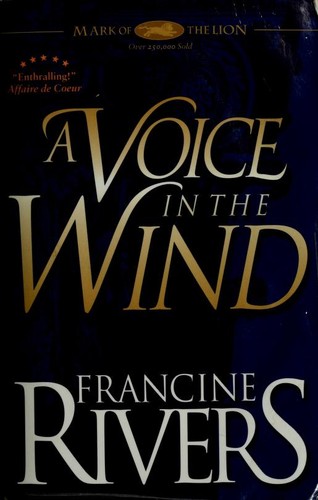
Voice in the Wind
by Francine Rivers
★ Top 25 book of 1993 · #11 on Best Books of 1993
Hadassah, a young Jewish slave brought to Rome after Jerusalem's destruction, quietly holds to her faith while serving a decadent household. A possible love with aristocrat Marcus tests her beliefs, as a captured German gladiator fights to survive.
Best for: Readers who enjoy faith-centered historical romance set in ancient Rome
Voice in the Wind is #11 on BookWard's Best Books of 1993, out of 36 1993 books that cleared our data bar.
What Voice in the Wind is about
Hadassah survives the destruction of Jerusalem by the Romans, though her family does not. Captured and sold, she is taken to Rome and becomes the personal slave of Julia Valerian, a reckless, pleasure-seeking woman who works against her at every turn.
Hadassah tries to live by the teachings of Jesus, even toward the people who own her, but she must hide her faith to stay alive. Her situation grows more tangled when she becomes drawn to Marcus, Julia's brother, a handsome aristocrat who believes in nothing. Set among Jews, Romans and barbarians in the shadow of the siege, the novel asks whether love can survive the gulf between a slave and a nobleman, and between conviction and doubt. Readers who enjoy earnest, emotional historical fiction about faith under pressure will find much here.
Voice in the Wind on the Best Books of 1993
Voice in the Wind came out in 1993. Of the 36 books first published in 1993 that met BookWard's data bar, it ranks #11 on our Best Books of 1993 list.
Why it made the list: 268 readers have shelved it on Open Library; readers rate it 3.8 out of 5 (18 ratings). The list ranks each year’s books on how many readers have picked them up, how highly readers rate them, and how many are reading them right now.
Nearby on the 1993 list
- Night of the Living Dummy Robert Lawrence Stine, #9
- The Client John Grisham, #10
- The Fires of Heaven Robert Jordan, #12
- Nightmares & Dreamscapes Stephen King, #13
See all Best Books of 1993 Best books by year
More years: Best Books of 1992 Best Books of 1994.
The numbers behind it
- Readers: 213 want to read it, 19 are reading it now and 35 have read it, according to Open Library.
- Ratings: 3.8 out of 5 from 18 Open Library ratings.
| Signal | This book (0 to 100) | Weight |
|---|---|---|
| Reach | 72 | 55% |
| Reader love | 25 | 25% |
| Being read right now | 89 | 20% |
Questions about Voice in the Wind
When was Voice in the Wind published?
Voice in the Wind by Francine Rivers was first published in 1993.
Was Voice in the Wind one of the best books of 1993?
Voice in the Wind is #11 on BookWard's Best Books of 1993, out of 36 1993 books that cleared our data bar. 268 readers have shelved it on Open Library; readers rate it 3.8 out of 5 (18 ratings).
Why is Voice in the Wind on the Best Books of 1993 list?
268 readers have shelved it on Open Library; readers rate it 3.8 out of 5 (18 ratings).
More of the best books of 1993
- The Giver Lois Lowry, #1
- The Scam Debashis Basu, #2
- Along Came a Spider James Patterson, #3
- A Suitable Boy Vikram Seth, #4
- Girl, Interrupted Susanna Kaysen, #5
- Understanding Comics Scott McCloud, #6
See the full Best Books of 1993, the Top 100, or new books on Rising.
How we know
This page uses public data: Open Library reader counts and ratings, and Wikipedia page views for recent years. The description is paraphrased from real source text. Rankings reflect reading interest, not quality or sales, and can be affected by data gaps. Lists update monthly.
Best suited to adult and older teen readers who enjoy faith-centered historical fiction.
Depends on the edition you pick.
Faith and slavery in Rome, with a romance at its center. 43% taste match
 BookWard’s take
Faith and slavery in Rome, with a romance at its center
This is the first book in Rivers's Mark of the Lion series, a Christian historical romance set in the years after Jerusalem's destruction. It follows Hadassah, a Jewish slave girl who must hide her faith in a Roman household, and the aristocrat Marcus, whose doubt sets him against everything she holds. The setup is clear and grabs early, but this is where I part company with it: the slave-and-master romance and the villainous Julia follow well-worn lines. Rivers does build real depth around Hadassah's quiet endurance, and the outlook leans hopeful. Its Rome is richly drawn, though the prose stays plain and the exposition is fairly direct. A warm, earnest book rather than a surprising one.
A big multi-thread historical novel that runs long, well past BookWard's love of tight, short books.
Several threads keep things moving, though the book takes its time with domestic and spiritual scenes.
The Roman setting is vivid, but the overall shape of the story is well-trodden ground.
The prose is plain and readable, in line with BookWard's middle ground.
Hadassah's inner journey and her relationships steer the story more than events alone.
Faith and grace form its backbone, making it notably more hopeful than BookWard's usual lean.
The structure is conventional, moving through intertwined storylines without formal experiment.
The tone is serious and devout, with little room for humor.
Slavery, gladiatorial combat and Roman excess give it real darkness, tempered by hope.
Faith, loss and love are rendered with strong feeling and little reserve.
See all 50 dialsEvery position, side by side with this book
Where it lines up
- Character depthBookWard 8 · book 7
- EndingBookWard 8 · book 7
- Story or ideasBookWard 3 · book 4
Where it pulls apart
- LengthBookWard 1 · book 8
- Familiar tropesBookWard 10 · book 3
- Internal logicBookWard 10 · book 6
A big multi-thread historical novel that runs long, well past BookWard's love of tight, short books.
Hadassah's captivity and the fall of Jerusalem give it a purposeful start, though less instant than BookWard prefers.
The slave-and-aristocrat romance and the cruel, spoiled mistress lean on familiar tropes, short of BookWard's taste for the unfamiliar.
The story's cause and effect hold together well enough, with some convenient turns typical of the genre.
Several threads keep things moving, though the book takes its time with domestic and spiritual scenes.
The Roman setting is vivid, but the overall shape of the story is well-trodden ground.
Hadassah's inner struggle between faith and survival is drawn with care, close to what BookWard values.
As part of a series it resolves its main arcs while leaving the larger story open.
Earnest and openly emotional, it favors warmth over restraint, unlike BookWard's cooler taste.
The arena and Rome's excess are dark, but they serve the story's themes rather than shocking for effect.
Rivers writes in a warm, clear, recognizable inspirational style, though not a strikingly distinct one.
Story leads, with the faith themes carried through plot and character rather than argument.
Beliefs and motives are often stated outright, further from BookWard's preference for showing in scene.
Moments of reflection slow the middle, though competing storylines mostly hold interest.
The prose is plain and readable, in line with BookWard's middle ground.
Hadassah's inner journey and her relationships steer the story more than events alone.
Faith and grace form its backbone, making it notably more hopeful than BookWard's usual lean.
The structure is conventional, moving through intertwined storylines without formal experiment.
The tone is serious and devout, with little room for humor.
The language is accessible and the story easy to follow.
The story moves between Hadassah, Marcus, Julia and the gladiator Atretes.
The story moves forward in time without major shifts.
It is grounded in historical Rome, with faith as the only supernatural note.
Jewish, Roman and barbarian characters across several households make for a sizable cast.
It spans the fall of Jerusalem and the decadence of Rome, giving it an epic backdrop.
It balances Hadassah's inner spiritual life with arena combat and household intrigue.
Conversations carry much of the faith and romance, in a moderate amount.
The love between Hadassah and Marcus is a central thread, beyond BookWard's usual interest.
Ancient Rome and Germania are far from daily life, giving a strongly unfamiliar setting.
Set in the first century, it is about as far from the present day as it gets.
Its themes of faith and love hold up, though the style is rooted in 1990s inspirational fiction.
The narration is straightforward and trustworthy.
Right and wrong are clearly drawn, with a firm Christian framework behind the story.
Rome's luxury and cruelty are rendered in generous, vivid detail.
It opens the Mark of the Lion series, so the story continues beyond this volume.
There are turns along the way, though many are what the genre leads you to expect.
It offers more comfort and reassurance than challenge, though its faith questions are pointed.
Slavery, gladiatorial combat and Roman excess give it real darkness, tempered by hope.
Faith, loss and love are rendered with strong feeling and little reserve.
Humor is minimal and gentle where it appears.
The siege, slavery and arena bring a good deal of violence to the page.
Roman decadence is depicted, but within the bounds of Christian fiction.
Empire and power form the backdrop, though faith matters more than politics.
The language is plain and accessible, with no heavy dialect.
The narration carries a clear spiritual viewpoint that shapes how events are framed.
It looks back to the ancient world, with some hope aimed at what faith can bring.
Hadassah's steady faith and the power of grace give it a strongly idealistic spine.
Review written by BookWard, dial version 1, November 2026.
Who is Voice in the Wind right for?
Best suited to adult and older teen readers who enjoy faith-centered historical fiction. It includes slavery, arena violence and Roman decadence, handled within the norms of Christian fiction.
The language is accessible and the story easy to follow.
Slavery, gladiatorial combat and Roman excess give it real darkness, tempered by hope.
Faith, loss and love are rendered with strong feeling and little reserve.
The siege, slavery and arena bring a good deal of violence to the page.
Book CompanionVoice in the Wind: ideas, characters, themes
A Jewish slave girl in Rome holds to her faith in secret while a skeptical aristocrat begins to change around her.
- A faith kept in secret. Hadassah must hide her religion to survive, so her beliefs show up in small acts of kindness rather than words.
- Two worlds in the same house. The story sets a devout Jewish captive against the pleasures and cruelty of a wealthy Roman household.
- The doubter and the believer. Marcus believes in nothing, which makes his attraction to Hadassah a clash of worldviews as well as a romance.
- Julia as foil. Julia's recklessness and spite put constant pressure on Hadassah and show what the household costs her.
- The arena thread. Atretes, a captured Germanic soldier forced into gladiator combat, gives the book a second storyline of survival.
Characters
Hadassah
Jewish slave girl
Survivor of Jerusalem's fall, sold into a Roman household and trying to live by Jesus's teachings in secret.
Marcus
Roman aristocrat
Julia's brother, handsome and unbelieving, drawn to Hadassah despite the gap between them.
Julia Valerian
Hadassah's mistress
A hedonistic, impulsive young woman who tries to undermine Hadassah at every turn.
Atretes
Gladiator
A soldier from Germania captured and forced to fight in the arena.
Themes
What it costs to hold a belief when revealing it could be fatal.
How ownership shapes the people who hold it and those who endure it.
A civilization shown rotting from its own excess.
Whether affection can cross gaps of status and belief.
What people do to endure captivity, war and the arena.
Discussion questions
- How does Hadassah's secrecy shape the way she shows her faith?
- What makes Marcus's lack of belief a real obstacle to love?
- Why pair the household story with Atretes's life in the arena?
- Does the portrayal of Rome's excess feel balanced or one-sided?
- How far can a romance across such unequal status feel believable?
Personalize your Book Companion
This is the general edition. In BookWard, the Companion is written for you: your reading profile, your notes, and spoiler-safe to the page you are on.
Buy, listen or borrow Voice in the Wind
Each link opens a search for this book on that store, in a new tab.
Read on a device
Borrow
Reviews and community
If you liked Voice in the Wind
Rome's arena and a slave's faith, in a long, earnest sequel
ScarlettAlexandra RipleyA big, soapy sequel that picks up where Gone with the Wind stopped
Reign of RoseKate GoldenA romantasy where prophecy, revenge and a damaged bond collide
A Kingdom of DreamsJudith McNaughtA kidnapped Highland heiress, an English duke, and a slow-burning war of wills
Find your own best books
Add what you have read, rate it, and BookWard will recommend what to read next.
Free to start. No credit card needed.