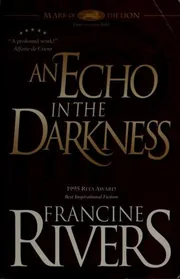
An echo in the darkness
by Francine Rivers · 1994
Best suited to adult and mature teen readers who like long historical fiction.
452 pages, about 7 to 10.5 hours.
Rome's arena and a slave's faith, in a long, earnest sequel. 45% taste match
The story
An Echo in the Darkness is a work of historical fiction by Francine Rivers, first published in 1994. It belongs to the religious fiction tradition and draws on the history of the early church, with its story set in Rome during the first centuries of Christianity. The book runs to roughly 452 pages in its median edition, and it has appeared in 17 editions since it first came out.
The story follows Marcus Lucianus Valerian, a wealthy trader whose fortune comes from supplying sand and slaves to the Roman games. He walks the streets of the Eternal City searching for some measure of inner calm. In his family's household lives Hadassah, a slave whose devotion to Christ sets her apart from those around her. Her fate in the arena upends his life and sends him toward Jerusalem, where he hopes to learn more about her god. The novel is part of a series, and its themes of slavery, faith and the life of women held in bondage place it among stories about the early Christian world under Roman rule. Readers of church history who enjoy it in narrative form will find a setting built around the city of Rome and its public spectacles.
Marcus Lucianus Valerian walked through a maze of streets in the Eternal City, hoping to find a sanctuary of peace within himself.
Setting
Rome
Period
Primitive and early church, ca. 30-600
Themes
Church historyWomen slavesHistory
- Want to read 148
- Reading now 13
- Read 24
Most people shelving it are saving it for later.
Of 185 readers who put it on a shelf, 80% want to read it, 7% are reading it now, 13% have finished it and 0% stopped before the end.
By the numbers
- The median edition runs 452 pages. Counting about 275 words a page and an adult reading pace of 250 words a minute, that is about 8.3 hours of reading.
- Open Library tracks 17 editions from 10 publishers, the earliest dated 1994 and the latest 2018, across 2 languages.
- On reader demand it ranks in the top 7% of the modern books in our catalog (15,152 of them).
- Libraries shelve it under Dewey 813.54 and Library of Congress class PS-3568.00000000.I83165E24.
 BookWard’s take
Rome's arena and a slave's faith, in a long, earnest sequel
This is the second novel in Francine Rivers' Mark of the Lion series, set in first-century Rome, and it works as a sweeping, faith-driven historical drama rather than a quiet character study. It is built to be read in order, so newcomers will want to start with the first book. Marcus, a trader who profits from the games, is pulled toward the faith of Hadassah, a slave in his household, and the story is driven by his inner struggle more than by outward events. It is long, with a wide cast and many viewpoints across Rome's classes. The tone is earnest and openly hopeful, with a clear moral frame, and the feeling runs warm instead of restrained. For readers who want Rome, spectacle and conviction in one story, it delivers.
At 452 pages it runs long and broad, well past BookWard's preference for tight, short books.
It moves at a steady, saga pace, slower than BookWard's taste for brisk momentum.
The Roman setting is vivid, but the arc of a seeker drawn to Christ is a familiar one.
The writing is accessible and plain, with description serving the story rather than showing off.
Events turn on Marcus's inner change and Hadassah's faith more than on plot mechanics.
Its central message is redemption and light breaking into darkness, which BookWard welcomes.
It follows a conventional, linear narrative from start to finish.
This is a serious, devotional story with little room for humor.
Slavery and the arena bring real darkness, balanced by the book's hope.
It plays for strong feeling throughout, in suffering, devotion and longing.
See all 50 dialsEvery position, side by side with this book
Where it lines up
- EndingBookWard 8 · book 8
- Character depthBookWard 8 · book 7
- Story or ideasBookWard 3 · book 4
Where it pulls apart
- LengthBookWard 1 · book 7
- Familiar tropesBookWard 10 · book 4
- OpeningBookWard 10 · book 6
At 452 pages it runs long and broad, well past BookWard's preference for tight, short books.
It opens on a wealthy slave trader and a devout slave in one household, which pulls readers in without being instant.
Faith-and-conversion in ancient Rome is well-worn ground, and the story follows familiar beats of the genre.
Cause and effect hold together within its historical frame, though devout turns lean on conviction over strict plausibility.
It moves at a steady, saga pace, slower than BookWard's taste for brisk momentum.
The Roman setting is vivid, but the arc of a seeker drawn to Christ is a familiar one.
Marcus and Hadassah are given real inner lives and conflict, which BookWard values.
As part of a series it resolves its main thread while still pointing onward.
Its warm, devotional tone is openly emotional, the opposite of BookWard's restrained preference.
The arena violence is part of the setting's brutality, though it is used to serve the story.
Not a nonfiction book, so rigor applies only loosely to its historical grounding.
The prose is clear and committed, with a recognizable earnest sincerity but no strikingly singular style.
It is story-led, using plot and character to carry its themes rather than arguing ideas outright.
Faith and history are often stated directly in conversation, more explained than BookWard prefers.
A long, multi-strand book that holds interest overall but has stretches that drift.
The writing is accessible and plain, with description serving the story rather than showing off.
Events turn on Marcus's inner change and Hadassah's faith more than on plot mechanics.
Its central message is redemption and light breaking into darkness, which BookWard welcomes.
It follows a conventional, linear narrative from start to finish.
This is a serious, devotional story with little room for humor.
The language is easy to follow, so reading effort stays low despite the length.
It moves among several characters across social classes, giving a broad view of Roman life.
It is firmly grounded in a historical world, with faith as the only reach beyond it.
Several households and social circles fill the book, making for a sizable cast.
The setting is the sweep of imperial Rome, though the heart of the story stays personal.
It balances Marcus's spiritual searching with the external drama of the games and household life.
Conversation drives much of the faith-and-conflict material, so dialogue is a substantial part.
Marcus's longing for Hadassah is a significant strand, though the faith story is larger.
Ancient Rome and its arena culture are unfamiliar territory for most readers, which suits BookWard.
It is set in first-century Rome, about as far from the present day as fiction goes.
Its themes of faith, bondage and redemption last, though the devotional style dates it a little.
The narration is straightforward and trustworthy, with no games played on the reader.
The book has a clear moral frame, with faith and cruelty set in sharp contrast.
Rome and its spectacles are drawn in generous, vivid detail.
It is the second book in the Mark of the Lion series and is meant to be read in sequence.
Events move the story along but the large turns are signaled more than hidden.
It pushes readers on faith and cruelty, though its comfort comes from a hopeful resolution.
Slavery and the arena bring real darkness, balanced by the book's hope.
It plays for strong feeling throughout, in suffering, devotion and longing.
The games and the cruelty around them put violence on the page in a notable way.
Roman power structures matter to the setting, but the book is concerned with faith more than politics.
The language is plain and modern in feel, with no dense or dialect-heavy passages.
The narration carries clear conviction about faith, rather than staying neutral.
Though set in the past, it looks back to early Christian history.
It holds firmly to belief in grace and redemption against cruelty.
Review written by BookWard, dial version 1, November 2026.
Who is An echo in the darkness right for?
Best suited to adult and mature teen readers who like long historical fiction. It includes scenes of slavery and arena violence, and its faith content is central.
The language is easy to follow, so reading effort stays low despite the length.
Slavery and the arena bring real darkness, balanced by the book's hope.
It plays for strong feeling throughout, in suffering, devotion and longing.
The games and the cruelty around them put violence on the page in a notable way.
Book CompanionAn echo in the darkness: ideas, characters, themes
A wealthy trader profiting from Rome's cruelty is drawn toward a different life by a slave whose faith will not bend.
- A trader tied to the arena. Marcus makes his fortune supplying sand and slaves to the games, so his wealth rests on the cruelty around him.
- Hadassah's quiet faith. A slave in his family's household, she holds to her belief in Christ in a house that does not share it.
- A turning point in the arena. Marcus's sister sends Hadassah toward the games, an act that tears his life apart.
- A journey toward Jerusalem. Marcus sets out to learn about Hadassah's god, shifting the story from Rome to a search for meaning.
- Part of a larger series. It is the second book in the Mark of the Lion series, continuing a story begun earlier.
Characters
Marcus Lucianus Valerian
Wealthy trader and seeker
He profits from the Roman games while searching for peace he cannot find.
Hadassah
Slave in the Valerian household
Her devotion to Christ sets her apart and draws Marcus toward her faith.
Themes
Belief that holds under pressure and draws others toward it.
The lives of people held in bondage and those who profit from them.
The chance for a troubled person to change course.
How Rome's public games turn suffering into entertainment.
A restless man looking for meaning beyond wealth.
Discussion questions
- How does Marcus's wealth shape the way he sees Hadassah at first?
- What makes Hadassah's faith so steady in a household that does not share it?
- How does the book use the arena to show Rome's values?
- Why might a story like this suit being part of a series?
- Does the hopeful outlook change how you read the darker scenes?
Personalize your Book Companion
This is the general edition. In BookWard, the Companion is written for you: your reading profile, your notes, and spoiler-safe to the page you are on.
Buy, listen or borrow An echo in the darkness
Each link opens a search for this book on that store, in a new tab.
Read on a device
Borrow
Reviews and community
If you liked An echo in the darkness
Faith and slavery in Rome, with a romance at its center
The White DragonAnne McCaffreyA dragon-and-Thread finale built around the smallest, whitest runt
Reign of RoseKate GoldenA romantasy where prophecy, revenge and a damaged bond collide
DragonquestAnne McCaffreyPern's second Threadfall: dragons, politics, and a planet to save
Sources: Open Library.
Track An echo in the darkness and find your next favorite
Add it to your shelf, rate what you have read, and BookWard will recommend what fits you.
Free to start. No credit card needed.