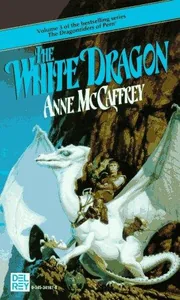
The White Dragon
by Anne McCaffrey · 1978
It suits teens and adults who enjoy fantasy and science fiction, and works best after the earlier Dragonriders books.
468 pages, about 7.5 to 11 hours.
A dragon-and-Thread finale built around the smallest, whitest runt. 56% taste match
The story
The White Dragon is a science fantasy novel by Anne McCaffrey, first published in 1978. It is set on Pern, a planet settled centuries earlier by people from Earth who wanted a more agrarian way of life. The book concludes the original Dragonriders trilogy within the Dragonriders of Pern series and appeared seven years after the second volume. Del Rey Books issued the first edition in June 1978.
Life on Pern revolves around the dragons that help humans defend the land against Thread, a destructive menace that falls from a neighbouring planet each time it passes close, roughly every couple of hundred years. Gold, bronze, blue and green dragons form a telepathic bond with the children they hatch for, and the pairs stay together. Young men destined to inherit and govern the semi-autonomous Holds are kept apart from this life of fighting Thread. Lord Jaxom, however, sees the smallest egg in a clutch struggling to hatch and rushes to help it. The creature that emerges is a white runt, not expected to live long, and Jaxom is allowed to keep it. Its name is Ruth. The novel has been issued in about forty editions, with a median length of 468 pages.
Setting
Pern
Themes
Pern (Imaginary place)Life on other planetsSpace coloniesDragonsNon-ClassifiableAmerican literature
- Want to read 105
- Reading now 1
- Read 51
Most people shelving it are saving it for later.
Of 157 readers who put it on a shelf, 67% want to read it, 1% are reading it now, 32% have finished it and 0% stopped before the end.
By the numbers
- The median edition runs 468 pages. Counting about 275 words a page and an adult reading pace of 250 words a minute, that is about 8.6 hours of reading.
- Open Library tracks 40 editions from 30 publishers, the earliest dated 1978 and the latest 2025, across 5 languages.
- On reader demand it ranks in the top 5% of the modern books in our catalog (15,152 of them).
- Libraries shelve it under Dewey 813.54 and Library of Congress class PS-3563.00000000.A255 Wh.
 BookWard’s take
A dragon-and-Thread finale built around the smallest, whitest runt
The White Dragon closes the original Dragonriders trilogy from an unusual angle. Lord Jaxom, an heir who is supposed to stay out of the Thread-fighting life, rushes to help the last struggling egg and ends up with a white runt named Ruth. That gives the book a strong, character-first hook. It is also the third volume of a long-running saga, and it works best with the earlier books behind you. The pace is steady rather than breakneck, and the world is tightly built, with its Holds, its dragon colours and the recurring fall of Thread all fitting together with a clear internal logic. It leans warmly on familiar ideas of dragons and bonds, so readers hoping for something fresh will find only part of what they want.
At 468 pages it is a substantial novel, longer than BookWard's taste for tight reads.
It moves at a steady clip but pauses for world and politics, a little slower than BookWard likes.
The Thread-fighting dragonriders of a lost colony were distinctive for their time, though the idea is well worn now.
The prose is clean and functional rather than ornate, close to BookWard's middle-low taste.
It balances Jaxom's growth with the larger Thread threat, leaning slightly character-driven like BookWard.
The runt-who-survives premise and the fight against Thread tilt toward hope, in line with BookWard.
It tells its story in a conventional, linear way, a touch plainer than BookWard's slight lean.
The tone is earnest and adventurous with little humor, below BookWard's lean toward funny.
Thread is a lethal danger but the book stays adventurous, a bit gentler than BookWard's middle.
The bond between Jaxom and Ruth carries real feeling, near BookWard's moderate intensity.
See all 50 dialsEvery position, side by side with this book
Where it lines up
- EndingBookWard 8 · book 8
- Character depthBookWard 8 · book 7
- Shock for effectBookWard 9 · book 8
Where it pulls apart
- Familiar tropesBookWard 10 · book 4
- LengthBookWard 1 · book 6
- OpeningBookWard 10 · book 7
At 468 pages it is a substantial novel, longer than BookWard's taste for tight reads.
Jaxom's rescue of the struggling egg gives it a clear early draw, close to BookWard's preference for hooking fast.
Dragons, telepathic bonds and a chosen runt lean on familiar fantasy ground, short of BookWard's tropeless ideal.
Pern's rules of Holds, dragon colours and Thread fall hold together consistently, close to BookWard's airtight preference.
It moves at a steady clip but pauses for world and politics, a little slower than BookWard likes.
The Thread-fighting dragonriders of a lost colony were distinctive for their time, though the idea is well worn now.
Jaxom and his bond with Ruth anchor the book in a drawn inner life, near BookWard's taste.
As the close of a trilogy, it brings its threads to a settled conclusion, matching BookWard's taste for resolution.
The dragon-and-rider bond is openly affectionate, warmer than BookWard's restrained preference.
Thread is a real threat and the stakes are earned, which suits BookWard's dislike of cheap shock.
This dial applies to nonfiction, so it does not apply to this novel.
McCaffrey's plain, confident storytelling is recognisable, a good fit with BookWard's appetite for distinct voice.
It is firmly story-led, a bond and a quest, which is just where BookWard sits.
Much of Pern's history and customs is explained along the way, somewhat more than BookWard prefers.
The middle carries a good deal of Hold and dragon business, so it holds attention less evenly than BookWard demands.
The prose is clean and functional rather than ornate, close to BookWard's middle-low taste.
It balances Jaxom's growth with the larger Thread threat, leaning slightly character-driven like BookWard.
The runt-who-survives premise and the fight against Thread tilt toward hope, in line with BookWard.
It tells its story in a conventional, linear way, a touch plainer than BookWard's slight lean.
The tone is earnest and adventurous with little humor, below BookWard's lean toward funny.
It reads easily for an epic fantasy, a bit lighter than BookWard's moderate effort.
The story follows several Holds and riders, not just one, close to BookWard's many-viewpoint taste.
Events run in order with no shifting, below BookWard's moderate appetite for time play.
Dragons, telepathy and an imagined colony world make this strongly fantastical, beyond BookWard's middle.
Holds, dragonriders and their dragons produce a large cast, more than BookWard's usual.
A whole planet under threat from Thread gives it wide stakes, above BookWard's intimate-leaning middle.
It balances Jaxom's inner bond with action against Thread, landing right at BookWard's middle.
Conversation among Holders and riders is a regular engine of the story, a little under BookWard's heavy-dialogue taste.
Romance is present but secondary to the dragons and Thread, close to BookWard's minor-ish middle.
Pern is a wholly invented setting that asks for learning, as BookWard prefers unfamiliar worlds.
It is set on a colony world centuries after settlement, far from the present day.
Its dragon-bond appeal has lasted, though its 1978 manner shows, a little under BookWard's lasting taste.
The narration is a straightforward, reliable third person, far from BookWard's unreliable lean.
Good and threat are fairly clearly drawn, which is clearer than BookWard's ambiguous taste.
Dragons and the land are described with moderate richness, right around BookWard's middle.
This is the third book of the original Dragonriders trilogy, firmly series, above BookWard's middle.
The story turns on its revelations but follows a mostly expected arc, under BookWard's many-surprises lean.
It is an accessible, comforting adventure more than a challenge, below BookWard's taste.
Thread is a lethal danger but the book stays adventurous, a bit gentler than BookWard's middle.
The bond between Jaxom and Ruth carries real feeling, near BookWard's moderate intensity.
Humor is light and occasional, dry rather than broad, a bit below BookWard's middle.
Thread and its dangers appear but the book is not graphic, under BookWard's middle.
Sexual content is light and tasteful for the genre, well below BookWard's middle.
Hold lordship and the tension between Holds and dragonriders give it political weight, near BookWard's middle.
The language is plain with invented Pern terms, close to BookWard's middle.
The narration lets events speak for themselves, more neutral than BookWard's lean.
It looks ahead to Pern's future as much as its past, matching BookWard's forward lean.
The runt-and-rider heart of the book is idealistic, in line with BookWard's lean.
Review written by BookWard, dial version 1, November 2026.
Who is The White Dragon right for?
It suits teens and adults who enjoy fantasy and science fiction, and works best after the earlier Dragonriders books. Content is adventure-level, with the danger of Thread and some mature themes but nothing graphic.
It reads easily for an epic fantasy, a bit lighter than BookWard's moderate effort.
Thread is a lethal danger but the book stays adventurous, a bit gentler than BookWard's middle.
The bond between Jaxom and Ruth carries real feeling, near BookWard's moderate intensity.
Thread and its dangers appear but the book is not graphic, under BookWard's middle.
Book CompanionThe White Dragon: ideas, characters, themes
A young Hold heir who should stay out of Thread-fighting rescues a runt white dragon egg and finds his place beside it.
- Third of a trilogy. It concludes the original Dragonriders trilogy, published seven years after the second book.
- The world of Pern. A colony planet settled by people seeking a more agrarian life, defended from Thread by dragons.
- Dragon bonds. Gold, bronze, blue and green dragons each form a telepathic link with a child at hatching.
- An heir apart. Young men set to rule the Holds are kept from the dragon-and-Thread life.
- The runt egg. Jaxom helps the last small egg hatch and is allowed to keep the white dragon, Ruth.
Characters
Jaxom
Young Lord of a Hold
An heir kept from dragonriding who rushes to help the struggling egg.
Ruth
The white dragon
A white runt not expected to live long, whom Jaxom is allowed to keep.
Themes
Finding a place when the role set for you excludes what you love.
The runt that nobody expects to survive becomes central.
Rank and expectation pulling against personal bonds.
A community united against the recurring menace of Thread.
Discussion questions
- Why does the book make its central dragon a white runt rather than a grand gold or bronze?
- How does Jaxom's position as heir shape what he is allowed to do?
- What does the dragon-and-rider bond say about friendship and responsibility?
- How does the cycle of Thread shape the way Pern's society is organised?
- Does the book work for you as a trilogy finale, and what would you want to have read first?
Personalize your Book Companion
This is the general edition. In BookWard, the Companion is written for you: your reading profile, your notes, and spoiler-safe to the page you are on.
Buy, listen or borrow The White Dragon
Each link opens a search for this book on that store, in a new tab.
Read on a device
Borrow
Reviews and community
If you liked The White Dragon
Pern's second Threadfall: dragons, politics, and a planet to save
The High KingLloyd AlexanderA fantasy finale where the hero's growing up is the real quest
A Gathering of ShadowsV. E. SchwabA middle volume that trades discovery for games and a gathering threat
SunbringerHannah KanerA gods-and-war sequel that rides on three strong leads
Sources: Open Library.
Track The White Dragon and find your next favorite
Add it to your shelf, rate what you have read, and BookWard will recommend what fits you.
Free to start. No credit card needed.