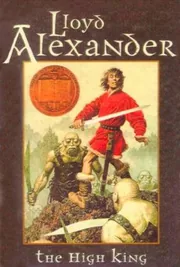
It suits middle-grade readers and up, including adults who love classic fantasy.
285 pages, about 4.5 to 6.5 hours.
A fantasy finale where the hero's growing up is the real quest. 57% taste match
The story
The High King, first published in 1968, is a children's fantasy novel by Lloyd Alexander and the closing volume of the Chronicles of Prydain. It won the Newbery Medal. The story is set in Prydain, an imaginary land, and follows Taran, who has been a young man of modest standing with big hopes of becoming a hero. In this last installment, the forces of good and evil come together in a final confrontation that decides his fate.
The book belongs to the tradition of fairy tales and draws on magic, magicians, swords, and questions of fate. It also follows Taran's growth from an impulsive, childish youth into someone who advises and works alongside kings, and it shows him giving up what he wants for a larger purpose. That path leads him to become High King of Prydain. Lloyd Alexander, an American author, drew on his own experiences as a soldier in the Second World War when writing it. The novel runs to roughly 285 pages in a typical edition and has appeared in 46 editions.
Under a chill, gray sky, two riders jogged across the turf.
Themes
Fairy talesMaturation (Psychology)MagiciansMagicFate and fatalismFantasyPrydain (Imaginary place)Good and evil
- Want to read 48
- Read 33
Readers are split between finishing it and saving it for later.
Of 81 readers who put it on a shelf, 59% want to read it, 0% are reading it now, 41% have finished it and 0% stopped before the end.
By the numbers
- The median edition runs 285 pages. Counting about 275 words a page and an adult reading pace of 250 words a minute, that is about 5.2 hours of reading.
- Open Library tracks 46 editions from 36 publishers, the earliest dated 1968 and the latest 2017, across 3 languages.
- On reader demand it ranks in the top 14% of the classic books in our catalog (8,749 of them).
- Libraries shelve it under Dewey 813.54 and Library of Congress class PZ-0007.00000000.A3774 Hi.
 BookWard’s take
A fantasy finale where the hero's growing up is the real quest
The High King closes the Chronicles of Prydain with a Newbery Medal behind it and a large payoff in front of it. Alexander ends the series by testing Taran, the former Assistant Pig-Keeper, against a final confrontation between good and evil, and he makes the cost of heroism matter more than the swordplay. The characterization is where the book is richest, since Taran's long arc from impulsive youth to counselor of kings is the whole point. Alexander shows rather than explains, letting scenes carry the weight, and the ending resolves firmly rather than trailing off. The honest caveat is how much of this is old fairy-tale furniture: magicians, swords and fate. Alexander's restraint with them, and his refusal to let sacrifice go cheap, keeps it from feeling stock. At 285 pages it stays tight for a series finale.
At 285 pages it is compact for a series finale, close to BookWard's preference for tight books.
A final confrontation drives the story forward at a brisk clip, close to BookWard's preference.
It is a distinctive take on fairy-tale fantasy, but its building blocks are familiar, so it falls short of BookWard's high bar.
The prose is clean and direct rather than ornate, close to BookWard's middle-low position.
Plot and character are intertwined, with Taran's inner growth shaping the outcome, slightly less character-led than BookWard.
Even through sacrifice the book ends on purpose and promise, matching BookWard's hopeful lean.
A conventional, forward-moving quest structure, in line with BookWard.
Humor appears in the series' voice but this finale is mostly earnest, less funny than BookWard's lean.
A war against evil gives it real shadow, though suited to young readers, near BookWard's middle.
Sacrifice and loss give the finale feeling, a little stronger than BookWard's middle.
See all 50 dialsEvery position, side by side with this book
Where it lines up
- Character depthBookWard 8 · book 8
- PaceBookWard 8 · book 7
- EndingBookWard 8 · book 9
Where it pulls apart
- Familiar tropesBookWard 10 · book 4
- OpeningBookWard 10 · book 6
- Internal logicBookWard 10 · book 7
At 285 pages it is compact for a series finale, close to BookWard's preference for tight books.
It opens with two riders on a gray turf, a steady start rather than an instant grab, so it sits below BookWard's bar.
Magicians, swords and fate are classic fairy-tale furniture, so it leans on familiar tropes more than BookWard likes.
Prydain's magic and its consequences hold together across the series, though not quite to BookWard's airtight standard.
A final confrontation drives the story forward at a brisk clip, close to BookWard's preference.
It is a distinctive take on fairy-tale fantasy, but its building blocks are familiar, so it falls short of BookWard's high bar.
Taran's growth from impulsive Assistant Pig-Keeper to counselor of kings is drawn with real depth, matching BookWard.
As the closing volume it resolves Taran's fate decisively, in line with BookWard's taste for full resolution.
Sacrifice carries emotional weight but is handled plainly, slightly more open-hearted than BookWard's restraint.
Its darker moments come from the stakes of the story, which suits BookWard's taste for earned darkness.
Not applicable to a work of fiction.
Alexander's plain, warm storytelling voice is recognizable, though less singular than BookWard's top picks.
This is firmly story-led, with themes carried by events rather than argued, a touch more story-led than BookWard.
Events and choices carry the narrative, which fits BookWard's preference for showing in scene.
The finale keeps its momentum with a clear goal ahead, close to BookWard's expectation.
The prose is clean and direct rather than ornate, close to BookWard's middle-low position.
Plot and character are intertwined, with Taran's inner growth shaping the outcome, slightly less character-led than BookWard.
Even through sacrifice the book ends on purpose and promise, matching BookWard's hopeful lean.
A conventional, forward-moving quest structure, in line with BookWard.
Humor appears in the series' voice but this finale is mostly earnest, less funny than BookWard's lean.
A children's novel with accessible language, so it is easier going than BookWard's middle position.
The story stays close to Taran, with limited shifts, so it has fewer viewpoints than BookWard's taste.
Events unfold in order, more linear than BookWard's middle position.
Magic, magicians and an imaginary kingdom make this thoroughly fantastical, well above BookWard's middle.
As a series finale it gathers a sizeable cast, more than BookWard's middle position.
A final clash that decides a kingdom's fate is epic in scope, above BookWard's middle.
Taran's inner growth matters, but the book is driven by action and quest, tilting outward.
Conversation among companions carries much of the story, close to BookWard's dialogue-friendly side.
Romance is a minor thread next to the quest, below BookWard's middle position.
Prydain is an invented land, unfamiliar and well suited to BookWard's taste for new settings.
A fairy-tale past of swords and kings sits at the far end from the present day.
A Newbery winner whose fairy-tale roots feel enduring, ahead of BookWard's middle.
The narration is straightforward and trustworthy, far from unreliable.
Good and evil are clearly drawn in this fairy-tale frame, more clear than BookWard's ambiguity preference.
Description serves the action rather than lingering, a little richer than sparse, close to BookWard.
Not applicable to a work of fiction.
Not applicable to a work of fiction.
It is the final volume of the Chronicles of Prydain, so it is deeply tied to a series.
A climactic confrontation and fate-deciding turns bring some surprises, a bit below BookWard's lean.
It asks real sacrifice of its hero, but within an accessible children's story, so it is mildly challenging.
A war against evil gives it real shadow, though suited to young readers, near BookWard's middle.
Sacrifice and loss give the finale feeling, a little stronger than BookWard's middle.
Where humor appears it is gentle and warm, a bit drier than broad.
Battle and swordplay appear, but the register is children's fantasy, close to BookWard's middle.
A children's novel with essentially no sexual content.
Kingship and rule matter to the plot without driving a political argument, just under BookWard's middle.
The language is plain and accessible, below BookWard's middle position.
The narration lets events speak, more neutral than BookWard's lean.
A tale of duty, sacrifice and good prevailing leans clearly idealistic, above BookWard's lean.
Review written by BookWard, dial version 1, November 2026.
Who is The High King right for?
It suits middle-grade readers and up, including adults who love classic fantasy. It contains battle and loss, handled in a style appropriate for young readers.
A children's novel with accessible language, so it is easier going than BookWard's middle position.
A war against evil gives it real shadow, though suited to young readers, near BookWard's middle.
Sacrifice and loss give the finale feeling, a little stronger than BookWard's middle.
Battle and swordplay appear, but the register is children's fantasy, close to BookWard's middle.
Book CompanionThe High King: ideas, characters, themes
The High King follows Taran, once an impulsive Assistant Pig-Keeper, as he faces the final clash between good and evil and learns what heroism truly demands.
- A series finale. It is the closing volume of the Chronicles of Prydain, bringing Taran's long arc to its end.
- A hero grows up. Taran matures from childish and impulsive to a colleague and counselor of kings.
- Sacrifice for the greater good. He is required to give up his own desires for something larger than himself.
- Good against evil. The forces of good and evil meet in an ultimate confrontation that decides Taran's fate.
- Newbery recognition. The novel won the Newbery Medal for children's literature.
Characters
Taran
Protagonist
The Assistant Pig-Keeper who wanted to be a hero and who grows into a counselor of kings and eventually High King of Prydain.
Themes
Taran's change from impulsive youth to wise leader.
Giving up personal wishes for the greater good.
Whether a person's path is set or chosen.
The final confrontation that decides Prydain's future.
What being a hero costs compared with what Taran first imagined.
Discussion questions
- How does Taran differ at the end from the boy who wanted to be a hero?
- What does Taran give up, and was it worth it?
- Does the book treat fate as fixed or something that can be shaped?
- How do magic and swords work as fairy-tale elements here?
- Why might this finale have earned the Newbery Medal?
Personalize your Book Companion
This is the general edition. In BookWard, the Companion is written for you: your reading profile, your notes, and spoiler-safe to the page you are on.
Buy, listen or borrow The High King
Each link opens a search for this book on that store, in a new tab.
Read on a device
Borrow
Reviews and community
If you liked The High King
A girl who talks to animals finds her place and her power
The White DragonAnne McCaffreyA dragon-and-Thread finale built around the smallest, whitest runt
The Book Of ThreeLloyd AlexanderA brisk, warm Celtic-flavored quest about wanting to be a hero
The Dangerous GiftTui T. SutherlandA young ice queen learns walls are not the same as safety
Sources: Open Library.
Track The High King and find your next favorite
Add it to your shelf, rate what you have read, and BookWard will recommend what fits you.
Free to start. No credit card needed.