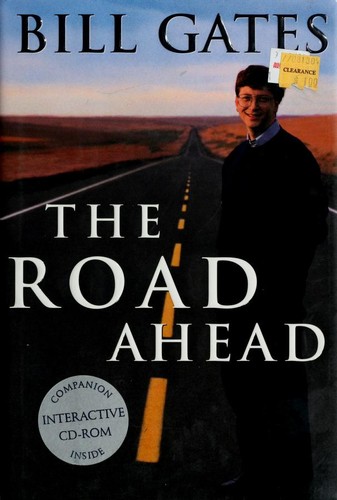
The Road Ahead
by Bill Gates
★ Top 25 book of 1995 · #21 on Best Books of 1995
Written in 1995, this book looks at how information and computer technology will shape society. It traces the history from ancient counting devices to personal computers, and covers Microsoft's early days and the role of software.
Best for: Readers curious about computing history and early predictions of the tech future
The Road Ahead is #21 on BookWard's Best Books of 1995, out of 28 1995 books that cleared our data bar.
What The Road Ahead is about
Bill Gates, writing with Nathan Myhrvold and Peter Rinearson, looks at what the personal computer revolution means and where it might lead. He pictures a future reshaped by a global information superhighway, and he builds that picture on a retelling of computing's past, from ancient counting devices through mainframes to the home machine. Along the way he recounts the early days of Microsoft, Apple, DEC, Compaq and IBM, and explains why software matters so much and why it is so complex and costly to produce. First published in 1995 and substantially revised about a year later, it suits readers who like to see how early hopes for the internet age were framed.
The Road Ahead on the Best Books of 1995
The Road Ahead came out in 1995. Of the 28 books first published in 1995 that met BookWard's data bar, it ranks #21 on our Best Books of 1995 list.
Why it made the list: 159 readers have shelved it on Open Library. The list ranks each year’s books on how many readers have picked them up, how highly readers rate them, and how many are reading them right now.
Nearby on the 1995 list
- Longitude Dava Sobel, #19
- Naked in Death Nora Roberts, #20
- True Betrayals Nora Roberts, #22
See all Best Books of 1995 Best books by year
More years: Best Books of 1994 Best Books of 1996.
The numbers behind it
- Readers: 141 want to read it, 11 are reading it now and 7 have read it, according to Open Library.
| Signal | This book (0 to 100) | Weight |
|---|---|---|
| Reach | 14 | 55% |
| Reader love | 54 | 25% |
| Being read right now | 39 | 20% |
Questions about The Road Ahead
When was The Road Ahead published?
The Road Ahead by Bill Gates was first published in 1995.
Was The Road Ahead one of the best books of 1995?
The Road Ahead is #21 on BookWard's Best Books of 1995, out of 28 1995 books that cleared our data bar. 159 readers have shelved it on Open Library.
Why is The Road Ahead on the Best Books of 1995 list?
159 readers have shelved it on Open Library.
More of the best books of 1995
- The Lost World Michael Crichton, #1
- Emotional Intelligence Daniel Goleman, #2
- Northern Lights Philip Pullman, #3
- Rose Madder Stephen King, #4
- Mindhunter John E. Douglas, #5
- Wicked Gregory Maguire, #6
See the full Best Books of 1995, the Top 100, or new books on Rising.
How we know
This page uses public data: Open Library reader counts and ratings, and Wikipedia page views for recent years. The description is paraphrased from real source text. Rankings reflect reading interest, not quality or sales, and can be affected by data gaps. Lists update monthly.
Suits curious teens and adults, especially anyone interested in technology or business history.
Depends on the edition you pick.
Gates maps the digital future in 1995, with a booster's optimism. 36% taste match
 BookWard’s take
Gates maps the digital future in 1995, with a booster's optimism
The Road Ahead is a big-picture tour of personal computing and the information superhighway Bill Gates expected to follow, written with Nathan Myhrvold and Peter Rinearson. It is driven by ideas rather than narrative, and it explains its points outright instead of dramatizing them in scene, which is a limitation for a reader who prefers to be shown. The authorial voice, though, is distinctive: confident, personal and openly opinionated. The outlook is firmly hopeful, looking forward with real enthusiasm. It also covers the early years of Microsoft, Apple and IBM, so there is historical grounding alongside the forecasting. Its rigor is closer to informed prediction than hard evidence, and that is where it frustrates a reader who wants more proof behind the claims. It is best read as a period document: a vivid record of how the future looked from inside the industry in 1995.
It moves briskly through history and prediction without lingering, a decent clip for a book of ideas.
The writing is plain and functional, built to explain complex technology clearly rather than to dazzle.
There is no plot to drive it; the pull comes from ideas and a few figures from industry history.
Its core stance is optimistic that technology will broadly improve life and education, a hopeful outlook BookWard shares.
It moves from history to the present to the future in a conventional, easy-to-follow arc.
The tone is earnest and businesslike, with little interest in comedy.
The content is benign and forward-looking, with nothing grim on the page.
Its register is analytical and enthusiastic rather than emotionally intense.
See all 50 dialsEvery position, side by side with this book
Where it lines up
- Shock for effectBookWard 9 · book 9
- SentimentBookWard 8 · book 7
- PaceBookWard 8 · book 6
Where it pulls apart
- Familiar tropesBookWard 10 · book 4
- ExpositionBookWard 2 · book 9
- LengthBookWard 1 · book 5
Technology-optimist forecasting was a well-worn genre by 1995, though the insider's vantage lifts it a little.
Its arguments follow clearly from point to point, but forecasts rest on assumptions rather than airtight reasoning.
It moves briskly through history and prediction without lingering, a decent clip for a book of ideas.
This is a book of ideas and industry history, so people appear as milestones rather than drawn characters.
The enthusiasm is warm and sometimes rosy, a touch less restrained than BookWard prefers.
There is no shock for effect; it is a sunny, explanatory book, which suits BookWard's dislike of cheap darkness.
It rests on insider experience and informed prediction rather than systematic evidence, short of BookWard's high bar for nonfiction.
Gates's confident, personal, opinionated voice is recognizable throughout and gives the book its character.
It is built around arguments and forecasts, not narrative, leaning far toward ideas where BookWard leans toward story.
It explains technology and its consequences outright, in contrast to BookWard's preference for showing in scene.
A survey structure holds interest reasonably well, though the history sections and the forecasts do not always carry equal energy.
The writing is plain and functional, built to explain complex technology clearly rather than to dazzle.
There is no plot to drive it; the pull comes from ideas and a few figures from industry history.
Its core stance is optimistic that technology will broadly improve life and education, a hopeful outlook BookWard shares.
It moves from history to the present to the future in a conventional, easy-to-follow arc.
The tone is earnest and businesslike, with little interest in comedy.
Written for general readers, it explains technical ideas accessibly, so it asks little of the reader.
Everything comes through a single authorial lens, that of a software industry insider.
It runs past to present to future in a straightforward order, with occasional looks back at computing history.
It deals in real technology and plausible near-future extrapolation, firmly grounded.
A handful of industry figures and companies appear, a modest cast overall.
It tackles society-wide change driven by technology, an epic canvas for a book of ideas.
The focus is on external developments in industry and society, not on inner reflection.
As expository nonfiction, it has essentially no dialogue.
Romance plays no part in a book about computing and the future.
The industry and its history will be new ground for some readers but is broadly familiar to many.
It is firmly a mid-1990s book, written before the web became ubiquitous.
Its forecasts are anchored to the 1995 moment, so it now reads mainly as a period document.
The author speaks in his own voice, plainly and directly, with nothing unreliable about the telling.
It makes its case plainly, treating technology as largely a force for good, with little moral ambiguity.
Description serves explanation, with enough detail to make the technology clear but little scenery.
It leans toward analysis and argument while using historical anecdote to keep things moving.
Gates draws on his own experience and the early days of Microsoft, so the perspective is notably personal.
It stands alone as a single book, though it was substantially revised about a year after first publication.
Its structure is expository, so surprises come only from the forecasts themselves.
It mostly reassures with a hopeful vision, rather than seriously unsettling the reader.
The content is benign and forward-looking, with nothing grim on the page.
Its register is analytical and enthusiastic rather than emotionally intense.
There is no violence in a book about computing and society.
No sexual content appears.
Policy and education come up, but the book is about technology, not partisan debate.
Gates argues his case and states his views openly, so the narration is clearly opinionated.
The whole book is oriented toward what is coming next, as the title promises.
It holds an idealistic faith that technology will improve education and everyday life.
Review written by BookWard, dial version 1, November 2026.
Who is The Road Ahead right for?
Suits curious teens and adults, especially anyone interested in technology or business history. Nothing in it is sensitive.
Written for general readers, it explains technical ideas accessibly, so it asks little of the reader.
The content is benign and forward-looking, with nothing grim on the page.
Its register is analytical and enthusiastic rather than emotionally intense.
There is no violence in a book about computing and society.
Book CompanionThe Road Ahead: ideas, characters, themes
Personal computing is the start of a larger transformation, an information superhighway that will reshape work, education and daily life.
- Computing's long lineage. The book traces the history of counting machines through mainframes to the personal computer to set up what came next.
- The global information highway. It describes a coming network that connects people and information worldwide, and what that could change.
- The industry's early years. It recounts the formative days of Microsoft and its peers, including Apple, IBM, DEC and Compaq.
- Why software matters. The book stresses the importance of software and its complexity, power and cost of production.
- Proceeds for education. Gates donated his proceeds to encourage technology in education through a foundation created by the National Education Association.
Themes
A belief that new technology will mostly improve society.
The 1990s vision of a global network connecting everyone to information.
The idea that software, not hardware, drives the computing revolution.
The hope that digital tools can transform how people learn.
Discussion questions
- Which of the book's predictions look most accurate today, and which look furthest off?
- How does knowing the author's role in the industry shape the way you read his forecasts?
- Does the book's optimism feel earned or too convenient?
- What does a 1995 view of the future reveal about what people could not yet imagine?
- How should we weigh an insider's vision against an outside analyst's?
Personalize your Book Companion
This is the general edition. In BookWard, the Companion is written for you: your reading profile, your notes, and spoiler-safe to the page you are on.
Buy, listen or borrow The Road Ahead
Each link opens a search for this book on that store, in a new tab.
Read on a device
Borrow
Reviews and community
If you liked The Road Ahead
A business method built on testing ideas against real customers early
Start with WhySimon SinekOne big idea, built on Apple, King and Kennedy
Emotional IntelligenceDaniel GolemanGoleman's case that emotional skill can outweigh IQ, and can be taught
Think and Grow RichNapoleon HillA 1937 success manual: 13 principles, big promises, thin proof
Find your own best books
Add what you have read, rate it, and BookWard will recommend what to read next.
Free to start. No credit card needed.