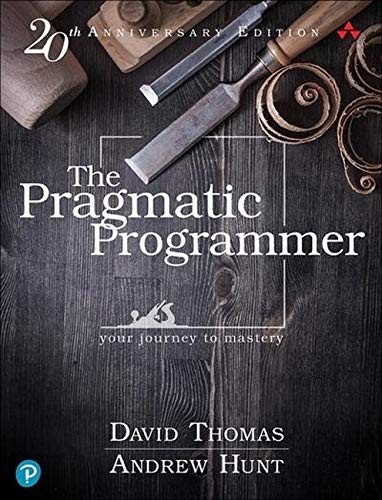
The Pragmatic Programmer
by Andy Hunt
★ Top 10 book of 1999 · #10 on Best Books of 1999
First written in 1999 by Dave Thomas and Andy Hunt, this influential guide looks at the essence of software development regardless of language or framework. The updated edition covers personal responsibility, career growth and flexible code architecture, helping programmers build habits for lasting success.
Best for: New coders, experienced programmers and managers responsible for software projects
The Pragmatic Programmer is #10 on BookWard's Best Books of 1999, out of 52 1999 books that cleared our data bar.
What The Pragmatic Programmer is about
Written by Andrew Hunt and David Thomas and first published in 1999, this guide gathers practical advice for working programmers who want to get better at their craft. Rather than building a formal theory, it offers a collection of tips, often illustrated with short stories and analogies such as broken windows, stone soup and the boiling frog. It helped popularize ideas like DRY, or don't repeat yourself.
The topics range from personal responsibility and career growth to techniques for writing flexible, reusable code. Its lessons do not depend on any one language, framework or method, so they stay useful as tools change. The authors wrote it to help people build better software and rediscover the joy of coding. A second edition appeared in 2019. It suits newer developers aiming to level up and experienced ones who want a refresher.
The Pragmatic Programmer on the Best Books of 1999
The Pragmatic Programmer came out in 1999. Of the 52 books first published in 1999 that met BookWard's data bar, it ranks #10 on our Best Books of 1999 list.
Why it made the list: 470 readers have shelved it on Open Library; readers rate it 4.3 out of 5 (53 ratings). The list ranks each year’s books on how many readers have picked them up, how highly readers rate them, and how many are reading them right now.
It earns Reader favorite.
Nearby on the 1999 list
- Speak Laurie Halse Anderson, #8
- Nonviolent Communication Marshall B. Rosenberg, #9
- A Walk to Remember Nicholas Sparks, #11
- Stardust Neil Gaiman, #12
See all Best Books of 1999 Best books by year
More years: Best Books of 1998 Best Books of 2000.
The numbers behind it
- Readers: 381 want to read it, 14 are reading it now and 75 have read it, according to Open Library.
- Ratings: 4.3 out of 5 from 53 Open Library ratings.
| Signal | This book (0 to 100) | Weight |
|---|---|---|
| Reach | 75 | 55% |
| Reader love | 94 | 25% |
| Being read right now | 60 | 20% |
Questions about The Pragmatic Programmer
When was The Pragmatic Programmer published?
The Pragmatic Programmer by Andy Hunt was first published in 1999.
Was The Pragmatic Programmer one of the best books of 1999?
The Pragmatic Programmer is #10 on BookWard's Best Books of 1999, out of 52 1999 books that cleared our data bar. 470 readers have shelved it on Open Library; readers rate it 4.3 out of 5 (53 ratings).
Why is The Pragmatic Programmer on the Best Books of 1999 list?
470 readers have shelved it on Open Library; readers rate it 4.3 out of 5 (53 ratings).
More of the best books of 1999
- Harry Potter and the Prisoner of Azkaban J. K. Rowling, #1
- Wings of Fire A. P. J. Abdul Kalam, #2
- The Perks of Being a Wallflower Stephen Chbosky, #3
- On Writing Stephen King, #4
- The Bad Beginning Lemony Snicket, #5
- The Coldest Winter Ever Sister Souljah, #6
See the full Best Books of 1999, the Top 100, or new books on Rising.
How we know
This page uses public data: Open Library reader counts and ratings, and Wikipedia page views for recent years. The description is paraphrased from real source text. Rankings reflect reading interest, not quality or sales, and can be affected by data gaps. Lists update monthly.
It suits working programmers, students and managers of software projects, and it is accessible to motivated beginners.
Depends on the edition you pick.
A tip-driven manual that taught a generation to code well. 51% taste match
 BookWard’s take
A tip-driven manual that taught a generation to code well
The Pragmatic Programmer is a manual for working programmers, built from short tips and small stories rather than one grand theory. It leans on analogies like broken windows, stone soup and the boiling frog to make habits stick, and it coined DRY and rubber duck debugging along the way. The voice is distinctive, practical and plainly opinionated. It explains its advice outright instead of dramatizing it, which gives it a teacherly directness. Its staying power is real: it works as a university text and earned a 20th anniversary second edition. Sagging in the middle is rarely a problem because each short section stands alone, and the book is driven by ideas rather than by story, which runs against my own preference for narrative.
A collection of short, self-contained tips keeps it compact and easy to dip into, which suits BookWard's taste for tight books.
Short sections move briskly, yet the book rewards slow, repeated reading rather than racing through.
It coined or popularized DRY and rubber duck debugging, though much of its advice builds on shared craft wisdom.
The writing is clear and plain, built to be understood quickly rather than admired for ornament.
There is no plot or cast to drive it, so the dial does not apply.
It treats good software and a good career as achievable through habit, giving it an encouraging outlook.
A series of numbered tips and short sections is a conventional shape for a practical guide.
Light analogies add some warmth, but it stays mostly serious and instructional.
It is a gentle, practical read with nothing dark in its content.
The emotional register is calm and even, aimed at clear thinking rather than strong feeling.
See all 50 dialsEvery position, side by side with this book
Where it lines up
- SentimentBookWard 8 · book 8
- Sagging middleBookWard 8 · book 8
- Authorial voiceBookWard 9 · book 8
Where it pulls apart
- ExpositionBookWard 2 · book 9
- OpeningBookWard 10 · book 6
- Familiar tropesBookWard 10 · book 6
A collection of short, self-contained tips keeps it compact and easy to dip into, which suits BookWard's taste for tight books.
It opens by laying out the pragmatic philosophy rather than grabbing you with a scene, a steady start for a manual.
It uses familiar stories like stone soup and the boiling frog, though it pairs them with fresh named ideas.
Its advice follows from clear principles, and each tip is argued so the reasoning holds together.
Short sections move briskly, yet the book rewards slow, repeated reading rather than racing through.
It coined or popularized DRY and rubber duck debugging, though much of its advice builds on shared craft wisdom.
This is a practical guide with no characters, so the dial does not apply.
A tip collection has no plot to resolve, so an ending in the story sense does not apply.
The tone is practical and matter-of-fact, with little room for sentimentality, matching BookWard's restrained taste.
There is no darkness to earn or exploit here, so the dial does not apply.
It rests on the authors' experience and analogies rather than formal research, so it is practical more than strictly rigorous.
The authors write with a recognizable, plainspoken confidence that sets it apart from dry technical manuals.
The whole book is built on ideas and habits, the reverse of BookWard's story-led leaning.
It states its lessons directly and explains them in full, which BookWard would normally prefer shown in scene.
Because each tip stands alone, there is no long middle to sag; interest stays even throughout.
The writing is clear and plain, built to be understood quickly rather than admired for ornament.
There is no plot or cast to drive it, so the dial does not apply.
It treats good software and a good career as achievable through habit, giving it an encouraging outlook.
A series of numbered tips and short sections is a conventional shape for a practical guide.
Light analogies add some warmth, but it stays mostly serious and instructional.
The writing is accessible, though applying its ideas takes real programming experience.
It speaks in the single, consistent voice of the authors throughout.
It is a topical guide, not a narrative, so a timeline does not apply.
It is firmly grounded in the everyday reality of software work.
With no characters in the pack, cast size does not apply.
It is concerned with the daily habits of an individual developer, an intimate frame for a technical book.
It centers on concrete actions and practices more than on private reflection.
As an expository guide, it has essentially no dialogue.
There is no romantic thread in a book about programming practice.
The world of software development is unfamiliar to many general readers, though familiar to its target audience.
It speaks to modern software work, and the 2019 edition updated it for current technology.
Its core principles outlived changing tools, earning a 20th anniversary second edition.
The authors speak plainly and directly, with no unreliable narration involved.
It offers clear advice about right and wrong ways to work, leaving little ambiguity.
Descriptions are sparse and in service of the point, using short analogies instead of rich scene-setting.
It leans toward analytical advice, though short stories and analogies soften it into something more narrative than a pure reference.
The authors speak from their own working experience, giving it a personal tone despite its practical aim.
It was the first in the Pragmatic Bookshelf label, and a second edition followed, giving it a loose series connection.
A guidebook offers insights, not plot surprises, so twists do not apply.
It asks readers to question their habits and take responsibility, which is a mild challenge more than a comfort.
It is a gentle, practical read with nothing dark in its content.
The emotional register is calm and even, aimed at clear thinking rather than strong feeling.
Where humor appears, it is dry and light, mostly through analogy.
There is no violence in a book about writing software.
There is no sexual content in a programming guide.
It stays out of politics and sticks to professional practice.
The language is plain and accessible, though it uses programming terminology.
The authors openly argue for their way of working, so the narration is decidedly opinionated.
It aims to help readers build better habits for the future, with an eye on adapting to change.
It believes careful craft and good habits can make software and careers better, an idealistic outlook.
Review written by BookWard, dial version 1, November 2026.
Who is The Pragmatic Programmer right for?
It suits working programmers, students and managers of software projects, and it is accessible to motivated beginners. There is no sensitive content.
The writing is accessible, though applying its ideas takes real programming experience.
It is a gentle, practical read with nothing dark in its content.
The emotional register is calm and even, aimed at clear thinking rather than strong feeling.
There is no violence in a book about writing software.
Book CompanionThe Pragmatic Programmer: ideas, characters, themes
Good programmers are pragmatic: they take responsibility, adapt quickly, think critically and build flexible software through small daily habits.
- Don't repeat yourself. The book popularized DRY, the idea that every piece of knowledge should live in one clear place.
- Fix broken windows. Using the broken windows theory, it warns that small neglected flaws invite further decay in a project.
- Rubber duck debugging. Explaining a problem aloud, even to a rubber duck, helps you see the bug yourself.
- Stone soup and the boiling frog. Short stories illustrate how to start change gradually and how to notice slow, creeping problems.
- Be a jack-of-all-trades. The pragmatic programmer is inquisitive, realistic and adaptable, learning widely rather than staying narrow.
Themes
Choosing practical, workable approaches over rigid theory.
Taking pride and care in the quality of everyday work.
Learning quickly and staying flexible as technology changes.
Owning your work, your career and your mistakes.
Questioning assumptions instead of following methods blindly.
Discussion questions
- Which tip in the book do you already follow, and which do you most often ignore?
- How does the idea of broken windows apply to a project you have worked on?
- Is DRY always the right rule, or can it be taken too far?
- Why might a book of tips outlast books tied to specific tools?
- What does being a pragmatic programmer mean to you in your own work?
Personalize your Book Companion
This is the general edition. In BookWard, the Companion is written for you: your reading profile, your notes, and spoiler-safe to the page you are on.
Buy, listen or borrow The Pragmatic Programmer
Each link opens a search for this book on that store, in a new tab.
Read on a device
Borrow
Reviews and community
If you liked The Pragmatic Programmer
A business method built on testing ideas against real customers early
Trading in the zoneMark DouglasA trader's psychology manual about thinking in probabilities, not predictions
DriveDaniel H. PinkA lively case that autonomy, mastery and purpose beat carrots and sticks
Get Better at AnythingScott YoungA clear framework for why some learning sticks and some stalls
Find your own best books
Add what you have read, rate it, and BookWard will recommend what to read next.
Free to start. No credit card needed.