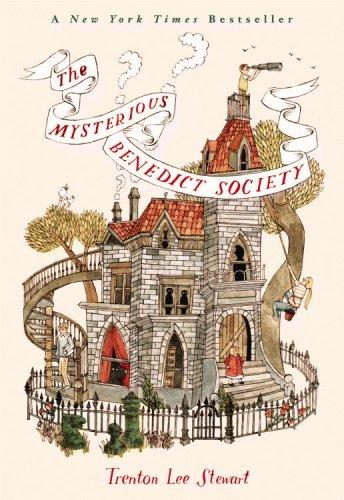
The Mysterious Benedict Society (the Mysterious Benedict Society #1)
by Trenton Lee Stewart
★ Top 25 book of 2007 · #22 on Best Books of 2007
A newspaper ad for gifted children leads dozens of kids through puzzling tests, and only four pass. The winners go undercover at a school with no rules, where hidden underground tunnels hold surprises.
Best for: Clever young readers who love puzzles, secret missions, and inventive adventures
The Mysterious Benedict Society (the Mysterious Benedict Society #1) is #22 on BookWard's Best Books of 2007, out of 53 2007 books that cleared our data bar.
What The Mysterious Benedict Society (the Mysterious Benedict Society #1) is about
A newspaper ad asks, 'Are you a gifted child looking for special opportunities?' Dozens of children answer it and sit through a long run of odd, tricky tests, and readers get to try the puzzles alongside them. Only four pass: Reynie, Sticky, Kate and Constance, two boys and two girls. The man behind it all is the eccentric Mr. Benedict, and he has a job for them.
Their mission means going undercover at the Learning Institute for the Very Enlightened, a school whose only rule is that there are no rules. Under it lie hidden tunnels that hold far more than chalk and notebooks. Their target is Ledroptha Curtain, Mr. Benedict's twin brother, who wants to take over the world. Whimsical and full of puzzles, this opening book of the series suits readers who like brainteasers, clever friendships and a group of misfits who succeed by pooling their different talents.
The Mysterious Benedict Society (the Mysterious Benedict Society #1) on the Best Books of 2007
The Mysterious Benedict Society (the Mysterious Benedict Society #1) came out in 2007. Of the 53 books first published in 2007 that met BookWard's data bar, it ranks #22 on our Best Books of 2007 list.
Why it made the list: 267 readers have shelved it on Open Library; readers rate it 4.2 out of 5 (26 ratings). The list ranks each year’s books on how many readers have picked them up, how highly readers rate them, and how many are reading them right now.
Nearby on the 2007 list
- Double Take Catherine Coulter, #20
- Tweak Nic Sheff, #21
- An Abundance of Katherines John Green, #23
See all Best Books of 2007 Best books by year
More years: Best Books of 2006 Best Books of 2008.
The numbers behind it
- Readers: 219 want to read it, 11 are reading it now and 37 have read it, according to Open Library.
- Ratings: 4.2 out of 5 from 26 Open Library ratings.
| Signal | This book (0 to 100) | Weight |
|---|---|---|
| Reach | 53 | 55% |
| Reader love | 60 | 25% |
| Being read right now | 45 | 20% |
Questions about The Mysterious Benedict Society (the Mysterious Benedict Society #1)
When was The Mysterious Benedict Society (the Mysterious Benedict Society #1) published?
The Mysterious Benedict Society (the Mysterious Benedict Society #1) by Trenton Lee Stewart was first published in 2007.
Was The Mysterious Benedict Society (the Mysterious Benedict Society #1) one of the best books of 2007?
The Mysterious Benedict Society (the Mysterious Benedict Society #1) is #22 on BookWard's Best Books of 2007, out of 53 2007 books that cleared our data bar. 267 readers have shelved it on Open Library; readers rate it 4.2 out of 5 (26 ratings).
Why is The Mysterious Benedict Society (the Mysterious Benedict Society #1) on the Best Books of 2007 list?
267 readers have shelved it on Open Library; readers rate it 4.2 out of 5 (26 ratings).
More of the best books of 2007
- Dog Days Jeff Kinney, #1
- A Thousand Splendid Suns Khaled Hosseini, #2
- Harry Potter and the Deathly Hallows J. K. Rowling, #3
- The Titan's Curse Rick Riordan, #4
- The Name of the Wind Patrick Rothfuss, #5
- Rodrick Rules Jeff Kinney, #6
See the full Best Books of 2007, the Top 100, or new books on Rising.
How we know
This page uses public data: Open Library reader counts and ratings, and Wikipedia page views for recent years. The description is paraphrased from real source text. Rankings reflect reading interest, not quality or sales, and can be affected by data gaps. Lists update monthly.
It suits confident middle-grade readers who enjoy puzzles and adventure, and it can be shared aloud with younger children.
Depends on the edition you pick.
Four gifted kids, a puzzle-box school, and a very clever mission. 59% taste match
 BookWard’s take
Four gifted kids, a puzzle-box school, and a very clever mission
This is a puzzle-adventure for middle-grade readers that opens with a newspaper ad and a battery of strange tests, and I like how quickly it commits. The opening grabs you at once, and the logic holds together: the tests and the mission are built so that clever solutions feel earned rather than handed over. Familiar types turn up, the gifted orphan and the eccentric patron, but the freshness of the setup and the book's distinctive voice keep them from feeling stale. The characters are well drawn for the genre, since each of the four kids is defined by what they are good at and what they lack. It runs long for its audience and is the first in a series, which is the main gap for a reader who prefers tight, standalone books.
It is a substantial children's novel, longer than a tight read, which sits above BookWard's preference for short books.
Steady and purposeful, with test sequences and mission beats moving along, a little more measured than BookWard's quick preference.
A school where there are no rules and tests that readers can try themselves give it a distinct angle, if not a wholly new one.
Clear, clean prose aimed at younger readers, with a touch of wit but little ornament.
The mission and its obstacles lead, with character growth riding alongside, which tilts toward plot more than BookWard does.
Courage, friendship and cleverness win out, giving it a hopeful outlook that fits BookWard's slightly optimistic side.
It follows a conventional linear adventure structure, a touch more traditional than BookWard's middle position.
Light humor and quirky characters run through a story that is mostly an adventure, so it leans mildly funny.
The threat is real but pitched for young readers, keeping the tone mostly gentle.
Feelings run warm and moderate, with some tension but nothing overwhelming.
See all 50 dialsEvery position, side by side with this book
Where it lines up
- Shock for effectBookWard 9 · book 9
- OpeningBookWard 10 · book 9
- Character depthBookWard 8 · book 7
Where it pulls apart
- LengthBookWard 1 · book 6
- Familiar tropesBookWard 10 · book 5
- SentimentBookWard 8 · book 4
It is a substantial children's novel, longer than a tight read, which sits above BookWard's preference for short books.
An ad and a string of odd tests pull the reader in from the first chapters, matching BookWard's love of a fast start.
Gifted children and an eccentric benefactor are well-worn setups, though the puzzle framing freshens them, so it lands mid-scale.
The tests and the mission are built around solvable cleverness, which suits BookWard's taste for airtight rules.
Steady and purposeful, with test sequences and mission beats moving along, a little more measured than BookWard's quick preference.
A school where there are no rules and tests that readers can try themselves give it a distinct angle, if not a wholly new one.
Each of the four children is defined by a particular strength and weakness, giving more shape than stock types.
The central mission reaches a firm resolution while leaving room for the sequels, close to BookWard's preference for closure.
It is warm and values friendship openly, so it leans more sentimental than BookWard's restrained taste.
Its menace is mild and in service of the adventure, so nothing is dark just for effect.
This is fiction, so the rigor dial does not apply.
Stewart's playful, puzzle-minded narration has a recognizable personality, close to what BookWard rewards.
Plot and mission drive things, with ideas about cleverness and teamwork serving the story rather than leading it.
Some explaining of puzzles and plans happens outright, but much is dramatized through the tests, so it sits low-middle.
The long run through the institute stays purposeful, with only slight slack between set pieces.
Clear, clean prose aimed at younger readers, with a touch of wit but little ornament.
The mission and its obstacles lead, with character growth riding alongside, which tilts toward plot more than BookWard does.
Courage, friendship and cleverness win out, giving it a hopeful outlook that fits BookWard's slightly optimistic side.
It follows a conventional linear adventure structure, a touch more traditional than BookWard's middle position.
Light humor and quirky characters run through a story that is mostly an adventure, so it leans mildly funny.
Easy to follow for its audience, with puzzles that invite engagement rather than strain.
The story follows the group but stays close to a small number of perspectives, so it sits mid-scale.
Events unfold in order without time jumps, making it more linear than BookWard's usual mix.
The world is heightened and gadget-laden but keeps one foot in the real, so it sits in the middle.
Four central kids and a handful of adults keep the cast compact, close to BookWard's small-cast preference.
The stakes are big in plot terms but the action stays within a school and its secrets, so it feels fairly contained.
Action and problem-solving outweigh introspection, tilting it toward outer events.
Scenes between the children and the adults carry much of the story, so dialogue is fairly prominent.
Romance plays no real part in this children's adventure.
A secretive institute and hidden tunnels feel unfamiliar, though the framing stays accessible.
Puzzle-solving, friendship and clever kids give it durable appeal beyond its publication year.
The narration is straightforward and trustworthy, in sharp contrast to BookWard's liking for unreliable narrators.
Good and bad are clearly drawn, with the villain plainly opposed to the heroes, so it lands on the clear end.
Settings and gadgets are given enough detail to picture, without the density of a heavily descriptive book.
This is fiction, so the nonfiction style dial does not apply.
This is fiction, so the nonfiction perspective dial does not apply.
This is the first of a multi-book series, well above BookWard's usual standalone preference.
Mysteries and reveals are central to the pleasure, so it carries a good number of surprises.
A comforting, encouraging read overall, with challenge coming from puzzles rather than difficult themes.
The threat is real but pitched for young readers, keeping the tone mostly gentle.
Feelings run warm and moderate, with some tension but nothing overwhelming.
Humor mixes quirky characters with gentle wit, landing near the middle of dry and broad.
There is no sexual content in this children's novel.
Politics are essentially absent, with the villain's schemes operating on a personal and fantastical level.
The language is plain and easy to read for its target age.
The narration keeps a light guiding hand with some playful commentary, but little overt opinion.
It looks mostly at the present adventure, with a slight nod toward a better future.
It champions cleverness, loyalty and cooperation, giving it a clearly idealistic worldview.
Review written by BookWard, dial version 1, November 2026.
Who is The Mysterious Benedict Society (the Mysterious Benedict Society #1) right for?
It suits confident middle-grade readers who enjoy puzzles and adventure, and it can be shared aloud with younger children. The peril is mild, but there are villains and a sense of threat that very young or anxious readers may find tense.
Easy to follow for its audience, with puzzles that invite engagement rather than strain.
The threat is real but pitched for young readers, keeping the tone mostly gentle.
Feelings run warm and moderate, with some tension but nothing overwhelming.
Book CompanionThe Mysterious Benedict Society (the Mysterious Benedict Society #1): ideas, characters, themes
Four gifted children are recruited through tests and sent undercover to a strange institute to stop a plan to take over the world.
- The ad and the tests. Children answer a newspaper ad asking about gifted kids and are put through a series of mind-bending challenges that readers can attempt too.
- Four who succeed. Only four children pass: two boys and two girls, each with a different kind of ability.
- A secret mission. The chosen four are given a task only the most intelligent and inventive children could complete.
- Undercover at the Institute. They go inside the Learning Institute for the Very Enlightened, a school where the only rule is that there are no rules.
- Hidden tunnels. Beneath the school lie underground tunnels and more than the usual school supplies.
Characters
Reynie Muldoon
One of the four chosen children
A member of the group Mr. Benedict assembles to carry out the mission.
Sticky Washington
One of the four chosen children
Works with the others as part of the team of gifted kids.
Kate Wetherall
One of the four chosen children
Joins the team that goes undercover at the Institute.
Constance Contraire
One of the four chosen children
The fourth child gathered by Mr. Benedict for the mission.
Mr. Benedict
Eccentric gatherer of the children
He brings the four together and sets them on their task.
Themes
Cleverness and inventiveness are what open doors, and what the mission depends on.
Four different kids succeed only by pooling what each does best.
A school with no rules raises questions about what freedom hides.
The children's side is set against a brother bent on taking over the world.
Gifted kids find where they belong and what their talents are for.
Discussion questions
- Which of the tests would you have passed, and which would have stumped you?
- Why might a school with no rules be a good cover for something sinister?
- What does each of the four children bring that the others lack?
- How does the book make readers feel part of the tests rather than just watching?
- Would you have answered the newspaper ad? Why or why not?
Personalize your Book Companion
This is the general edition. In BookWard, the Companion is written for you: your reading profile, your notes, and spoiler-safe to the page you are on.
Buy, listen or borrow The Mysterious Benedict Society (the Mysterious Benedict Society #1)
Each link opens a search for this book on that store, in a new tab.
Read on a device
Borrow
Reviews and community
If you liked The Mysterious Benedict Society (the Mysterious Benedict Society #1)
A brisk, classic fantasy apprenticeship that rewards young readers
FablehavenBrandon MullA brisk, inventive middle-grade fantasy about a hidden creature sanctuary
We Solve MurdersRichard OsmanA lively, globe-trotting murder mystery with a flight-from-danger engine
Artemis Fowl and the Arctic IncidentEoin ColferA fast, clever fairy-crime caper with a frozen Russian heist
Find your own best books
Add what you have read, rate it, and BookWard will recommend what to read next.
Free to start. No credit card needed.