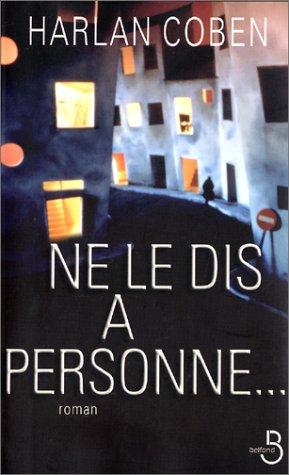
Tell No One
by Harlan Coben
★ Top 25 book of 2001 · #18 on Best Books of 2001
Eight years after his wife Elizabeth was murdered, Dr David Beck gets an anonymous email leading him to a webcam showing her image. As he searches for the truth, the FBI tries to blame him and people he turns to keep dying.
Best for: Readers who like mysteries built on loss, a murdered wife, and FBI pressure.
Tell No One is #18 on BookWard's Best Books of 2001, out of 35 2001 books that cleared our data bar.
What Tell No One is about
David Beck has spent eight years grieving his wife, Elizabeth. The two were just 25 and barely a year into their marriage when she was abducted at the lake where they were marking the anniversary of their first kiss. She was later murdered, and her killer was found and prosecuted, yet David never recovered.
Then the past starts moving again. Two bodies, long dead, turn up at that same lake. An email arrives from someone unidentified, quoting a phrase meant to be known only to David and Elizabeth, and it leads him to a web cam showing a face he thought he would never see. The FBI begins to look hard at David himself, and the people he turns to for help seem to meet bad ends. The story is described as one about loss and redemption, and it reads quickly, driven by secrets and a husband unwilling to let go.
Tell No One on the Best Books of 2001
Tell No One came out in 2001. Of the 35 books first published in 2001 that met BookWard's data bar, it ranks #18 on our Best Books of 2001 list.
Why it made the list: 248 readers have shelved it on Open Library; readers rate it 3.4 out of 5 (12 ratings). The list ranks each year’s books on how many readers have picked them up, how highly readers rate them, and how many are reading them right now.
Nearby on the 2001 list
- The Noonday Demon Andrew Solomon, #16
- Ella Minnow Pea Mark Dunn, #17
- Dead Until Dark (Sookie Stackhouse, #1) Charlaine Harris, #19
- The Ersatz Elevator Lemony Snicket, #20
See all Best Books of 2001 Best books by year
More years: Best Books of 2000 Best Books of 2002.
The numbers behind it
- Readers: 201 want to read it, 15 are reading it now and 32 have read it, according to Open Library.
- Ratings: 3.4 out of 5 from 12 Open Library ratings.
| Signal | This book (0 to 100) | Weight |
|---|---|---|
| Reach | 54 | 55% |
| Reader love | 11 | 25% |
| Being read right now | 63 | 20% |
Questions about Tell No One
When was Tell No One published?
Tell No One by Harlan Coben was first published in 2001.
Was Tell No One one of the best books of 2001?
Tell No One is #18 on BookWard's Best Books of 2001, out of 35 2001 books that cleared our data bar. 248 readers have shelved it on Open Library; readers rate it 3.4 out of 5 (12 ratings).
Why is Tell No One on the Best Books of 2001 list?
248 readers have shelved it on Open Library; readers rate it 3.4 out of 5 (12 ratings).
More of the best books of 2001
- American Gods Neil Gaiman, #1
- Eat That Frog! 21 Great Ways to Stop Procrastinating and Get More Done in Less Time Brian Tracy, #2
- Crucial Conversations Kerry Patterson, #3
- Point Blanc Anthony Horowitz, #4
- Getting Things Done David Allen, #5
- Unbroken Laura Hillenbrand, #6
See the full Best Books of 2001, the Top 100, or new books on Rising.
How we know
This page uses public data: Open Library reader counts and ratings, and Wikipedia page views for recent years. The description is paraphrased from real source text. Rankings reflect reading interest, not quality or sales, and can be affected by data gaps. Lists update monthly.
Suits adult and mature teen readers who enjoy suspense.
Depends on the edition you pick.
A grieving widower, an impossible email, and a thriller that never lets go. 56% taste match
 BookWard’s take
A grieving widower, an impossible email, and a thriller that never lets go
Tell No One opens on a murder and then jumps eight years to an email that should be impossible. It's a strong hook: the premise lands in the first pages and the questions keep coming. The pace is fast, and the plot keeps pulling David Beck deeper, so the middle never sags. Coben leans on a few familiar thriller moves, though not so heavily that the book feels stale. The internal logic mostly holds, even if the twists lean on coincidence. The prose is plain and quick, built for momentum rather than ornament, and the ending ties its threads up firmly. Published in 2001, it was Coben's first book to reach The New York Times Best Seller list, a mark of how well the machine runs.
A standard-length thriller that moves briskly; it fits BookWard's taste for tight books reasonably well, though it is not especially short.
Short chapters and constant forward motion keep it quick, close to BookWard's preferred speed.
The dead-wife-appears-online hook is a strong twist on a familiar setup, but it stays within thriller convention.
The prose is plain and functional, built for speed, a little plainer than BookWard's middle ground.
Events drive the book more than inner change, leaning plot-driven against BookWard's character-leaning taste.
It starts in grief but moves toward some measure of hope, a gentler outlook than most crime fiction.
A straightforward forward-moving structure with an eight-year jump at the start, nothing experimental.
Mostly serious, with a little wry humour in the voice; BookWard prefers more levity.
Murder and loss run through it, but it stays within mainstream thriller limits.
Grief and longing are felt, though plot keeps the intensity in check.
See all 50 dialsEvery position, side by side with this book
Where it lines up
- OpeningBookWard 10 · book 10
- EndingBookWard 8 · book 8
- Sagging middleBookWard 8 · book 8
Where it pulls apart
- Familiar tropesBookWard 10 · book 5
- Internal logicBookWard 10 · book 6
- LengthBookWard 1 · book 4
A standard-length thriller that moves briskly; it fits BookWard's taste for tight books reasonably well, though it is not especially short.
A murder, then an email that should be impossible; the premise grabs immediately, exactly the kind of opening BookWard rewards.
It uses recognisable thriller machinery: the wrongly suspected man, the dead loved one who may not be dead. BookWard would want fresher ground.
The central puzzle holds together well enough to drive the story, though some turns lean on coincidence, which BookWard would notice.
Short chapters and constant forward motion keep it quick, close to BookWard's preferred speed.
The dead-wife-appears-online hook is a strong twist on a familiar setup, but it stays within thriller convention.
David's grief gives him real weight, though the book prioritises plot, so most others are drawn more briskly than BookWard prefers.
The mystery resolves fully and answers its central questions, which suits BookWard's taste for closure.
Grief and lost love sit at the center, and the book allows itself some emotional pull rather than staying cool.
The darkness serves the mystery rather than existing for show, though some twists aim squarely at surprise.
This is a novel, so the rigor dial does not apply.
Coben's conversational, wry thriller voice is recognisable, if more efficient than distinctive.
This is plot first: the story and its questions come before any larger argument or idea.
Backstory is woven into scenes and dialogue, with only occasional explaining, close to BookWard's preference.
The story keeps escalating without a long lull, which BookWard values highly.
The prose is plain and functional, built for speed, a little plainer than BookWard's middle ground.
Events drive the book more than inner change, leaning plot-driven against BookWard's character-leaning taste.
It starts in grief but moves toward some measure of hope, a gentler outlook than most crime fiction.
A straightforward forward-moving structure with an eight-year jump at the start, nothing experimental.
Mostly serious, with a little wry humour in the voice; BookWard prefers more levity.
Easy reading by design; the story carries you without effort, below BookWard's middle.
It follows David mainly, with a few other viewpoints in support, fewer than BookWard tends to enjoy.
Mostly linear after the opening jump, with the past surfacing as the mystery unfolds.
Entirely grounded in a real-world thriller setting.
A sizeable supporting cast of suspects, allies and officials, a bit more than BookWard's middle.
The stakes are personal and local rather than epic, with a man's loss at the heart.
It moves through action and investigation more than introspection, though grief colours David's choices.
Conversations and confrontations carry much of the story, in line with BookWard's liking for dialogue.
The love between David and Elizabeth drives the whole plot, giving romance real weight.
The setting is ordinary contemporary life, so BookWard would find it familiar rather than new.
Written in 2001, it is recent enough to feel contemporary, though now slightly dated by its technology.
The emotional hook lasts, but the early-2000s internet details place it in its moment.
Narration is straightforward and reliable, unlike the unreliable narrators BookWard enjoys.
The moral lines are fairly clear, with good and bad people easy to tell apart.
Description is kept lean so the plot keeps moving.
This is fiction, so the nonfiction style dial does not apply.
This is fiction, so the perspective dial does not apply.
A standalone novel, written after Coben's Myron Bolitar series because the idea would not work for Myron.
Reveals arrive often and are the book's main pleasure, a strong match for BookWard.
A reading experience built to entertain and satisfy more than to unsettle.
Murder and loss run through it, but it stays within mainstream thriller limits.
Grief and longing are felt, though plot keeps the intensity in check.
Any humor is dry, wry and light in touch.
Violence is present as part of the crimes, but the book does not linger on it.
Little sexual content on the page.
Politics stay mostly out of the story.
Plain, accessible language throughout.
The narration stays close to events with only light commentary.
It looks back at a loss while moving forward to resolve it, leaning slightly toward the past.
Love and loyalty are treated as worth fighting for, while the world around is wary.
Review written by BookWard, dial version 1, November 2026.
Who is Tell No One right for?
Suits adult and mature teen readers who enjoy suspense. It involves murder, grief and some violence, but is not graphic or explicit.
Easy reading by design; the story carries you without effort, below BookWard's middle.
Murder and loss run through it, but it stays within mainstream thriller limits.
Grief and longing are felt, though plot keeps the intensity in check.
Violence is present as part of the crimes, but the book does not linger on it.
Book CompanionTell No One: ideas, characters, themes
A man who has spent eight years mourning his murdered wife gets an email suggesting she may still be alive, and the truth about that night begins to unravel.
- The anniversary opening. David and Elizabeth Beck return to a quiet lake to mark their first kiss, and the weekend ends in tragedy.
- Eight years of grief. David never recovers from Elizabeth's death and throws himself into work as a pediatrician.
- The impossible email. On the eighth anniversary, he gets a message that uses a phrase only he and Elizabeth should know.
- Bodies at the lake. Two long-dead bodies are unearthed at the same lake, adding new questions about what happened there.
- Suspicion closes in. As David searches for answers, the authorities begin to look at him as a suspect.
Characters
David Beck
Protagonist
A grieving pediatrician who has never moved on from his wife's murder.
Elizabeth Beck
The lost wife
David's childhood sweetheart, taken from him at the lake on their anniversary.
Themes
How loss can freeze a life in place for years.
The pull of a bond that does not fade with time.
Whether answering old questions is worth what it costs.
How quickly an innocent man can become a target.
Discussion questions
- Why does the email affect David so deeply after eight years?
- Is David's pursuit of the truth brave, reckless, or both?
- How does grief shape the choices he makes?
- Which twist surprised you most, and did it feel earned?
- What makes a thriller hook work from the very first pages?
Personalize your Book Companion
This is the general edition. In BookWard, the Companion is written for you: your reading profile, your notes, and spoiler-safe to the page you are on.
Buy, listen or borrow Tell No One
Each link opens a search for this book on that store, in a new tab.
Read on a device
Borrow
Reviews and community
If you liked Tell No One
A kidnapping thriller that never lets go of its hook
The ClientJohn GrishamA boy, a dead body, and a lawyer worth rooting for
Not Quite Dead yetHolly JacksonA dying woman has one week to find her attacker
Then She Was GoneLisa JewellA missing-girl mystery that hooks fast and grips to the end
Find your own best books
Add what you have read, rate it, and BookWard will recommend what to read next.
Free to start. No credit card needed.