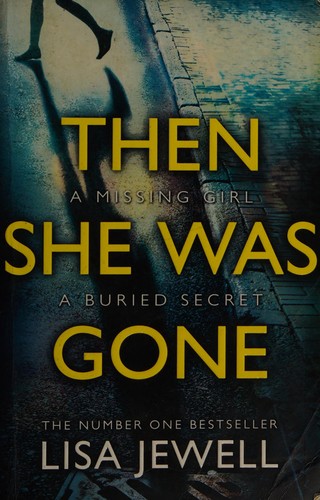
Then She Was Gone
by Lisa Jewell
★ Top 10 book of 2018 · #8 on Best Books of 2018
Ten years after her teenage daughter Ellie vanished, Laurel meets a charming man whose young daughter looks strikingly like the missing girl. Old questions resurface, and Laurel begins doubting who this man really is.
Best for: Suspense readers who like domestic mysteries built around a long-unsolved disappearance
Then She Was Gone is #8 on BookWard's Best Books of 2018, out of 60 2018 books that cleared our data bar.
What Then She Was Gone is about
Fifteen-year-old Ellie Mack, the youngest of three children, vanishes just days before a family summer vacation. Ten years later, her remains are found and a funeral is held, but the loss has already reshaped everything around her. Her mother, Laurel, has watched her marriage end and her family relationships weaken in the wake of that disappearance.
Then Laurel meets Floyd, a charming man she encounters in a cafe, and the two begin dating. Floyd's youngest daughter, Poppy, shares Ellie's looks and mannerisms in ways Laurel cannot ignore. As she learns that Poppy's mother seems to have had some connection to Ellie, old questions start to stir again. Lisa Jewell's suspense novel is about grief, family, and the long shadow cast by a loss that was never explained.
Then She Was Gone on the Best Books of 2018
Then She Was Gone came out in 2018. Of the 60 books first published in 2018 that met BookWard's data bar, it ranks #8 on our Best Books of 2018 list.
Why it made the list: 752 readers have shelved it on Open Library; readers rate it 4.4 out of 5 (28 ratings); 44 are reading it right now. The list ranks each year’s books on how many readers have picked them up, how highly readers rate them, and how many are reading them right now.
Nearby on the 2018 list
- Verity Colleen Hoover, #6
- Normal People Sally Rooney, #7
- Circe Madeline Miller, #9
- Restore Me Tahereh Mafi, #10
See all Best Books of 2018 Best books by year
More years: Best Books of 2017 Best Books of 2019.
The numbers behind it
- Readers: 655 want to read it, 44 are reading it now and 53 have read it, according to Open Library.
- Ratings: 4.4 out of 5 from 28 Open Library ratings.
| Signal | This book (0 to 100) | Weight |
|---|---|---|
| Reach | 80 | 55% |
| Reader love | 82 | 25% |
| Being read right now | 85 | 20% |
Questions about Then She Was Gone
When was Then She Was Gone published?
Then She Was Gone by Lisa Jewell was first published in 2018.
Was Then She Was Gone one of the best books of 2018?
Then She Was Gone is #8 on BookWard's Best Books of 2018, out of 60 2018 books that cleared our data bar. 752 readers have shelved it on Open Library; readers rate it 4.4 out of 5 (28 ratings); 44 are reading it right now.
Why is Then She Was Gone on the Best Books of 2018 list?
752 readers have shelved it on Open Library; readers rate it 4.4 out of 5 (28 ratings); 44 are reading it right now.
More of the best books of 2018
- Heartstopper, Volume 1 Alice Oseman, #1
- Where the Crawdads Sing Delia Owens, #2
- The Laws of Human Nature Robert Greene, #3
- Atomic Habits James Clear, #4
- Five Feet Apart Rachael Lippincott, #5
- Verity Colleen Hoover, #6
See the full Best Books of 2018, the Top 100, or new books on Rising.
How we know
This page uses public data: Open Library reader counts and ratings, and Wikipedia page views for recent years. The description is paraphrased from real source text. Rankings reflect reading interest, not quality or sales, and can be affected by data gaps. Lists update monthly.
Suits adult and older teen readers who enjoy suspense.
Depends on the edition you pick.
A missing-girl mystery that hooks fast and grips to the end. 58% taste match
 BookWard’s take
A missing-girl mystery that hooks fast and grips to the end
Lisa Jewell opens with a mother ten years into the loss of her fifteen-year-old daughter, then gives her a new relationship and a child who looks uncannily like the girl who vanished. It is a premise built to hook at once, and it does. That strong opening is the main reason to pick this one up. The pace is brisk, and the middle stays sustained rather than sagging, because every chapter feeds the central question. My one reservation is how familiar it all feels: the missing-child thriller is well-worn ground, and the genre's habits show. The internal logic is tight, the ending resolves, and the sentiment stays mostly restrained despite the subject. The characters are drawn with the most depth in Laurel, a believably worn-down parent, rather than in anyone else.
A single-premise domestic thriller of standard novel length, close to BookWard's preference for tight storytelling.
Short chapters and a steady stream of questions keep it moving, in line with BookWard's fast-pace taste.
The lookalike-child hook adds a twist, but the overall shape is a recognizable genre template.
Plain, accessible sentences that stay out of the way of the plot, close to BookWard's mildly plain taste.
Plot drives the book, though Laurel's grief gives it an emotional anchor.
The tone is shadowed by loss and menace, leaning bleaker than BookWard's mildly hopeful middle.
A mostly conventional thriller layout with some shifting between perspectives and time.
This is a serious book about loss with little room for jokes.
Child loss and sinister motives make it dark, though the book stays within thriller bounds.
Grief and dread drive much of the experience, running intense.
See all 50 dialsEvery position, side by side with this book
Where it lines up
- PaceBookWard 8 · book 8
- EndingBookWard 8 · book 8
- Sagging middleBookWard 8 · book 8
Where it pulls apart
- Familiar tropesBookWard 10 · book 4
- LengthBookWard 1 · book 4
- Internal logicBookWard 10 · book 7
A single-premise domestic thriller of standard novel length, close to BookWard's preference for tight storytelling.
A daughter vanished a decade ago and a lookalike child appears; the book grabs from the start, which BookWard rewards.
The missing-girl thriller is familiar territory, so it leans on genre conventions BookWard tends to mark down.
The mystery is built so its pieces connect, which sits close to BookWard's liking for airtight plotting.
Short chapters and a steady stream of questions keep it moving, in line with BookWard's fast-pace taste.
The lookalike-child hook adds a twist, but the overall shape is a recognizable genre template.
Laurel is drawn with real weariness and grief, though the wider cast serves the plot more than the portrait.
It resolves the central mystery rather than leaving it open, which suits BookWard.
Grief is central, and the book can tip toward emotional pull, a little warmer than BookWard prefers.
The darkness serves the mystery, though some reveals are built for effect, a mixed fit for BookWard.
Not applicable to a novel.
Jewell's style is clean and readable, with a recognizable thriller voice rather than a strongly singular one.
This is story-led, driven by a mystery and its answers, which matches BookWard's lean toward story.
Backstory comes out through the investigation and the characters' memories rather than lectures.
The central question keeps pulling forward, so the middle holds up, as BookWard likes.
Plain, accessible sentences that stay out of the way of the plot, close to BookWard's mildly plain taste.
Plot drives the book, though Laurel's grief gives it an emotional anchor.
The tone is shadowed by loss and menace, leaning bleaker than BookWard's mildly hopeful middle.
A mostly conventional thriller layout with some shifting between perspectives and time.
This is a serious book about loss with little room for jokes.
Easy to read in long stretches, a bit lighter than BookWard's middle setting.
The story moves between more than one point of view, which suits BookWard's liking for several voices.
It moves between the present and the events around the disappearance, a fit with BookWard's tolerance for shifting time.
Entirely grounded in ordinary contemporary life.
A focused family and a few key figures keep the cast compact.
A personal, household-sized story about one family's loss.
Balances Laurel's inner turmoil with the outward work of piecing together what happened.
Conversations carry much of the revelation, a decent match for BookWard's dialogue-friendly taste.
A new relationship matters to the plot but sits alongside the mystery rather than leading it.
A familiar domestic British setting rather than an unfamiliar world.
Set in a recognizably modern period, in line with BookWard's present-day lean.
A well-made genre thriller, but one tied to its type of story rather than built to outlast it.
The reader is told things straightforwardly; this is not a book about unreliable narration.
Right and wrong are fairly clear, even where motives are unsettling.
Setting is sketched enough to place the scenes but the book is not lavish with detail.
Not applicable to a novel.
Not applicable to a novel.
Reads as a standalone story with a self-contained mystery.
Built around reveals and shifting understandings, which suits BookWard's liking for surprises.
A tense read, but it asks little of the reader beyond attention.
Child loss and sinister motives make it dark, though the book stays within thriller bounds.
Grief and dread drive much of the experience, running intense.
Menace and harm are central, but the book is more about dread than graphic scenes.
Sexual content is minimal and not a focus.
Largely absent; this is a personal, domestic story.
Straightforward modern English with no dense language to wade through.
The narration stays close to the characters rather than editorializing.
Rooted in the past: a decade-old loss and the search for what happened.
The outlook is guarded and wary, shaped by loss and betrayal.
Review written by BookWard, dial version 1, November 2026.
Who is Then She Was Gone right for?
Suits adult and older teen readers who enjoy suspense. It deals with a missing child, grief and a sense of threat, which some readers may find upsetting.
Easy to read in long stretches, a bit lighter than BookWard's middle setting.
Child loss and sinister motives make it dark, though the book stays within thriller bounds.
Grief and dread drive much of the experience, running intense.
Menace and harm are central, but the book is more about dread than graphic scenes.
Book CompanionThen She Was Gone: ideas, characters, themes
A mother who has lived ten years without her missing daughter meets a child who looks exactly like her, and the past starts to reopen.
- A decade of grief. The book begins long after the disappearance, showing how loss has reshaped Laurel's life and family.
- An unsettling resemblance. Meeting Floyd's daughter Poppy, who echoes Ellie in looks and manner, pulls Laurel back into old questions.
- A family in pieces. The disappearance strained Laurel's marriage and her bond with her other children, ending in divorce.
- A new relationship under suspicion. Laurel's connection with Floyd moves quickly, and the more she learns, the less settled it feels.
- The case reopens. Ellie's remains are found and a funeral is held, but the real answers are still out of reach.
Characters
Laurel Mack
Ellie's mother
A woman trying to rebuild her life ten years after her daughter vanished.
Ellie Mack
The missing daughter
A fifteen-year-old who disappeared, remembered as a beloved and bright girl.
Floyd
Laurel's new partner
A charming single father whom Laurel meets and begins dating.
Poppy
Floyd's young daughter
A child whose looks and mannerisms strongly recall Ellie.
Themes
How loss lingers and reshapes a person and a family over years.
How the past, and the people we lost, keep returning in new forms.
How hard it is to know who someone really is, especially someone new.
How a single event can strain the ties between parents and children.
Discussion questions
- Why does Poppy affect Laurel so strongly, and is her reaction understandable?
- How does the long gap since Ellie's disappearance change the way the story unfolds?
- What does the book suggest about how families cope with unresolved loss?
- Did you trust Floyd as Laurel did, and when did your view change?
- How well does the book balance suspense against its emotional core?
Personalize your Book Companion
This is the general edition. In BookWard, the Companion is written for you: your reading profile, your notes, and spoiler-safe to the page you are on.
Buy, listen or borrow Then She Was Gone
Each link opens a search for this book on that store, in a new tab.
Read on a device
Borrow
Reviews and community
If you liked Then She Was Gone
A family thriller where old home videos unearth a buried crime
The Reappearance of Rachel PriceHolly JacksonA missing mother returns and the questions get sharper
Middle of the NightRiley SagerA suburban cold case with a hook that lands at once
Forget Me NotStacy WillinghamA sister's cold case reopens inside a vineyard diary
Find your own best books
Add what you have read, rate it, and BookWard will recommend what to read next.
Free to start. No credit card needed.