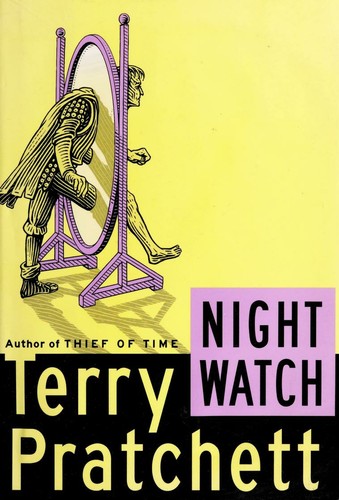
Night Watch
by Terry Pratchett
★ Top 25 book of 2002 · #13 on Best Books of 2002
Commander Sam Vimes is flung thirty years into the past of Ankh-Morpork by meddling monks, landing on the eve of a street rebellion. With his old enemy the murderer also sent back, he must decide whether altering history is worth risking his own future.
Best for: Discworld fans who like time travel mixed with police adventure
Night Watch is #13 on BookWard's Best Books of 2002, out of 32 2002 books that cleared our data bar.
What Night Watch is about
Samuel Vimes, commander of Ankh-Morpork's City Watch, is chasing the murderer Carcer when a lightning storm throws him back in time. It happens on the very morning his wife goes into labour with their first child. Carcer is flung into the past too, and the pair land in a younger, rougher city under the secret police of Lord Winder. Lu-Tze appears with a stark instruction: Vimes must take the place of the murdered Sergeant-at-Arms John Keel.
So Vimes finds himself teaching his own younger self the lessons he once admired in Keel, while Fred Colon and other watchmen help push a barricade revolt through the streets. Terry Pratchett's 2002 Discworld novel, the sixth to centre on the Watch, mixes wit and a sardonic edge with real feeling for duty, justice, and the poor. It placed second in the Locus Poll for best fantasy novel.
Night Watch on the Best Books of 2002
Night Watch came out in 2002. Of the 32 books first published in 2002 that met BookWard's data bar, it ranks #13 on our Best Books of 2002 list.
Why it made the list: 204 readers have shelved it on Open Library; readers rate it 4.5 out of 5 (59 ratings). The list ranks each year’s books on how many readers have picked them up, how highly readers rate them, and how many are reading them right now.
It earns Reader favorite.
Nearby on the 2002 list
- Dragon Ball Z; Thank You 鳥山 明 [Akira Toriyama], #11
- Middlesex Jeffrey Eugenides, #12
- Understanding Power Noam Chomsky, #14
- Without Fail Lee Child, #15
See all Best Books of 2002 Best books by year
More years: Best Books of 2001 Best Books of 2003.
The numbers behind it
- Readers: 114 want to read it, 1 are reading it now and 89 have read it, according to Open Library.
- Ratings: 4.5 out of 5 from 59 Open Library ratings.
| Signal | This book (0 to 100) | Weight |
|---|---|---|
| Reach | 44 | 55% |
| Reader love | 100 | 25% |
| Being read right now | 6 | 20% |
Questions about Night Watch
When was Night Watch published?
Night Watch by Terry Pratchett was first published in 2002.
Was Night Watch one of the best books of 2002?
Night Watch is #13 on BookWard's Best Books of 2002, out of 32 2002 books that cleared our data bar. 204 readers have shelved it on Open Library; readers rate it 4.5 out of 5 (59 ratings).
Why is Night Watch on the Best Books of 2002 list?
204 readers have shelved it on Open Library; readers rate it 4.5 out of 5 (59 ratings).
More of the best books of 2002
- Romancing Mister Bridgerton Julia Quinn, #1
- Coraline Neil Gaiman, #2
- Why Does He Do That? Lundy Bancroft, #3
- Room on the Broom Julia Donaldson, #4
- Stories of Your Life and Others Ted Chiang, #5
- Everything's Eventual. 14 Dark Tales Stephen King, #6
See the full Best Books of 2002, the Top 100, or new books on Rising.
How we know
This page uses public data: Open Library reader counts and ratings, and Wikipedia page views for recent years. The description is paraphrased from real source text. Rankings reflect reading interest, not quality or sales, and can be affected by data gaps. Lists update monthly.
Suits adult and older teen readers who enjoy witty fantasy with a serious core.
Depends on the edition you pick.
Vimes, thrown thirty years back, must teach his younger self to police. 68% taste match
 BookWard’s take
Vimes, thrown thirty years back, must teach his younger self to police
Night Watch drops Sam Vimes into an Ankh-Morpork three decades before his title and fortune, with the murderer he was chasing sent back alongside him. The hook is immediate: a rooftop chase, a lightning storm, and Vimes waking in the street in the past. The opening is as gripping as one could want, and the premise is tightly reasoned, so the internal logic holds up. Pratchett stays funny without softening the stakes, and the book earns its darkness rather than leaning on shock. The characters are the real engine, since Vimes is forced to mentor the young copper he once was. It is the 29th Discworld novel and the sixth starring the City Watch, but the plot stands by itself.
The plot keeps pushing through curfews, interrogations and barricades, with enough momentum to match BookWard's taste for speed.
A veteran copper mentoring his own younger self during a revolution is a distinctive angle on a well-worn device.
Clear and quick, with jokes landing in the sentence structure rather than ornament.
The plot has real momentum, but what drives it is Vimes's choices and his relationship to his younger self.
The setting is grim, yet the book argues that stubborn decency can still make a difference.
The structure is a fairly straightforward adventure, with the time-slip as the one big departure.
Humor runs through the book, softening a dark political backdrop without undercutting it.
The streets are violent and the regime is cruel, but the tone never loses its humane center.
The stakes land hard, especially in Vimes's bond with the young man he used to be.
See all 50 dialsEvery position, side by side with this book
Where it lines up
- EndingBookWard 8 · book 8
- Shock for effectBookWard 9 · book 9
- Sagging middleBookWard 8 · book 8
Where it pulls apart
- LengthBookWard 1 · book 6
- Familiar tropesBookWard 10 · book 7
- Internal logicBookWard 10 · book 8
Vimes is mid-chase on a rooftop when lightning sends him back thirty years, so the story is moving from the first pages.
Time travel is familiar, but Pratchett uses it for a story about policing and conscience rather than a gimmick.
The time-travel setup has clear rules, including the temporal shattering and the need for Vimes to take John Keel's place.
The plot keeps pushing through curfews, interrogations and barricades, with enough momentum to match BookWard's taste for speed.
A veteran copper mentoring his own younger self during a revolution is a distinctive angle on a well-worn device.
Vimes confronting who he was and who taught him is the heart of the book, and it is drawn with real care.
There is warmth, especially around mentoring and Vimes's family, but the book keeps its feelings from turning syrupy.
The danger and the street violence carry weight and serve the story rather than existing for effect.
Not applicable; this is a novel.
Pratchett's wry, humane narration is instantly recognisable and one of the book's biggest strengths.
Ideas about law, power and duty matter, but they are carried by plot and character rather than argued directly.
The world and its history come through scenes and action, and the story seldom stops to lecture the reader.
The middle stays busy with barricades, a divided city and Vimes's gamble, so it holds tension throughout.
Clear and quick, with jokes landing in the sentence structure rather than ornament.
The plot has real momentum, but what drives it is Vimes's choices and his relationship to his younger self.
The setting is grim, yet the book argues that stubborn decency can still make a difference.
The structure is a fairly straightforward adventure, with the time-slip as the one big departure.
Humor runs through the book, softening a dark political backdrop without undercutting it.
Easy to follow and read, even with a revolution and a time-travel plot in play.
Mostly anchored to Vimes, with some wider glimpses of the city and the people around him.
Vimes lives in the past while his own future hangs in the balance, a single big shift rather than constant jumping.
A Discworld story with time-manipulating monks, so it sits firmly in fantasy, even as the politics feel real.
A good-sized cast of watchmen, rebels and officials, though the story stays clear on who matters.
The stakes are the fate of a city's streets, yet the story stays close to a few men on the ground.
Vimes's inner reckoning is balanced against chases, standoffs and street-level action.
Quick, witty exchanges carry much of the characterisation and a good share of the humor.
Vimes's marriage is a background motivation, not a plot, so romance stays minor.
Ankh-Morpork is a place regular readers of the series will know, though newcomers can find their footing quickly.
The story is set in the Discworld's past, though its concerns about authority feel current.
Its ideas about policing, revolution and doing the job well will hold up for a long time.
The narration is reliable and clear, letting Vimes's confusion be the only uncertainty.
The book has a firm sense of right and wrong, though the characters are still caught between competing duties.
Descriptions are efficient and flavourful, giving the old city texture without slowing the story.
It is the 29th Discworld novel and the sixth featuring the City Watch, though it works as a story on its own.
Time travel and a murderous chase keep the reader guessing, even when the broad direction is clear.
Light on style but willing to ask hard questions about law, loyalty and the cost of order.
The streets are violent and the regime is cruel, but the tone never loses its humane center.
The stakes land hard, especially in Vimes's bond with the young man he used to be.
The humor leans wry and observational, with the occasional broad gag.
Street fighting and revolution mean real violence, though it is not lingered over.
Sexual content is minimal and not central to the story.
Tyranny, secret police and revolution are central, and the book has plenty to say about power.
The language is plain and quick, with the occasional street-level flavour.
The narration has clear views on authority and decency and does not hide them.
Mostly looks back, with Vimes revisiting a past that shaped him and a future he must protect.
It admits how rotten the system can be while still believing ordinary decency can matter.
Review written by BookWard, dial version 1, November 2026.
Who is Night Watch right for?
Suits adult and older teen readers who enjoy witty fantasy with a serious core. It includes street violence, murder and political oppression, though nothing is dwelt on gratuitously.
Easy to follow and read, even with a revolution and a time-travel plot in play.
The streets are violent and the regime is cruel, but the tone never loses its humane center.
The stakes land hard, especially in Vimes's bond with the young man he used to be.
Street fighting and revolution mean real violence, though it is not lingered over.
Book CompanionNight Watch: ideas, characters, themes
Sam Vimes is thrown thirty years into the past and must hold the line for decency while helping shape the young copper he once was.
- Time-slip opening. A rooftop chase and a lightning storm send Vimes back to a darker Ankh-Morpork, setting the stakes immediately.
- Borrowed identity. Vimes must take the place of John Keel, the sergeant who was meant to arrive that day, which gives the story its engine.
- Mentor and student. Vimes teaches the lessons he once learned, with Young Vimes believing he is being taught by Keel.
- Keeping the peace. As revolution builds, Vimes tries to keep his corner of the city calm and protect ordinary people.
- The pursuer follows. Carcer, the murderer Vimes was chasing, is sent back too, so the danger never leaves the picture.
Characters
Sam Vimes
Protagonist
Commander of the City Watch, thrown back thirty years and forced to act as someone else.
Carcer
Antagonist
A notorious criminal who murders watchmen and is sent back in time alongside Vimes.
John Keel
Vimes's hero and mentor
The sergeant whose identity Vimes assumes after Keel is killed by Carcer.
Lu-Tze
Time monk
Freezes time to explain to Vimes what has happened and what he must do.
Lord Winder
Ruler of the city
The paranoid Patrician whose secret police terrorise the city.
Themes
What it means to do a hard job well when nobody is watching.
How power grows paranoid and what ordinary people do in the face of it.
How the lessons we are taught shape who we become.
Being forced to live as another person while holding on to who you are.
Whether one person can steer events without losing their own future.
Discussion questions
- Why does Vimes accept the role of John Keel instead of simply trying to get home?
- How does the book use humor to handle a violent, oppressive setting?
- What does Vimes teach his younger self, and what does he learn in return?
- Is Vimes right to try to change history, given what it could cost him?
- How does the Watch's idea of policing compare with the secret police of the time?
Personalize your Book Companion
This is the general edition. In BookWard, the Companion is written for you: your reading profile, your notes, and spoiler-safe to the page you are on.
Buy, listen or borrow Night Watch
Each link opens a search for this book on that store, in a new tab.
Read on a device
Borrow
Reviews and community
If you liked Night Watch
Pratchett's Watch novel pairs a golem murder with a poisoned Patrician
Small GodsTerry PratchettA tortoise god, one true believer, and a very funny argument about faith
Miecz przeznaczeniaAndrzej SapkowskiGeralt's second story collection, sharper and sadder than the first
Men at ArmsTerry PratchettPratchett's cop story: a city, a gonne, a rightful king
Find your own best books
Add what you have read, rate it, and BookWard will recommend what to read next.
Free to start. No credit card needed.