Suits mature teens and adults who enjoy fantasy.
400 pages, about 6.5 to 9.5 hours.
Geralt's second story collection, sharper and sadder than the first. 72% taste match
The story
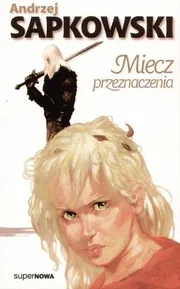
Miecz przeznaczenia is a fantasy short story collection by the Polish author Andrzej Sapkowski, first published in 1992. It belongs to the witcher cycle and follows Geralt of Rivia, a monster hunter who works under a code of his own, in a world of magic, adventure and danger. The stories mix action with historical flavor, and the book runs to roughly 400 pages in its typical edition.
Geralt shares the pages with a recurring circle of people, among them the bard Dandelion, the sorceress Yennefer, Ciri, Visenna, Eithné, Braenn and Essi Daven. Monsters and assassins figure in the tales, and in one of them Geralt joins a group of famed dragon slayers, including the knight Eyck of Denesle and a band of dwarves led by Yarpen Zigrin, on an expedition organized by Niedamir. The witcher's code forbids killing dragons, though it permits hunting other creatures, which sets up the tension in that story. Readers of epic and adventure fantasy, and those who enjoy Polish fiction in the genre, will find a collection with many editions in print.
Characters
DandelionYenneferVisennaEithnéBraennEssi Daven
Themes
New York Times bestsellerAssassinsMonstersadventurefantasyAction & AdventureEpicHistorical
- Want to read 92
- Reading now 1
- Read 67
Readers are split between finishing it and saving it for later.
Of 160 readers who put it on a shelf, 58% want to read it, 1% are reading it now, 42% have finished it and 0% stopped before the end.
By the numbers
- The median edition runs 400 pages. Counting about 275 words a page and an adult reading pace of 250 words a minute, that is about 7.3 hours of reading.
- Open Library tracks 28 editions from 13 publishers, the earliest dated 1992 and the latest 2023, across 7 languages.
- On reader demand it ranks in the top 5% of the modern books in our catalog (15,152 of them).
- Libraries shelve it under Dewey 891.8537 and Library of Congress class PG-7178.00000000.A65 M5413 2015.
 BookWard’s take
Geralt's second story collection, sharper and sadder than the first
Miecz przeznaczenia gathers Sapkowski's witcher stories into a collection that works as a book rather than a pile of episodes, with a thread running through it that pays off by the end. It hooks at once: the first pages put Geralt in the middle of a problem and let the world explain itself through scenes, not lectures, which is exactly how this kind of opening should work. The stories lean on fairy tales and then twist them, so the book is steeped in familiar tropes and still manages to feel fresh. Dialogue is heavy, wry and quick, and the humor is dry. The one real caveat is that this is the second witcher book, and it rewards having started earlier, so newcomers may feel the gap. The restraint holds throughout, and the darkness feels earned.
At around 400 pages of linked stories it is compact for fantasy, which suits BookWard's preference for tight books.
The stories move briskly from setup to confrontation, close to BookWard's fast-leaning pace.
Reworking folklore through a weary, ethical monster hunter feels fresh, which BookWard rewards.
The language is plain and clean with sharp irony, somewhat less ornate than the middle of the scale.
Plot drives each tale, though character relationships give it weight, slightly more plot-led than BookWard's lean.
Outcomes are often bitter or compromised, so it sits on the bleak side of BookWard's mildly hopeful stance.
Stories alternate with a framing thread, a modest departure from conventional structure, close to BookWard.
Wry banter and dark jokes recur throughout, in line with BookWard's taste for humor.
Violence and cruelty are real but leavened with humor, near BookWard's middle.
Feeling runs under irony and shows up in key moments, close to BookWard's measured position.
See all 50 dialsEvery position, side by side with this book
Where it lines up
- Character depthBookWard 8 · book 8
- Authorial voiceBookWard 9 · book 9
- Story or ideasBookWard 3 · book 3
Where it pulls apart
- LengthBookWard 1 · book 4
- Internal logicBookWard 10 · book 7
- Familiar tropesBookWard 10 · book 8
At around 400 pages of linked stories it is compact for fantasy, which suits BookWard's preference for tight books.
Each story drops Geralt straight into trouble, matching BookWard's wish to be hooked at once.
It takes familiar fairy-tale and monster setups and bends them, so it mostly avoids standard fantasy tropes, in line with BookWard.
Magic, contracts and the witcher's code mostly hold together, though a few turns lean on convenience, a touch looser than BookWard likes.
The stories move briskly from setup to confrontation, close to BookWard's fast-leaning pace.
Reworking folklore through a weary, ethical monster hunter feels fresh, which BookWard rewards.
Geralt, Yennefer and Dandelion carry real history and contradictions, matching BookWard's taste for drawn characters.
Individual tales close cleanly while the larger arc stays open, a little less resolved than BookWard prefers.
Feeling is present but undercut by irony and restraint, which BookWard values.
Darkness comes from consequences within the stories, not from cheap shocks, which BookWard appreciates.
Sapkowski's sardonic, allusive narration is unmistakable and a clear match for BookWard.
These are story-led, with moral questions arising from incident rather than argument, as BookWard prefers.
The world is revealed through scenes and quarrels, not explanation, exactly BookWard's preference.
The stories stay lively from one to the next, with little drag, which BookWard values.
The language is plain and clean with sharp irony, somewhat less ornate than the middle of the scale.
Plot drives each tale, though character relationships give it weight, slightly more plot-led than BookWard's lean.
Outcomes are often bitter or compromised, so it sits on the bleak side of BookWard's mildly hopeful stance.
Stories alternate with a framing thread, a modest departure from conventional structure, close to BookWard.
Wry banter and dark jokes recur throughout, in line with BookWard's taste for humor.
The prose is accessible, though allusions and the cycle's backstory ask some attention, near BookWard's level.
Geralt anchors nearly every story, making it narrower than BookWard's many-viewpoint taste.
Stories run mostly in sequence with some looking back, a touch more linear than BookWard's pick.
Monsters, sorcery and an invented continent make this clearly fantastical, above BookWard's middle position.
Recurring friends and enemies add up to a mid-sized cast, a little bigger than BookWard's.
Stakes are mostly personal and local, with a larger destiny hinted at, near the middle.
Action and conversation lead, with Geralt's doubts surfacing, leaning slightly outward of BookWard's balance.
Quick, barbed exchanges carry much of the book, well above BookWard's already high preference.
The Geralt and Yennefer thread gives romance real weight, more central than BookWard usually likes.
A secondary world with its own politics and creatures reads as unfamiliar, matching BookWard.
Set in an invented, medieval-style past, far from BookWard's lean toward the present.
Fairy-tale roots and moral questions give these stories lasting appeal, equal to BookWard's view.
The narration is straightforward and trustworthy, less slippery than BookWard's taste for unreliability.
Geralt's talk of neutrality and the lesser evil keeps choices murky, which BookWard values.
Settings and creatures are drawn efficiently with occasional rich detail, a bit fuller than BookWard.
This is the second witcher book and part of a cycle, well beyond BookWard's standalone position.
Fairy-tale expectations get turned over regularly, in line with BookWard's taste for surprise.
The moral dilemmas unsettle without lecturing, a little less demanding than BookWard.
Violence and cruelty are real but leavened with humor, near BookWard's middle.
Feeling runs under irony and shows up in key moments, close to BookWard's measured position.
The wit is dry and sardonic, drier than BookWard's middle ground.
Monster fights and killings are frequent and sometimes graphic, slightly above BookWard's middle.
Intimacy is present but not dwelt on, a little below BookWard's middle.
Wars, prejudice and rulers' schemes shape events without dominating, close to BookWard.
The Polish is accessible, with some archaic and invented terms, a bit plainer than BookWard's middle.
The narrator's irony colors events, matching BookWard's slightly opinionated lean.
Fate and the past weigh on the characters more than the future does, unlike BookWard's forward lean.
Geralt's worn pragmatism keeps this on the cynical side, unlike BookWard's mild idealism.
Review written by BookWard, dial version 1, November 2026.
Who is Miecz przeznaczenia right for?
Suits mature teens and adults who enjoy fantasy. It contains fantasy violence and some adult themes.
The prose is accessible, though allusions and the cycle's backstory ask some attention, near BookWard's level.
Violence and cruelty are real but leavened with humor, near BookWard's middle.
Feeling runs under irony and shows up in key moments, close to BookWard's measured position.
Monster fights and killings are frequent and sometimes graphic, slightly above BookWard's middle.
Book CompanionMiecz przeznaczenia: ideas, characters, themes
A professional monster hunter tries to stay neutral in a world where every choice has a cost, and fate keeps drawing him in.
- The witcher's code. Geralt works by rules that forbid some hunts, which creates the tension in the dragon expedition.
- Fairy tales turned over. Familiar monsters and story shapes are reworked so expectations are subverted.
- A recurring circle. Dandelion, Yennefer and others return, giving the stories continuity.
- Neutrality under pressure. Geralt's wish to stay out of conflicts is repeatedly tested.
- Fate as theme. The title points to destiny and the weight it places on choices.
Characters
Geralt of Rivia
Witcher and protagonist
A monster hunter bound by a code he questions.
Yennefer
Sorceress
A powerful magic user with a tangled link to Geralt.
Dandelion
Bard
Geralt's talkative companion, known in some editions as Jaskier.
Ciri
Young girl tied to Geralt's fate
Named among the book's central figures.
Themes
Whether choices are free or destiny pulls the strings.
Whether staying out of conflict is possible or moral.
How the line between beast and person blurs.
What rules obligate you to, and when to break them.
Discussion questions
- Is Geralt's neutrality a virtue or an evasion?
- How do the stories reshape the fairy tales they draw on?
- Where does the book blur monsters and humans?
- What does the title suggest about fate and choice?
- Which recurring character most changes how you see Geralt?
Personalize your Book Companion
This is the general edition. In BookWard, the Companion is written for you: your reading profile, your notes, and spoiler-safe to the page you are on.
Buy, listen or borrow Miecz przeznaczenia
Each link opens a search for this book on that store, in a new tab.
Read on a device
Borrow
Reviews and community
If you liked Miecz przeznaczenia
Vimes, thrown thirty years back, must teach his younger self to police
Crooked KingdomLeigh BardugoA heist sequel that rewards loyalty and clever planning
The Drawing of the ThreeStephen KingDoorways on a beach, and a gunslinger who needs allies
The Tainted CupRobert Jackson BennettA Holmes-and-Watson murder mystery inside a leviathan-haunted fantasy empire
Sources: Open Library.
Track Miecz przeznaczenia and find your next favorite
Add it to your shelf, rate what you have read, and BookWard will recommend what fits you.
Free to start. No credit card needed.