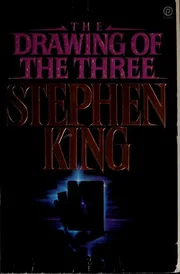
The Drawing of the Three
by Stephen King · 1987
Best suited to mature teens and adults, as it is a long novel with series context.
455 pages, about 7 to 10.5 hours.
Doorways on a beach, and a gunslinger who needs allies. 66% taste match
The story
The Drawing of the Three is a fantasy novel by Stephen King, first published in 1987. It is the second volume of The Dark Tower saga, the series that follows Roland Deschain, also called Roland of Gilead, the last gunslinger. The book picks up after the events of the first volume, with Roland still tied to the figure of the man in black and the quest toward the Dark Tower.
On a beach, Roland comes upon three doorways. Each one opens into the life of a different person in New York City, and through them he draws the companions who will join his journey. Eddie Dean, Odetta Holmes and Susannah Dean, Jack Mort and Enrico Balazar are among the figures in the story, which moves between Roland's world and the New York of 1964 and 1977. The novel blends fantasy and horror, and draws on parallel universes, tarot cards, drug addiction, dissociative identity disorder and civil rights. Strange creatures called lobstrosities also appear. The edition runs to roughly 455 pages.
The Drawing of the Three is the second volume of a long tale called The Dark Tower, a tale inspired by and to some degree dependent upon Robert Browning's narrative poem "Childe Roland to the Dark Tower Came" (which in its turn owes a debt to King Lear).
Characters
Susannah DeanJack MortThe Man in BlackRoland DeschainOdetta HolmesEnrico Balazar
Setting
New York City
Period
198719641977
Themes
sociopathsdissociative identity disordercivil rightsheroincocainelobstrositiestarot cardshorror tales
- Want to read 379
- Reading now 20
- Read 184
Most people shelving it are saving it for later.
Of 583 readers who put it on a shelf, 65% want to read it, 3% are reading it now, 32% have finished it and 0% stopped before the end.
By the numbers
- The median edition runs 455 pages. Counting about 275 words a page and an adult reading pace of 250 words a minute, that is about 8.3 hours of reading.
- Open Library tracks 78 editions from 56 publishers, the earliest dated 1987 and the latest 2023, across 9 languages.
- On reader demand it ranks in the top 1% of the modern books in our catalog (15,152 of them).
- Libraries shelve it under Dewey 813.54 and Library of Congress class PS-3561.00000000.I483.
 BookWard’s take
Doorways on a beach, and a gunslinger who needs allies
The Drawing of the Three is the second Dark Tower book, and it trades the first volume's spare, mythic wasteland for something stranger: three doors on a beach, each opening into a different life in New York. The premise is original and the hook is immediate, the kind of opening that grabs you at once. The doorway structure keeps the pace brisk, and each companion is drawn with real interior detail, so the character work is a genuine strength. The darkness here is tied to addiction, fractured identity and violence rather than shock for its own sake. It is also firmly a series book, so it rewards anyone who starts at the beginning. Roland's world and the New York of the 1960s and 1970s play off each other, giving the story its shifting timeline and a pull between fantasy and street-level grit.
At 455 pages it is substantial, though it moves faster than its size suggests; BookWard prefers tighter books.
Each doorway sets a new problem in motion, so the book keeps moving at a pace BookWard enjoys.
Doorways that open into other people's lives in New York make for a distinctive premise within epic fantasy.
King writes plainly and colloquially, with only occasional flourishes, near BookWard's own mid-low position.
Plot machinery and character study share the load, with a slight tilt toward character, close to BookWard's lean.
The mood is harsh but the mission gives it forward motion; hope is present without being a comfort.
Three episodes each built around a doorway give it a modular shape that is more distinctive than a straight line.
Grim and tense for the most part, with occasional dry exchanges rather than real comedy.
Addiction, violence and fractured identity give it a clearly dark edge without being relentlessly bleak.
The characters' pain and fear are rendered with force, so the feeling runs strong.
See all 50 dialsEvery position, side by side with this book
Where it lines up
- PaceBookWard 8 · book 8
- Character depthBookWard 8 · book 8
- Story or ideasBookWard 3 · book 3
Where it pulls apart
- LengthBookWard 1 · book 6
- Familiar tropesBookWard 10 · book 7
- Internal logicBookWard 10 · book 7
At 455 pages it is substantial, though it moves faster than its size suggests; BookWard prefers tighter books.
The beach and its three doorways set the story going almost immediately, exactly the kind of opening BookWard rewards.
Wasteland quest and gunslinger mythology carry familiar fantasy echoes, but the doorway premise keeps it fresh against BookWard's high bar.
The doors follow clear rules within the story, which suits BookWard's liking for airtight internal logic.
Each doorway sets a new problem in motion, so the book keeps moving at a pace BookWard enjoys.
Doorways that open into other people's lives in New York make for a distinctive premise within epic fantasy.
The companions are given real inner lives and troubled histories, matching BookWard's appreciation for deeply drawn people.
It closes its own arc while clearly pointing onward to the next volume, somewhat less resolved than BookWard prefers.
King leans into feeling in places, but the grit of the material keeps it from turning syrupy.
The darkness grows out of addiction and fractured identity rather than being there for effect, which BookWard respects.
King's conversational, confident narration is unmistakable and fits BookWard's taste for distinctive voice.
This is a story-led book; its ideas arrive through character and incident rather than argument.
Roland's world and the New York sections are conveyed through scene and action rather than lectures, close to BookWard's preference.
The structure of three separate drawings keeps energy up, with few stretches where momentum fades.
King writes plainly and colloquially, with only occasional flourishes, near BookWard's own mid-low position.
Plot machinery and character study share the load, with a slight tilt toward character, close to BookWard's lean.
The mood is harsh but the mission gives it forward motion; hope is present without being a comfort.
Three episodes each built around a doorway give it a modular shape that is more distinctive than a straight line.
Grim and tense for the most part, with occasional dry exchanges rather than real comedy.
It reads easily and propulsively, though the series context asks a little of newcomers.
The story moves between Roland and the people he draws, giving a few distinct viewpoints.
Roland's world is set against New York in 1964 and 1977, so the story moves across time.
Doorways between worlds and creatures called lobstrosities place it clearly in fantasy, though the New York scenes stay grounded.
The core group stays small, with a handful of people carrying most of the story.
Epic in ambition through the Dark Tower quest, yet much of the action is close, personal and street-level.
Action and confrontation drive the story, with real attention to what the characters are feeling inside.
Conversation carries a lot of the characterisation and tension, especially in the New York scenes.
Relationships matter to the story, but romance is not its engine.
A post-apocalyptic gunslinger's world meeting 1960s and 70s New York feels very unfamiliar, and BookWard likes the contrast.
Roland's world is outside time and the New York scenes look back to 1964 and 1977, so little of it is present day.
The mythic quest and richly drawn characters give it lasting pull, as its long afterlife in the series shows.
The narration is straightforward and trustworthy, with no games played about what is true.
Roland is a driven, sometimes ruthless hero, and the book leaves room for moral complexity.
Beaches, doorways and New York streets are vividly drawn, with detail where it counts.
This is the second book of The Dark Tower saga and reads best in sequence.
Each doorway brings reversals and revelations, so surprises are frequent.
Addiction, illness and identity make it tougher than comfort reading, though it stays a page-turner.
Addiction, violence and fractured identity give it a clearly dark edge without being relentlessly bleak.
The characters' pain and fear are rendered with force, so the feeling runs strong.
What humor there is stays dry and character-based rather than broad.
Gunfights and brutal confrontations appear regularly, and horror elements add to it.
Sexual content is limited and not central.
Civil rights is part of the backdrop, which brings politics in without making it the main message.
Roland's and the New Yorkers' distinct speech adds flavor, though the text stays readable.
King narrates in a neutral, story-first way rather than editorializing.
The quest points forward toward the Dark Tower, though the characters are shaped by their pasts.
It sits between cynicism and idealism, with hard-bitten people drawn toward something larger than themselves.
Review written by BookWard, dial version 1, November 2026.
Who is The Drawing of the Three right for?
Best suited to mature teens and adults, as it is a long novel with series context. It deals with drug addiction, violence, dissociative identity disorder and racial injustice, with horror elements.
It reads easily and propulsively, though the series context asks a little of newcomers.
Addiction, violence and fractured identity give it a clearly dark edge without being relentlessly bleak.
The characters' pain and fear are rendered with force, so the feeling runs strong.
Gunfights and brutal confrontations appear regularly, and horror elements add to it.
Book CompanionThe Drawing of the Three: ideas, characters, themes
Roland, the last gunslinger, uses three doorways on a beach to draw into his world the people who will help him reach the Dark Tower.
- Three doors, three lives. Each doorway opens into a different person in New York, giving the book a clear episodic backbone.
- Two worlds colliding. Roland's post-apocalyptic world meets New York in 1964 and 1977, and both are made stronger by the contrast.
- Companions, not sidekicks. The people Roland draws carry their own histories, and their struggles drive much of the story.
- Horror inside fantasy. King blends quest fantasy with horror, including strange creatures like the lobstrosities.
- A series-building volume. It extends the saga begun in the first book and sets up what follows, so it works best read in order.
Characters
Roland Deschain
The last gunslinger
Also called Roland of Gilead, he is the single-minded seeker of the Dark Tower.
Eddie Dean
One of the drawn companions
A New Yorker whose life opens onto Roland's quest through one of the doors.
Odetta Holmes
One of the drawn companions
A woman from 1960s New York whose story touches on civil rights and fractured identity; she is also linked to the name Susannah Dean.
Jack Mort
A figure in the New York storyline
One of the people connected to the doorways and to the dark side of the story.
Enrico Balazar
A figure in the New York storyline
A dangerous presence from the criminal side of New York in the story.
Themes
Strangers from different worlds become allies in a shared mission.
Drug dependence shapes character and drives conflict.
Fractured selves raise questions about who a person really is.
The 1960s setting brings race and injustice into the story.
Roland draws people into a destiny they did not choose.
Discussion questions
- Why might the doorway structure suit this story better than a single continuous journey?
- How do the New York scenes change the feel of Roland's quest?
- Which of the drawn companions feels most fully realised, and why?
- Where does the book use horror, and does it add or distract?
- How well does this volume stand on its own versus as part of the series?
Personalize your Book Companion
This is the general edition. In BookWard, the Companion is written for you: your reading profile, your notes, and spoiler-safe to the page you are on.
Buy, listen or borrow The Drawing of the Three
Each link opens a search for this book on that store, in a new tab.
Read on a device
Borrow
Reviews and community
If you liked The Drawing of the Three
A gods-and-war sequel that rides on three strong leads
King of ScarsLeigh BardugoA young king's secret curse, told through three sharp voices
Blood of the Old KingsSung-Il KimAn empire that mines its dead sorcerers, seen through several fighters
Crooked KingdomLeigh BardugoA heist sequel that rewards loyalty and clever planning
Sources: Open Library.
Track The Drawing of the Three and find your next favorite
Add it to your shelf, rate what you have read, and BookWard will recommend what fits you.
Free to start. No credit card needed.