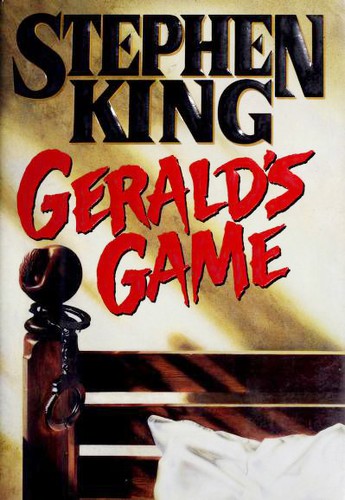
Gerald's Game
by Stephen King
★ Top 10 book of 1992 · #9 on Best Books of 1992
On a quiet October weekend at a summer house, a romantic getaway turns deadly when Jessie finds herself handcuffed to the bed and alone. With only a stray dog and her own haunted thoughts for company, she begins to suspect someone is watching.
Best for: Horror readers who enjoy claustrophobic, psychological suspense with a single trapped heroine
Gerald's Game is #9 on BookWard's Best Books of 1992, out of 43 1992 books that cleared our data bar.
What Gerald's Game is about
Jessie Burlingame and her husband Gerald, a lawyer, drive from Portland to their lake house in western Maine for a spontaneous romantic getaway. The season is over and their neighbors have gone, so the place is empty. Gerald has a sexual game in mind that involves handcuffs, and Jessie goes along only by pretending. When she asks him to stop and he ignores her, she lashes out and he dies of a heart attack, leaving her handcuffed to the bed with no one likely to miss them for several days.
From there, Stephen King keeps the story almost entirely inside one room and one mind. Voices begin to speak to her, some belonging to people she has known and some to versions of herself. They push her toward memories she has long kept buried and toward a hard look at her marriage. Readers who like tense, confined, psychological suspense will find it here, though the tone is dark and often disturbing.
Gerald's Game on the Best Books of 1992
Gerald's Game came out in 1992. Of the 43 books first published in 1992 that met BookWard's data bar, it ranks #9 on our Best Books of 1992 list.
Why it made the list: 602 readers have shelved it on Open Library; readers rate it 3.7 out of 5 (36 ratings); 24 are reading it right now. The list ranks each year’s books on how many readers have picked them up, how highly readers rate them, and how many are reading them right now.
Nearby on the 1992 list
- Small Gods Terry Pratchett, #7
- Your Money or Your Life Vicki Robin, #8
- A Fire Upon the Deep Vernor Vinge, #10
- Wild Magic Tamora Pierce, #11
See all Best Books of 1992 Best books by year
More years: Best Books of 1991 Best Books of 1993.
The numbers behind it
- Readers: 486 want to read it, 24 are reading it now and 92 have read it, according to Open Library.
- Ratings: 3.7 out of 5 from 36 Open Library ratings.
| Signal | This book (0 to 100) | Weight |
|---|---|---|
| Reach | 91 | 55% |
| Reader love | 23 | 25% |
| Being read right now | 86 | 20% |
Questions about Gerald's Game
When was Gerald's Game published?
Gerald's Game by Stephen King was first published in 1992.
Was Gerald's Game one of the best books of 1992?
Gerald's Game is #9 on BookWard's Best Books of 1992, out of 43 1992 books that cleared our data bar. 602 readers have shelved it on Open Library; readers rate it 3.7 out of 5 (36 ratings); 24 are reading it right now.
Why is Gerald's Game on the Best Books of 1992 list?
602 readers have shelved it on Open Library; readers rate it 3.7 out of 5 (36 ratings); 24 are reading it right now.
More of the best books of 1992
- Welcome to Dead House Robert Lawrence Stine, #1
- The Secret History Donna Tartt, #2
- Snow Crash Neal Stephenson, #3
- The Indispensable Calvin and Hobbes Bill Watterson, #4
- The Shadow Rising Robert Jordan, #5
- The Artist's Way Julia Cameron, #6
See the full Best Books of 1992, the Top 100, or new books on Rising.
How we know
This page uses public data: Open Library reader counts and ratings, and Wikipedia page views for recent years. The description is paraphrased from real source text. Rankings reflect reading interest, not quality or sales, and can be affected by data gaps. Lists update monthly.
Best suited to adult readers comfortable with sustained fear and psychological distress.
Depends on the edition you pick.
One woman, one bed, and a mind that talks back. 68% taste match
 BookWard’s take
One woman, one bed, and a mind that talks back
Gerald's Game drops Jessie Burlingame into a trap within the first act and refuses to let her out, which is why the opening hooks at once and the pace stays brisk despite a single location. The internal logic holds: every problem she faces follows from the handcuffs, the empty lake house and the season. King keeps the scale tight, almost claustrophobic, so the character depth comes from the voices in Jessie's head rather than from outside action. The focus is inward, and the material is dark, though it earns that darkness through what the story is about. Readers who like tight, logical, character-led suspense will find a close fit here, even if the prose stays plain and the familiar thriller setup is bent into something stranger.
A single-room premise keeps it more contained than most of King's output, which suits BookWard's liking for tight books.
The situation keeps tightening despite one setting, though it breathes more slowly than a chase thriller.
Building a whole novel around one trapped woman and the voices in her head is a bold, uncommon structure.
King writes in plain, direct sentences, with lyric touches kept to a minimum.
The suspense comes from Jessie's mind and history more than from external events.
It confronts despair and trauma, with survival the only hope on offer.
The voices and flashbacks add some texture, but it stays close to a linear ordeal.
This is a grim, serious book with essentially no comic relief.
Death, entrapment and childhood trauma make this one of King's darker books.
Fear, dread and grief run high throughout.
See all 50 dialsEvery position, side by side with this book
Where it lines up
- OpeningBookWard 10 · book 10
- EndingBookWard 8 · book 8
- SentimentBookWard 8 · book 8
Where it pulls apart
- LengthBookWard 1 · book 4
- Familiar tropesBookWard 10 · book 8
- Internal logicBookWard 10 · book 8
A single-room premise keeps it more contained than most of King's output, which suits BookWard's liking for tight books.
A husband's death with his wife handcuffed to the bed arrives in the first act, exactly the immediate grab BookWard rewards.
It takes a stock suspense setup and works it through psychology rather than the usual rescue-or-escape formula.
Each obstacle Jessie faces follows plainly from the handcuffs, the empty season and the isolated lake house, which BookWard values.
The situation keeps tightening despite one setting, though it breathes more slowly than a chase thriller.
Building a whole novel around one trapped woman and the voices in her head is a bold, uncommon structure.
Jessie's past and the voices she hallucinates give her real depth, matching BookWard's taste for deeply drawn characters.
The story drives toward a definite outcome rather than leaving the central situation open.
The book is raw and unsparing about fear and trauma instead of reaching for easy comfort.
Much of the darkness comes from Jessie's history and the horror of her trap, not from gratuitous jolts.
This is a novel, so the dial does not apply.
King's conversational, immediate narration is unmistakable and carries the claustrophobia.
It is firmly story-led, driven by one woman's survival rather than a thesis.
Backstory surfaces through memory and the voices in her head, which partly explain and partly dramatize.
With one person and one room, the tension is built to sustain, though a few stretches loop.
King writes in plain, direct sentences, with lyric touches kept to a minimum.
The suspense comes from Jessie's mind and history more than from external events.
It confronts despair and trauma, with survival the only hope on offer.
The voices and flashbacks add some texture, but it stays close to a linear ordeal.
This is a grim, serious book with essentially no comic relief.
Easy to read in style, though the subject matter asks for emotional stamina.
The story stays almost wholly inside Jessie's perspective.
Memories of her childhood break into the present, though the main thread runs straight.
The story stays grounded, with hallucinated voices and a figure in the dark playing on the edge of the real.
Effectively one living person, with a stray dog and the voices in her mind.
Almost everything happens in Jessie's thoughts, memories and fears.
Much of the talk is Jessie's inner voices speaking to her, which keeps dialogue frequent.
The marriage is the starting point, but this is no romance.
A secluded Maine lake house is a familiar kind of King setting.
Published in 1992, it reads as late twentieth century rather than present day.
The central predicament is primal and holds up well beyond its year of publication.
The narration is mostly trustworthy, but Jessie's hallucinations blur what is real.
Jessie's fear and her husband's act are fairly clear, though her past is more tangled.
King renders the room, the thirst and the body's discomfort in vivid physical detail.
It is a standalone novel.
The unease builds through revelations and uncertainty more than through plot reversals.
It confronts abuse, fear and trauma head-on and is not a comforting read.
Death, entrapment and childhood trauma make this one of King's darker books.
Fear, dread and grief run high throughout.
There is a fatal blow and bodily horror, though much of the dread is psychological.
The handcuff game and abuse in the backstory make the subject matter sexual and unsettling.
It touches on power between men and women but is not a political book.
The language is plain and accessible.
The narration stays close to Jessie rather than editorializing.
Her ordeal pulls the past into the present more than it looks ahead.
It is clear-eyed about harm and betrayal, tempered by a stubborn will to survive.
Review written by BookWard, dial version 1, November 2026.
Who is Gerald's Game right for?
Best suited to adult readers comfortable with sustained fear and psychological distress. It deals with sexual coercion, death, abuse in the backstory and bodily horror, so it may be difficult for some readers.
Easy to read in style, though the subject matter asks for emotional stamina.
Death, entrapment and childhood trauma make this one of King's darker books.
Fear, dread and grief run high throughout.
There is a fatal blow and bodily horror, though much of the dread is psychological.
Book CompanionGerald's Game: ideas, characters, themes
A woman trapped alone must face both her physical danger and the buried memories that surface in her mind.
- A weekend away. Jessie and Gerald Burlingame travel from Portland to a secluded lake house in western Maine for a spontaneous getaway.
- The game. Gerald handcuffs Jessie to the bedposts, a practice she only pretends to enjoy.
- The turn. When Jessie asks to stop and is ignored, she lashes out, and the shock leaves Gerald dead and her still cuffed.
- Nobody coming. With the season over and the lake emptied, she realizes no one is likely to find her for days.
- The voices. Panic and thirst conjure voices in her head, including a Puritanical self, her child self, an old roommate and a former psychologist.
Characters
Jessie Burlingame
Protagonist
A woman handcuffed to a bed who must survive her ordeal while confronting memories she has long avoided.
Gerald Burlingame
Her husband
A successful lawyer whose fatal heart attack leaves Jessie trapped.
Goodwife Burlingame
A voice in Jessie's mind
A Puritanical version of Jessie who insists things will be fine and that she should wait.
Punkin
A voice in Jessie's mind
A representation of Jessie as a ten-year-old girl.
Ruth Neary
A voice in Jessie's mind
A college roommate Jessie abandoned when a conversation neared her childhood trauma.
Themes
Physical captivity that mirrors being stuck in the past.
Painful childhood memories that resurface under pressure.
Who holds control, and what happens when consent is ignored.
The competing voices that make up one mind in crisis.
The will to endure when rescue seems unlikely.
Discussion questions
- How do the different voices in Jessie's head shape the choices she makes?
- Why might King confine nearly the whole story to one room?
- What does the story say about avoiding painful memories?
- How does the book treat consent, and where does Jessie's fear begin?
- Did the tension come more from the physical danger or the psychological one?
Personalize your Book Companion
This is the general edition. In BookWard, the Companion is written for you: your reading profile, your notes, and spoiler-safe to the page you are on.
Buy, listen or borrow Gerald's Game
Each link opens a search for this book on that store, in a new tab.
Read on a device
Borrow
Reviews and community
If you liked Gerald's Game
Four tight novellas about retribution, with no comfort offered
TweakNic SheffA raw, first-person account of meth addiction and relapse
Sharp ObjectsGillian FlynnA journalist goes home to Wind Gap and her own wounds
WintergirlsLaurie Halse AndersonA short, raw novel of hunger and haunting
Find your own best books
Add what you have read, rate it, and BookWard will recommend what to read next.
Free to start. No credit card needed.