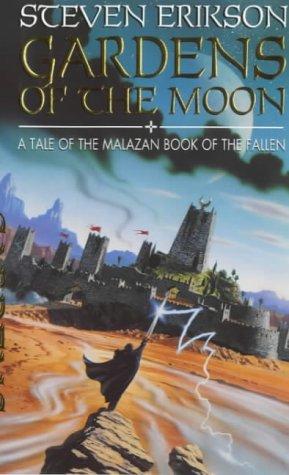
Gardens of the Moon
by Steven Erikson
★ Top 25 book of 1999 · #19 on Best Books of 1999
The sprawling Malazan empire, worn down by endless war, faces unrest while Empress Lasseen eyes the last free city, Darujhistan. Soldiers, sorcerers, and even the gods are drawn into a vast game, launching an epic series.
Best for: Epic fantasy fans who want a complex mythology and a large cast
Gardens of the Moon is #19 on BookWard's Best Books of 1999, out of 52 1999 books that cleared our data bar.
What Gardens of the Moon is about
Steven Erikson opens his Malazan Book of the Fallen with an empire worn thin. The Malazan realm has been drained by endless warfare and infighting, and discontent simmers beneath the surface. Its ruler, Empress Lasseen, is ambitious beyond any limit, and her armies have already clashed bloodily with Lord Anomander Rake and his Tiste Andii.
The story picks up in the aftermath of the siege of Pale. Sergeant Whiskeyjack and his Bridgeburners are at the heart of it, alongside Tattersail, the only sorceress of the Second Legion to survive. Darujhistan, the last free city of Genabackis, still holds out, while sinister forces gather and the gods prepare to take a hand. Dense, gritty and epic in scale, it suits readers who enjoy being dropped into a vast world and left to find their footing, with magic, myth and the weariness of war all in play.
Gardens of the Moon on the Best Books of 1999
Gardens of the Moon came out in 1999. Of the 52 books first published in 1999 that met BookWard's data bar, it ranks #19 on our Best Books of 1999 list.
Why it made the list: 380 readers have shelved it on Open Library; readers rate it 4 out of 5 (59 ratings). The list ranks each year’s books on how many readers have picked them up, how highly readers rate them, and how many are reading them right now.
Nearby on the 1999 list
- Kensuke's Kingdom Michael Morpurgo, #17
- The Reptile Room Lemony Snicket, #18
- Scattered Gabor Maté, #20
- Hannibal Thomas Harris, #21
See all Best Books of 1999 Best books by year
More years: Best Books of 1998 Best Books of 2000.
The numbers behind it
- Readers: 293 want to read it, 9 are reading it now and 78 have read it, according to Open Library.
- Ratings: 4 out of 5 from 59 Open Library ratings.
| Signal | This book (0 to 100) | Weight |
|---|---|---|
| Reach | 67 | 55% |
| Reader love | 60 | 25% |
| Being read right now | 25 | 20% |
Questions about Gardens of the Moon
When was Gardens of the Moon published?
Gardens of the Moon by Steven Erikson was first published in 1999.
Was Gardens of the Moon one of the best books of 1999?
Gardens of the Moon is #19 on BookWard's Best Books of 1999, out of 52 1999 books that cleared our data bar. 380 readers have shelved it on Open Library; readers rate it 4 out of 5 (59 ratings).
Why is Gardens of the Moon on the Best Books of 1999 list?
380 readers have shelved it on Open Library; readers rate it 4 out of 5 (59 ratings).
More of the best books of 1999
- Harry Potter and the Prisoner of Azkaban J. K. Rowling, #1
- Wings of Fire A. P. J. Abdul Kalam, #2
- The Perks of Being a Wallflower Stephen Chbosky, #3
- On Writing Stephen King, #4
- The Bad Beginning Lemony Snicket, #5
- The Coldest Winter Ever Sister Souljah, #6
See the full Best Books of 1999, the Top 100, or new books on Rising.
How we know
This page uses public data: Open Library reader counts and ratings, and Wikipedia page views for recent years. The description is paraphrased from real source text. Rankings reflect reading interest, not quality or sales, and can be affected by data gaps. Lists update monthly.
Best suited to adult and mature teen readers comfortable with long, complex fantasy.
Depends on the edition you pick.
A dense, throw-you-in epic that rewards patience with real payoff. 50% taste match
 BookWard’s take
A dense, throw-you-in epic that rewards patience with real payoff
Gardens of the Moon drops you into the Malazan empire's long war with no tour guide, and that is both its appeal and its price. Almost nothing is explained, since the world is shown through soldiers and sorcerers who already know it, and I respect that choice even when it leaves me adrift. It takes real effort to read, and the cast is large, so the early chapters ask for close attention. Where it shines is originality: the mythology feels built from scratch rather than borrowed. It is also the first of a series, and the scale is epic throughout. The hook is slower than I would like, but the magic and politics follow a consistent internal logic, and that rewards those who stay.
A big, sprawling epic, far longer than BookWard's taste for tight books, and it uses that space for scope rather than padding.
Events move steadily across many fronts, but the dense setup means it never races, a little slower than BookWard likes.
The mythology and magic feel built from scratch, which is exactly the kind of invention BookWard rewards.
The language is solid and sometimes lyrical but mostly serves the story, a touch more ornate than BookWard's plain-leaning taste.
Plot and character share the load, with campaigns and intrigue pulling alongside individuals, slightly more plot-led than BookWard prefers.
The tone is grim and weary, with little comfort, which is bleaker than BookWard's mildly hopeful lean.
It braids many storylines without strict signposting, a little more experimental than BookWard's conventional tilt.
Soldiers' gallows humor appears, but the book stays largely serious, less funny than BookWard's taste.
War, loss and cruelty run through it, darker than BookWard's mid-range comfort.
Grief and loyalty land with weight but are rarely loud, close to BookWard's balanced emotional register.
See all 50 dialsEvery position, side by side with this book
Where it lines up
- OriginalityBookWard 9 · book 9
- SentimentBookWard 8 · book 8
- Character depthBookWard 8 · book 7
Where it pulls apart
- LengthBookWard 1 · book 9
- OpeningBookWard 10 · book 4
- Internal logicBookWard 10 · book 7
A big, sprawling epic, far longer than BookWard's taste for tight books, and it uses that space for scope rather than padding.
It opens mid-war with little orientation, so the pull comes from curiosity rather than an instant grab, slower than BookWard prefers.
Its gods, empires and soldiers feel invented rather than inherited, so it avoids most stock epic fantasy furniture, which suits BookWard well.
Magic and politics follow consistent rules, though much stays unexplained at first; BookWard values the underlying coherence.
Events move steadily across many fronts, but the dense setup means it never races, a little slower than BookWard likes.
The mythology and magic feel built from scratch, which is exactly the kind of invention BookWard rewards.
Soldiers and sorcerers carry history and weariness, giving them real weight, close to BookWard's preference for deeply drawn people.
It resolves its immediate conflicts while clearly setting up a larger saga, leaving more open than BookWard usually favors.
War is treated plainly, with grief and loyalty kept restrained rather than milked, which BookWard appreciates.
The darkness grows out of a brutal war and the stakes feel earned rather than staged, matching BookWard's taste.
This is a novel, so the rigor dial does not apply.
Erikson's voice is confident and hard to mistake for anyone else, which BookWard prizes.
Big ideas about empire and gods sit in the background, but the book is driven by its soldiers and campaigns, closer to BookWard's story lean.
Almost nothing is explained outright; the world is revealed through scenes and assumed knowledge, right where BookWard sits.
The sprawling middle holds together through shifting storylines, with only occasional stretches that lose tension, close to BookWard's standard.
The language is solid and sometimes lyrical but mostly serves the story, a touch more ornate than BookWard's plain-leaning taste.
Plot and character share the load, with campaigns and intrigue pulling alongside individuals, slightly more plot-led than BookWard prefers.
The tone is grim and weary, with little comfort, which is bleaker than BookWard's mildly hopeful lean.
It braids many storylines without strict signposting, a little more experimental than BookWard's conventional tilt.
Soldiers' gallows humor appears, but the book stays largely serious, less funny than BookWard's taste.
It asks for focus and memory with little hand-holding, noticeably more demanding than BookWard's easier lean.
Many characters across soldiers, sorcerers and city dwellers carry the story, beyond BookWard's already high comfort with multiple viewpoints.
The story moves forward in time without major jumps, more linear than BookWard's shifting tilt.
Gods, sorcery and warrens make this wholly fantastical, well beyond BookWard's mid-range comfort.
A huge cast of soldiers, mages, rulers and gods fills the pages, far past BookWard's mid-sized preference.
Empire-spanning war and godly stakes make this epic in every sense, well beyond BookWard's mid-range scale.
Campaigns, battles and intrigue lead, with inner life present but secondary, leaning more outward than BookWard.
Soldiers' banter and plotting conversations carry much of the story, in line with BookWard's taste for dialogue.
Romance plays at most a minor role, with war and politics dominating, lower than BookWard's mid-range.
A wholly invented setting with its own history and powers, far more unfamiliar than BookWard's already adventurous taste.
Set in an invented past of swords and sorcery, well away from the present day BookWard leans toward.
Its themes of war and loyalty and its original world should age well, matching BookWard's staying-power preference.
The narration is straightforward and trustworthy, not playing games with the reader, so more reliable than BookWard's lean.
Empires, soldiers and gods are all compromised, leaving little clean right and wrong, a strong match for BookWard's ambiguity.
The setting is drawn with texture but not lingered over, somewhat richer than BookWard's middle position.
This is a novel, so the nonfiction style dial does not apply.
This is a novel, so the perspective dial does not apply.
It is the first book of a ten-volume saga and clearly built as an opening chapter, far more series-bound than BookWard's neutral stance.
Hidden loyalties and godly gambits keep upending expectations, a good fit for BookWard's liking for surprises.
It demands patience and offers little reassurance, more challenging than BookWard's already challenge-leaning taste.
War, loss and cruelty run through it, darker than BookWard's mid-range comfort.
Grief and loyalty land with weight but are rarely loud, close to BookWard's balanced emotional register.
What humor exists is dry and sardonic soldier talk, drier than BookWard's mid-range.
War is central and battle and bloodshed appear often, above BookWard's moderate level.
Sexual content is limited and incidental, a touch below BookWard's mid-range.
Empire, rebellion and rival powers drive much of the plot, more politically charged than BookWard's neutral taste.
Invented names, terms and history create a dense language barrier early on, more demanding than BookWard's middle position.
The narration stays neutral and lets events speak, less opinionated than BookWard's slight lean.
The book looks back on ancient histories and old wars more than it looks ahead, unlike BookWard's forward lean.
A weary, war-hardened view of power leans cynical, unlike BookWard's mildly idealistic outlook.
Review written by BookWard, dial version 1, November 2026.
Who is Gardens of the Moon right for?
Best suited to adult and mature teen readers comfortable with long, complex fantasy. It contains war violence and dark themes, and demands sustained attention.
It asks for focus and memory with little hand-holding, noticeably more demanding than BookWard's easier lean.
War, loss and cruelty run through it, darker than BookWard's mid-range comfort.
Grief and loyalty land with weight but are rarely loud, close to BookWard's balanced emotional register.
War is central and battle and bloodshed appear often, above BookWard's moderate level.
Book CompanionGardens of the Moon: ideas, characters, themes
A war-weary empire pushes toward conquest while soldiers, mages and gods quietly pursue agendas of their own.
- A war already underway. The story begins in the middle of the Malazan empire's long struggle for Genabackis, with the aftermath of the siege of Pale still fresh.
- Soldiers at the center. Sergeant Whiskeyjack and his Bridgeburners show the human cost of an empire's ambitions on the ground.
- Sorcery with consequences. Tattersail, the Second Legion's last surviving sorceress, represents magic that is powerful, wayward and costly.
- A city that still holds out. Darujhistan, the last of the Free Cities, stands between the empire and complete conquest of the region.
- Gods in the game. Powers beyond the human world are preparing to act, hinting that the war is only one layer of something larger.
Characters
Sergeant Whiskeyjack
Leader of the Bridgeburners
A soldier leading his squad through the aftermath of the siege of Pale.
Tattersail
Sorceress of the Second Legion
The sole surviving sorceress of her legion, caught up in the empire's wider schemes.
Empress Lasseen
Ruler of the Malazan empire
Her ambition drives the empire onward, with Darujhistan the next target.
Lord Anomander Rake
Leader of the Tiste Andii
A formidable adversary whose confrontations with the empire have bled it dry.
Themes
What endless conquest takes from the soldiers who fight it and the people it swallows.
How soldiers stay faithful to each other even as war grinds them down.
How rulers, mages and gods maneuver, often indifferent to the people below.
The absence of clean heroes or villains in a conflict where everyone is compromised.
How an ancient, layered past presses on the present.
Discussion questions
- How does being dropped into the middle of a war, without explanation, change the way you read?
- Which side of the conflict did you find yourself sympathizing with, and why?
- What does the book suggest about the people who fight an empire's wars?
- How do the human and godly layers of the story relate to each other?
- Did the density of the world feel like a reward or a barrier, and at what point did that shift?
Personalize your Book Companion
This is the general edition. In BookWard, the Companion is written for you: your reading profile, your notes, and spoiler-safe to the page you are on.
Buy, listen or borrow Gardens of the Moon
Each link opens a search for this book on that store, in a new tab.
Read on a device
Borrow
Reviews and community
If you liked Gardens of the Moon
A desert planet, a doomed duke, and a vast, patient epic
Lord of ChaosRobert JordanThe sixth Wheel of Time book: vast, political, and deep in the series
The Great Hunt (the Wheel of Time Book 2)Robert JordanJordan's second Wheel of Time book widens the world and the stakes
The Amber SpyglassPhilip PullmanA vast, daring finale that trades pace for ambition
Find your own best books
Add what you have read, rate it, and BookWard will recommend what to read next.
Free to start. No credit card needed.