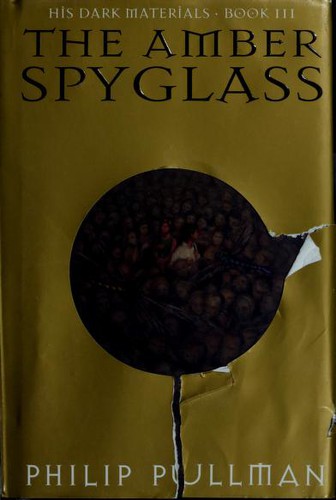
The Amber Spyglass
by Philip Pullman
★ Top 25 book of 1999 · #23 on Best Books of 1999
The closing chapter of the His Dark Materials trilogy sends Lyra and Will into grave peril as they venture to a gloomy realm no living person has entered. With allies like an armored bear, Lord Asriel's rebellion rages and the fate of the living and the dead rests on two children.
Best for: Readers who want an epic, high-stakes fantasy finale with armored bears and angels
The Amber Spyglass is #23 on BookWard's Best Books of 1999, out of 52 1999 books that cleared our data bar.
What The Amber Spyglass is about
The closing volume of Philip Pullman's His Dark Materials trilogy, published in 1999, finds Lyra and Will in serious peril and relying on unusual allies. Iorek Byrnison, the armored bear, stands beside them, along with a pair of tiny Gallivespian spies.
Their path leads into a gray, dim world that no living person has ever entered. Elsewhere, Dr. Mary Malone constructs the Amber Spyglass and finds an assassin on her trail, while Lord Asriel leads a rebellion backed by a troop of shining angels. As war spreads, Dust drains out of the sky. Everything rests on two children and the truth of one simple story.
The mood is epic and thoughtful, touched with sadness. Readers who have followed the earlier books will find questions about rebellion, love, sacrifice, and what lies beyond death waiting here.
The Amber Spyglass on the Best Books of 1999
The Amber Spyglass came out in 1999. Of the 52 books first published in 1999 that met BookWard's data bar, it ranks #23 on our Best Books of 1999 list.
Why it made the list: 389 readers have shelved it on Open Library; readers rate it 3.9 out of 5 (112 ratings). The list ranks each year’s books on how many readers have picked them up, how highly readers rate them, and how many are reading them right now.
Nearby on the 1999 list
- Hannibal Thomas Harris, #21
- Code Charles Petzold, #22
- The Birchbark House Louise Erdrich, #24
See all Best Books of 1999 Best books by year
More years: Best Books of 1998 Best Books of 2000.
The numbers behind it
- Readers: 200 want to read it, 5 are reading it now and 184 have read it, according to Open Library.
- Ratings: 3.9 out of 5 from 112 Open Library ratings.
| Signal | This book (0 to 100) | Weight |
|---|---|---|
| Reach | 69 | 55% |
| Reader love | 42 | 25% |
| Being read right now | 8 | 20% |
Questions about The Amber Spyglass
When was The Amber Spyglass published?
The Amber Spyglass by Philip Pullman was first published in 1999.
Was The Amber Spyglass one of the best books of 1999?
The Amber Spyglass is #23 on BookWard's Best Books of 1999, out of 52 1999 books that cleared our data bar. 389 readers have shelved it on Open Library; readers rate it 3.9 out of 5 (112 ratings).
Why is The Amber Spyglass on the Best Books of 1999 list?
389 readers have shelved it on Open Library; readers rate it 3.9 out of 5 (112 ratings).
More of the best books of 1999
- Harry Potter and the Prisoner of Azkaban J. K. Rowling, #1
- Wings of Fire A. P. J. Abdul Kalam, #2
- The Perks of Being a Wallflower Stephen Chbosky, #3
- On Writing Stephen King, #4
- The Bad Beginning Lemony Snicket, #5
- The Coldest Winter Ever Sister Souljah, #6
See the full Best Books of 1999, the Top 100, or new books on Rising.
How we know
This page uses public data: Open Library reader counts and ratings, and Wikipedia page views for recent years. The description is paraphrased from real source text. Rankings reflect reading interest, not quality or sales, and can be affected by data gaps. Lists update monthly.
It suits teens and adults who have read the earlier books and are ready for big questions about death, religion and authority.
Depends on the edition you pick.
A vast, daring finale that trades pace for ambition. 54% taste match
 BookWard’s take
A vast, daring finale that trades pace for ambition
The Amber Spyglass closes the His Dark Materials trilogy on an enormous scale: several worlds, a war in heaven, a journey to the land of the dead, and two children at the center of it all. Its originality and voice are the standouts. Pullman builds a cosmology and a theology of his own rather than borrowing a familiar one. The canvas is epic, and the viewpoints range widely as the story keeps several threads in motion at once. That breadth is also its risk. The middle asks more patience than the opening of the trilogy does, and the book leans toward ideas more than I usually like. The payoff is an ending that earns its weight and resolves what the trilogy set up. Read it with the earlier books fresh.
A big, sprawling finale that gives its many threads room, which is more length than BookWard's taste for tight books.
Battles and journeys keep things moving, but the large cast and thread-switching slow it below BookWard's preferred speed.
The cosmology, the Gallivespian spies and the land of the dead are original in design, which sits very well with BookWard.
Clear and vivid with moments of grandeur, leaning a bit more ornate than BookWard's plain-leaning taste.
Plot and character carry roughly equal weight, as the quest and the children's growth are bound together.
After heavy loss it lands somewhere tender and hopeful, a little more than BookWard's usual outlook.
It follows a classic quest shape while cutting between worlds, only mildly adventurous in structure.
This is a serious book, with little humor beyond the occasional dry exchange.
It deals with death and loss seriously, yet the story stays within young-adult territory.
Loss, love and sacrifice are felt strongly, making it emotionally intense.
See all 50 dialsEvery position, side by side with this book
Where it lines up
- OriginalityBookWard 9 · book 9
- Character depthBookWard 8 · book 8
- EndingBookWard 8 · book 8
Where it pulls apart
- LengthBookWard 1 · book 8
- OpeningBookWard 10 · book 6
- Internal logicBookWard 10 · book 7
A big, sprawling finale that gives its many threads room, which is more length than BookWard's taste for tight books.
It drops straight back into danger for Lyra and Will, though it asks you to remember a lot from the earlier books.
Its angels, armored bears and realm of the dead are reworked into something new, which BookWard rewards.
The multiverse and the nature of Dust follow rules the trilogy has set up, mostly holding together as the stakes rise.
Battles and journeys keep things moving, but the large cast and thread-switching slow it below BookWard's preferred speed.
The cosmology, the Gallivespian spies and the land of the dead are original in design, which sits very well with BookWard.
Lyra and Will are drawn with real inner conflict, close to the depth BookWard values.
The trilogy's major questions are answered with finality, matching BookWard's liking for resolved endings.
It reaches for strong feeling openly, a touch more sentimental than BookWard's restrained taste.
Its darkest turns serve the story's argument, and the sacrifices feel earned.
This is a novel, so the nonfiction rigor dial does not apply.
Pullman's narration is unmistakable, confident and moral, which BookWard values highly.
Big questions about authority, death and growing up share the stage with the adventure, more idea-led than BookWard prefers.
Much of the cosmology comes through characters explaining it, a little more telling than BookWard likes.
With so many separate threads, some stretches feel less urgent than the opening and finish.
Clear and vivid with moments of grandeur, leaning a bit more ornate than BookWard's plain-leaning taste.
Plot and character carry roughly equal weight, as the quest and the children's growth are bound together.
After heavy loss it lands somewhere tender and hopeful, a little more than BookWard's usual outlook.
It follows a classic quest shape while cutting between worlds, only mildly adventurous in structure.
This is a serious book, with little humor beyond the occasional dry exchange.
The ideas and the many threads ask real attention, more effort than BookWard's easy-leaning taste.
The story moves between Lyra, Will, Mary, Asriel and others, giving it a wide range of viewpoints.
The story moves forward through events rather than jumping around in time.
Parallel worlds, angels and the land of the dead put it at the fully fantastical end.
Lyra and Will lead a huge ensemble of bears, spies, angels and scientists.
A war involving worlds and heaven itself makes it as epic as fiction gets.
Battles and journeys share space with the children's inner struggles, leaning slightly outward.
Conversation carries a fair share of the explaining and arguing, balanced with action.
The bond between Lyra and Will is a meaningful thread without taking over the story.
Its invented realms are among the most unfamiliar settings in children's and young-adult fiction.
Its worlds are invented and unplaced in time, so it reads as set away from the present day.
Its themes of freedom, loss and growing up give it staying power well beyond its 1999 release.
The narrator tells the story plainly and reliably, with no trickery about what is true.
Authority, sacrifice and faith are treated with nuance rather than easy answers.
The invented worlds are described with richness and imagination.
This is fiction, so the nonfiction style dial does not apply.
This is fiction, so the nonfiction perspective dial does not apply.
It is the third and final book of His Dark Materials and depends heavily on what came before.
Allegiances and revelations keep shifting, though the book is more about convergence than surprise.
It takes on religion, death and authority directly, pushing readers well beyond comfort.
It deals with death and loss seriously, yet the story stays within young-adult territory.
Loss, love and sacrifice are felt strongly, making it emotionally intense.
Humor is sparse and dry, with little broad comedy.
There are battles and killings, handled with weight rather than relish.
Sexual content is minimal and implied rather than explicit, in keeping with the book's age.
Questions of power and institutional authority run through the plot, though not as a direct political debate.
The language is accessible, with only occasional invented terms and character speech patterns.
The narration carries a clear moral stance on freedom and authority without being preachy.
It looks forward to what the next generation might build, a mildly forward-facing story.
It ends on a hopeful, idealistic note about love and conscience after hard losses.
Review written by BookWard, dial version 1, November 2026.
Who is The Amber Spyglass right for?
It suits teens and adults who have read the earlier books and are ready for big questions about death, religion and authority. It contains war, death and themes some readers find sensitive, particularly its challenge to organized religion.
The ideas and the many threads ask real attention, more effort than BookWard's easy-leaning taste.
It deals with death and loss seriously, yet the story stays within young-adult territory.
Loss, love and sacrifice are felt strongly, making it emotionally intense.
There are battles and killings, handled with weight rather than relish.
Book CompanionThe Amber Spyglass: ideas, characters, themes
Two children at the center of a cosmic struggle must journey beyond the world of the living to decide whether authority or freedom will shape the future.
- The land of the dead. Lyra and Will undertake a journey to a gray world where no living person has gone.
- Lord Asriel's rebellion. Asriel leads a troop of angels in a mighty rebellion in a battle of strange allies.
- The Amber Spyglass. Dr. Mary Malone works to build the instrument of the title while an assassin tracks her.
- Allies for the journey. Iorek Byrnison the armored bear and two tiny Gallivespian spies help the children.
- Dust draining away. As war rages, Dust drains from the sky and the fate of both the living and the dead comes into question.
Characters
Lyra
One of the two child protagonists
She is in grave danger as the story begins and carries the fate of the living and the dead.
Will
The second child protagonist
He travels with Lyra on the journey to the land of the dead.
Iorek Byrnison
The armored bear and ally
He helps the children as they undertake their dangerous journey.
Lord Asriel
Leader of the rebellion
He commands a troop of shining angels in a mighty battle.
Dr. Mary Malone
Scientist building the spyglass
She builds the Amber Spyglass while an assassin hunts her.
Themes
The story weighs rule from above against the right to choose one's own path.
The journey to the land of the dead asks what loss and the afterlife mean.
Characters give up what they hold dear for something larger than themselves.
Lyra and Will face adult burdens while still children.
The fate of worlds comes to depend on the simple truth of one story.
Discussion questions
- Why does the book send its heroes to the land of the dead, and what does that journey say about how we face loss?
- How do Lyra and Will change from the start of the book to its end?
- What does the draining of Dust suggest about what the story values?
- Which sacrifices in the book felt earned, and which felt costly in a different way?
- How does knowing this is the final book of a trilogy change the way you read it?
Personalize your Book Companion
This is the general edition. In BookWard, the Companion is written for you: your reading profile, your notes, and spoiler-safe to the page you are on.
Buy, listen or borrow The Amber Spyglass
Each link opens a search for this book on that store, in a new tab.
Read on a device
Borrow
Reviews and community
If you liked The Amber Spyglass
Jordan's second Wheel of Time book widens the world and the stakes
The Way of KingsBrandon SandersonA vast, stormswept epic that rewards patience with real payoff
DuneFrank HerbertA desert planet, a doomed duke, and a vast, patient epic
OathbringerBrandon SandersonThird Stormlight volume: huge, character-rich, and built to pay off
Find your own best books
Add what you have read, rate it, and BookWard will recommend what to read next.
Free to start. No credit card needed.