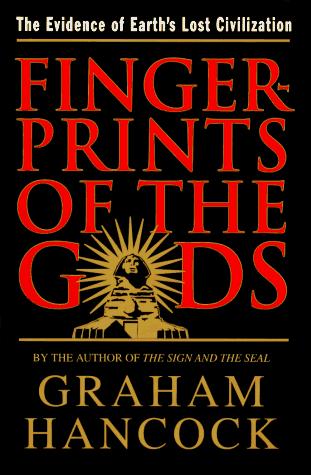
Fingerprints of the Gods
by Graham Hancock
★ Top 25 book of 1995 · #17 on Best Books of 1995
Graham Hancock questions conventional accounts of human beginnings, arguing that ancient structures worldwide may be far older than believed. He wonders how distant civilizations seemingly communicated, and whether a superior race taught them advanced technology.
Best for: Fans of alternative history who enjoy challenging accepted theories about ancient civilizations
Fingerprints of the Gods is #17 on BookWard's Best Books of 1995, out of 28 1995 books that cleared our data bar.
What Fingerprints of the Gods is about
Graham Hancock proposes that history's standard account of the beginning of civilization is missing something large. He claims that during the last ice age an advanced culture lived on Antarctica, before the continent shifted south to its present position, and that survivors carried their knowledge to peoples around the world, giving rise to the earliest known civilizations. He points to ancient structures he says are far older than usually believed, and asks whether early societies were visited by a superior race or taught technology they could not have developed alone.
The book draws heavily on the earlier work of Ignatius L. Donnelly and Charles Hapgood. It is worth knowing that it is described as pseudoarchaeology and promotes a form of hyperdiffusionism, so it is best read as speculative, provocative alternative history rather than settled science. It will appeal to readers who enjoy lost-civilization mysteries and want to see the case made at full length.
Fingerprints of the Gods on the Best Books of 1995
Fingerprints of the Gods came out in 1995. Of the 28 books first published in 1995 that met BookWard's data bar, it ranks #17 on our Best Books of 1995 list.
Why it made the list: 207 readers have shelved it on Open Library. The list ranks each year’s books on how many readers have picked them up, how highly readers rate them, and how many are reading them right now.
Nearby on the 1995 list
- Dreams from My Father Barack Obama, #15
- Lies My Teacher Told Me James W. Loewen, #16
- The Firework-maker's Daughter Philip Pullman, #18
- Longitude Dava Sobel, #19
See all Best Books of 1995 Best books by year
More years: Best Books of 1994 Best Books of 1996.
The numbers behind it
- Readers: 191 want to read it, 6 are reading it now and 10 have read it, according to Open Library.
| Signal | This book (0 to 100) | Weight |
|---|---|---|
| Reach | 32 | 55% |
| Reader love | 79 | 25% |
| Being read right now | 14 | 20% |
Questions about Fingerprints of the Gods
When was Fingerprints of the Gods published?
Fingerprints of the Gods by Graham Hancock was first published in 1995.
Was Fingerprints of the Gods one of the best books of 1995?
Fingerprints of the Gods is #17 on BookWard's Best Books of 1995, out of 28 1995 books that cleared our data bar. 207 readers have shelved it on Open Library.
Why is Fingerprints of the Gods on the Best Books of 1995 list?
207 readers have shelved it on Open Library.
More of the best books of 1995
- The Lost World Michael Crichton, #1
- Emotional Intelligence Daniel Goleman, #2
- Northern Lights Philip Pullman, #3
- Rose Madder Stephen King, #4
- Mindhunter John E. Douglas, #5
- Wicked Gregory Maguire, #6
See the full Best Books of 1995, the Top 100, or new books on Rising.
How we know
This page uses public data: Open Library reader counts and ratings, and Wikipedia page views for recent years. The description is paraphrased from real source text. Rankings reflect reading interest, not quality or sales, and can be affected by data gaps. Lists update monthly.
Suited to curious teens and adults who enjoy big historical questions.
Depends on the edition you pick.
A lost-civilization thesis that is bold, sweeping, and deeply contested. 40% taste match
 BookWard’s take
A lost-civilization thesis that is bold, sweeping, and deeply contested
Fingerprints of the Gods argues that an advanced ice age civilization, which Hancock places in Antarctica, seeded the earliest known cultures around the world. It is a big, idea-led book, and its originality lies in the voice rather than the lineage, since it leans heavily on the earlier work of Ignatius L. Donnelly and Charles Hapgood. The real trouble is rigor. The book is classed as pseudoarchaeology, and its case rests on connecting dots rather than proving them, so the logic is looser than the confident narration suggests. Hancock's voice is strong and opinionated, and the opening pulls you into its questions at once. Read it as a provocative argument to test, not a settled account.
A globe-spanning case built from site after site, this is a long book, which sits against BookWard's love of tight reads.
It moves briskly from site to site, though the accumulation of examples can slow the argument down.
The central thesis draws on earlier writers like Donnelly and Hapgood, so it is a bold repackaging more than a fresh idea.
The prose is clear and readable, aiming at persuasion and wonder over ornament.
As an argument-led nonfiction book, the plot versus character split does not really apply.
It offers a reassuring suggestion that human history is richer and older than we thought, a mildly uplifting note.
A broadly conventional build of claim and evidence, organised by region and monument.
It is earnest and serious, with almost no humor in the telling.
Despite talk of catastrophe and lost worlds, the tone stays wondering rather than grim.
The feeling is fascination and awe more than deep emotional intensity.
See all 50 dialsEvery position, side by side with this book
Where it lines up
- SentimentBookWard 8 · book 7
- Authorial voiceBookWard 9 · book 8
- OpeningBookWard 10 · book 8
Where it pulls apart
- LengthBookWard 1 · book 8
- Internal logicBookWard 10 · book 3
- Familiar tropesBookWard 10 · book 4
A globe-spanning case built from site after site, this is a long book, which sits against BookWard's love of tight reads.
It opens on enormous questions about humanity's origins, which grabs attention quickly, matching BookWard's taste for an immediate pull.
The lost-civilization premise is a well-worn staple of alternative history, so it leans on familiar ground despite its confident framing.
The chain of inference links distant sites and cultures through suggestion, leaving gaps that BookWard, which wants airtight reasoning, will notice.
It moves briskly from site to site, though the accumulation of examples can slow the argument down.
The central thesis draws on earlier writers like Donnelly and Hapgood, so it is a bold repackaging more than a fresh idea.
This is an argument about civilizations, not a book about individual people, so character depth does not apply.
The tone is awestruck about humanity's forgotten past, which leans a little toward romantic wonder over restraint.
The shock is intellectual, in overturning accepted history, and the claims are bigger than the evidence that earns them.
It is classified as pseudoarchaeology and argues by selective connection, which falls well short of BookWard's demand for rigor.
Hancock writes with a confident, personal, unmistakable conviction that makes the book unmistakably his own.
The book is driven almost entirely by its central theory, with the argument itself as the story.
The thesis is laid out directly and at length, with the author explaining his reading of each site outright.
The repeating pattern of site, comparison, and inference can drag in the middle despite the strong premise.
The prose is clear and readable, aiming at persuasion and wonder over ornament.
As an argument-led nonfiction book, the plot versus character split does not really apply.
It offers a reassuring suggestion that human history is richer and older than we thought, a mildly uplifting note.
A broadly conventional build of claim and evidence, organised by region and monument.
It is earnest and serious, with almost no humor in the telling.
The ideas are accessible, but tracking the many sites and claims takes sustained attention.
The book speaks overwhelmingly through Hancock's single argumentative point of view.
It ranges back and forth across deep prehistory and later cultures, shifting across millennia.
Though presented as fact, its claims about vanished advanced civilizations read as speculative and borderline fantastical.
A handful of researchers and theorists appear, but the focus stays on places and cultures rather than a cast.
Its subject is the whole of human prehistory across the planet, which is as epic as nonfiction gets.
It looks outward at monuments, maps, and sites rather than into any inner life.
As an argumentative work of nonfiction, it has essentially no dialogue.
Romance has no place in this subject.
It takes readers to remote and unfamiliar sites around the globe, many of them far from everyday experience.
The subject is ancient and prehistoric, with a 1995 publication date, so it faces firmly toward the past.
Its questions about origins endure, but the argument is tied to its decade's alternative-history wave.
Hancock's confident certainty can shade into overstatement, which makes his account a little hard to take at face value.
The book is more about plausibility than right and wrong, with a mildly ambiguous attitude toward mainstream scholars.
The monuments and landscapes are vividly evoked, which gives the argument some of its pull.
It reads as a guided investigation, a mix of travelogue and case-building rather than a dry analysis.
Hancock inserts himself and his own quest throughout, which keeps the perspective personal.
Hancock later extended the story in Magicians of the Gods, so it leads into a wider body of work.
New claims keep arriving, but they follow a predictable pattern of revelation.
It challenges mainstream history, though it asks you to accept rather than test its claims.
Despite talk of catastrophe and lost worlds, the tone stays wondering rather than grim.
The feeling is fascination and awe more than deep emotional intensity.
There is no meaningful humor, so a humor style does not apply.
Cataclysms are discussed in the abstract, with little violence on the page.
There is no sexual content.
It takes a stance against academic orthodoxy but is not a political book.
The language is plain and general-audience, with occasional technical terms.
Hancock argues his case forcefully and openly, making this a strongly opinionated narration.
It looks to the distant past to rewrite history, not ahead to the future.
There is a quiet idealism in its picture of a wiser, more advanced human past.
Review written by BookWard, dial version 1, November 2026.
Who is Fingerprints of the Gods right for?
Suited to curious teens and adults who enjoy big historical questions. It contains no graphic content, but readers should treat its claims as contested rather than established fact.
The ideas are accessible, but tracking the many sites and claims takes sustained attention.
Despite talk of catastrophe and lost worlds, the tone stays wondering rather than grim.
The feeling is fascination and awe more than deep emotional intensity.
Cataclysms are discussed in the abstract, with little violence on the page.
Book CompanionFingerprints of the Gods: ideas, characters, themes
Hancock argues that an advanced ice age civilization, which he places in Antarctica, passed its knowledge to survivors who seeded the world's earliest cultures.
- The lost civilization claim. The book proposes that a sophisticated society existed during the last ice age, well before accepted history allows.
- Antarctica at the center. Hancock links this civilization to Antarctica, which he says lay in a different position before shifting south.
- Knowledge carried by survivors. He argues that survivors spread their learning around the world and shaped the earliest known civilizations.
- Hyperdiffusionism. The book promotes the idea that culture spread from a single source rather than arising independently in many places.
- Earlier influences. It draws heavily on the work of Ignatius L. Donnelly and Charles Hapgood.
Themes
The idea that the human past is older and richer than mainstream accounts allow.
The book sets itself against accepted archaeological and historical consensus.
The claim that knowledge and culture spread from one source across the world.
The gap between suggestive connections and demonstrated proof.
Discussion questions
- How convincing is it to link distant sites through similarities rather than direct evidence?
- What separates a bold hypothesis from pseudoarchaeology?
- Why do lost-civilization stories hold such lasting appeal?
- How does Hancock's personal, quest-style voice shape how persuasive the book feels?
- What kinds of evidence would you need to accept or reject the central claim?
Personalize your Book Companion
This is the general edition. In BookWard, the Companion is written for you: your reading profile, your notes, and spoiler-safe to the page you are on.
Buy, listen or borrow Fingerprints of the Gods
Each link opens a search for this book on that store, in a new tab.
Read on a device
Borrow
Reviews and community
If you liked Fingerprints of the Gods
A former Pentagon insider's personal case for taking UAP seriously
Confessions of an Economic Hit ManPerkins, JohnA first-person insider tale about loans as a tool of empire
Danse MacabreStephen KingKing on horror: a fan's tour from Hill House to Karloff
Autobiography of a YogiYogananda ParamahansaA sprawling spiritual memoir that opened yoga to the West
Find your own best books
Add what you have read, rate it, and BookWard will recommend what to read next.
Free to start. No credit card needed.