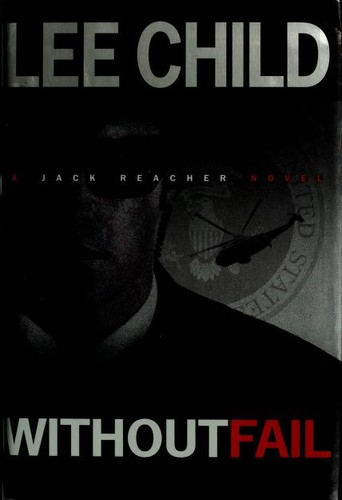
Without Fail
by Lee Child
★ Top 25 book of 2002 · #15 on Best Books of 2002
A Secret Service agent hires the cautious, anonymous Jack Reacher to hunt for weaknesses in her security by plotting the vice president's assassination, at least on paper. A covert group is already planning the real attack, but has not accounted for Reacher.
Best for: Thriller readers who like a sharp, resourceful hero racing against a plot
Without Fail is #15 on BookWard's Best Books of 2002, out of 32 2002 books that cleared our data bar.
What Without Fail is about
Jack Reacher is staying in Atlantic City when Secret Service agent M.E. Froelich finds him. She once dated his late brother Joe, and she has an odd job to offer. Written death threats are arriving about Vice President-elect Brook Armstrong, who knows nothing of them, and she wants Reacher to audit the security around him. His task is to think like an assassin and find the weak spots. He calls in an old military police colleague, Frances Neagley, now a security consultant in Chicago. Then the threats begin to turn real. This sixth Reacher novel, told in the third person, suits readers who like a tough, methodical hero and a plot built on loyalty and protection.
Without Fail on the Best Books of 2002
Without Fail came out in 2002. Of the 32 books first published in 2002 that met BookWard's data bar, it ranks #15 on our Best Books of 2002 list.
Why it made the list: 212 readers have shelved it on Open Library; readers rate it 3.7 out of 5 (12 ratings). The list ranks each year’s books on how many readers have picked them up, how highly readers rate them, and how many are reading them right now.
Nearby on the 2002 list
- Night Watch Terry Pratchett, #13
- Understanding Power Noam Chomsky, #14
- Prey Michael Crichton, #16
- Hoot Carl Hiaasen, #17
See all Best Books of 2002 Best books by year
More years: Best Books of 2001 Best Books of 2003.
The numbers behind it
- Readers: 168 want to read it, 9 are reading it now and 35 have read it, according to Open Library.
- Ratings: 3.7 out of 5 from 12 Open Library ratings.
| Signal | This book (0 to 100) | Weight |
|---|---|---|
| Reach | 53 | 55% |
| Reader love | 28 | 25% |
| Being read right now | 50 | 20% |
Questions about Without Fail
When was Without Fail published?
Without Fail by Lee Child was first published in 2002.
Was Without Fail one of the best books of 2002?
Without Fail is #15 on BookWard's Best Books of 2002, out of 32 2002 books that cleared our data bar. 212 readers have shelved it on Open Library; readers rate it 3.7 out of 5 (12 ratings).
Why is Without Fail on the Best Books of 2002 list?
212 readers have shelved it on Open Library; readers rate it 3.7 out of 5 (12 ratings).
More of the best books of 2002
- Romancing Mister Bridgerton Julia Quinn, #1
- Coraline Neil Gaiman, #2
- Why Does He Do That? Lundy Bancroft, #3
- Room on the Broom Julia Donaldson, #4
- Stories of Your Life and Others Ted Chiang, #5
- Everything's Eventual. 14 Dark Tales Stephen King, #6
See the full Best Books of 2002, the Top 100, or new books on Rising.
How we know
This page uses public data: Open Library reader counts and ratings, and Wikipedia page views for recent years. The description is paraphrased from real source text. Rankings reflect reading interest, not quality or sales, and can be affected by data gaps. Lists update monthly.
Suited to adult and older teen readers who enjoy thrillers.
Depends on the edition you pick.
Reacher audits the Secret Service, then the threats turn real. 55% taste match
 BookWard’s take
Reacher audits the Secret Service, then the threats turn real
Without Fail opens with a neat inversion: Jack Reacher is hired to find the holes in the protection around the Vice President-elect, and then discovers someone else is probing the same holes. It is the sixth Reacher novel, and it grabs you at once with that audit premise, then keeps a brisk, sustained pace. The real pleasure is how the plot holds together, because Reacher's method is to think like the attacker, so close attention to detail pays off. The prose is plain and clipped, though the exposition leans toward explanation, which can feel heavier than it needs to. It is more story-led than idea-led, and while this is part of a series, it works fine as a standalone thriller.
Short chapters and a ticking threat keep things moving, close to BookWard's preferred speed.
The hired-to-find-the-weaknesses premise is a smart twist, but the shape is a recognizable genre thriller; short of BookWard's appetite for the original.
Spare, short sentences with little ornament; plainer than BookWard's middle ground, though that economy suits the genre.
Events and the unfolding threat drive everything, so it is more plot-led than BookWard's character-leaning taste.
A grim threat is met with competence and a degree of justice; neither bleak nor especially uplifting.
A straightforward forward-moving thriller, plainer in form than BookWard's mild tolerance for experiment.
Mostly serious, with the occasional dry aside from Reacher; more sober than BookWard's lean toward wit.
Assassination plots and killings give it a real edge, a touch darker than BookWard's midpoint.
Feeling stays controlled and understated, a little cooler than BookWard's middle.
See all 50 dialsEvery position, side by side with this book
Where it lines up
- PaceBookWard 8 · book 8
- EndingBookWard 8 · book 8
- OpeningBookWard 10 · book 9
Where it pulls apart
- Familiar tropesBookWard 10 · book 4
- LengthBookWard 1 · book 5
- OriginalityBookWard 9 · book 5
The security-audit setup puts Reacher inside the problem almost immediately, which matches BookWard's love of an instant hook.
Bodyguards, threats and a lone ex-soldier are familiar thriller territory, though the audit angle freshens them; this is less clear of trope than BookWard likes.
Reacher's whole approach is reasoning like the attacker, so the plot is built on cause and effect, which BookWard prizes.
Short chapters and a ticking threat keep things moving, close to BookWard's preferred speed.
The hired-to-find-the-weaknesses premise is a smart twist, but the shape is a recognizable genre thriller; short of BookWard's appetite for the original.
Characters serve the plot and are defined by competence and a few traits, lighter than the depth BookWard favors.
Feeling is kept understated and tough-minded, so it sits close to BookWard's restraint.
Violence is part of the threat and is used to raise stakes rather than for cheap effect, roughly acceptable to BookWard.
This is a novel, so the nonfiction rigor dial does not apply.
Child's clipped, confident, procedural narration is recognizable at once, matching BookWard's wish for a distinctive voice.
This is firmly story-led, driven by who is threatening whom, which matches BookWard's preference for story over ideas.
Reacher often reasons things out and explains them to others, so exposition runs higher than BookWard's show-in-scene preference.
The threat keeps tightening from start to finish, which fits BookWard's wish for a sustained middle.
Spare, short sentences with little ornament; plainer than BookWard's middle ground, though that economy suits the genre.
Events and the unfolding threat drive everything, so it is more plot-led than BookWard's character-leaning taste.
A grim threat is met with competence and a degree of justice; neither bleak nor especially uplifting.
A straightforward forward-moving thriller, plainer in form than BookWard's mild tolerance for experiment.
Mostly serious, with the occasional dry aside from Reacher; more sober than BookWard's lean toward wit.
Quick, clear and easy to follow, a lighter read than BookWard's slightly demanding middle.
Centered on Reacher with a few other perspectives around the threat; fewer than BookWard's liking for many views.
Told in a clear forward sequence, matching nothing in BookWard's taste for shifting time.
Entirely grounded in a realistic security world, below BookWard's mild openness to the fantastical.
A working-sized ensemble of agents and allies, close to BookWard's modest cast preference.
A protection operation with national stakes but a tight, local focus on a few people and places.
Outward action and procedure dominate over reflection, well past BookWard's balance toward inner life.
Plenty of terse back-and-forth carries the investigation, in line with BookWard's taste for dialogue.
A relationship between Reacher and an agent is present but secondary to the threat.
The Secret Service and security world is somewhat specialized but never hard to follow, a bit less unfamiliar than BookWard likes.
Set in the early 2000s, recent enough to feel contemporary, close to BookWard's lean toward the present day.
A well-made genre thriller that still reads cleanly, though tied somewhat to its setting.
Third-person narration is plain and trustworthy, far from BookWard's taste for the unreliable.
Right and wrong are fairly clear, with Reacher on the side of protection; less ambiguous than BookWard prefers.
Description is kept lean and functional, serving the action, below BookWard's mid-range.
This is fiction, so the nonfiction style dial does not apply.
This is fiction, so the nonfiction perspective dial does not apply.
The sixth Reacher novel, though it is written to stand on its own for newcomers.
The identity of the threat and how it unfolds supply real surprises, close to BookWard's liking for them.
A fast, absorbing entertainment that asks little of the reader beyond attention, more comforting than BookWard's taste.
Assassination plots and killings give it a real edge, a touch darker than BookWard's midpoint.
Feeling stays controlled and understated, a little cooler than BookWard's middle.
Humor, when it appears, is dry and understated rather than broad.
Killings and an assassination attempt put real violence on the page, somewhat above BookWard's midpoint.
A relationship is handled briefly and without much focus, below BookWard's midpoint.
The setting involves a Vice President-elect but the book is about protection, not policy; politics stays in the background.
Plain, direct language throughout makes this easy going, far from dense or dialect-heavy.
The narration tracks Reacher's confident view of things, with some attitude, close to BookWard's opinionated lean.
A present-tense security problem more than a vision of the future, so it looks back more than forward.
Reacher is a pragmatic, somewhat hardened figure, sitting on the cynical side of BookWard's idealism.
Review written by BookWard, dial version 1, November 2026.
Who is Without Fail right for?
Suited to adult and older teen readers who enjoy thrillers. It contains violence including killings and an assassination attempt, along with some mature relationship content.
Quick, clear and easy to follow, a lighter read than BookWard's slightly demanding middle.
Assassination plots and killings give it a real edge, a touch darker than BookWard's midpoint.
Feeling stays controlled and understated, a little cooler than BookWard's middle.
Killings and an assassination attempt put real violence on the page, somewhat above BookWard's midpoint.
Book CompanionWithout Fail: ideas, characters, themes
A former military cop hired to expose weaknesses in presidential protection finds a real killer exploiting the same gaps.
- The audit premise. Reacher is brought in by the Secret Service to test the protection around the Vice President-elect, so the book begins by treating security as a puzzle to be solved.
- A hidden threat. Death threats are already arriving, though the Vice President-elect himself does not know about them, which raises the pressure on the small team.
- Assembling a team. Reacher brings in his old colleague Frances Neagley, giving the investigation a second sharp mind and a shared history.
- Warning killings. Men resembling the target and sharing his name are killed as a message, showing the opponents are patient and organized.
- Cooperating agencies. The Secret Service and the FBI both become involved, and suspicion over who can be trusted shapes how the investigation moves.
Characters
Jack Reacher
Protagonist
A retired military police officer who thinks like an attacker and is hired to find the holes in the protection.
M.E. Froelich
Secret Service agent
The agent who recruits Reacher and who once dated his late brother Joe.
Frances Neagley
Reacher's ally
A former military police colleague, now a Chicago security consultant, brought in to help with the audit.
Brook Armstrong
Vice President-elect
The man being protected, unaware of the threats directed at him.
Stuyvesant
Froelich's supervisor
The Secret Service supervisor who agrees to bring in Reacher and Neagley.
Themes
Even well-guarded targets have gaps that a careful mind can find.
Working inside institutions means not knowing who is truly on your side.
The book prizes skill, preparation and clear thinking under pressure.
Several characters put themselves between others and danger.
Reacher's link to Froelich runs through his late brother, giving the story a quiet personal thread.
Discussion questions
- Why does thinking like an attacker make Reacher good at defense?
- How does the idea of an audit change the usual shape of a thriller?
- What does the book suggest about trusting institutions versus individuals?
- How does Neagley's presence change how Reacher works?
- Does the story work as a standalone, or is it better with series context?
Personalize your Book Companion
This is the general edition. In BookWard, the Companion is written for you: your reading profile, your notes, and spoiler-safe to the page you are on.
Buy, listen or borrow Without Fail
Each link opens a search for this book on that store, in a new tab.
Read on a device
Borrow
Reviews and community
If you liked Without Fail
A fast Reacher thriller built around a killer who leaves nothing behind
Echo BurningLee ChildA hitchhiking drifter, a Texas ranch, and a family worth fearing
In Too DeepLee ChildReacher wakes shackled and starts dismantling his captors' plan
Along Came a SpiderJames PattersonA fast, familiar kidnapping thriller that launched the Alex Cross series
Find your own best books
Add what you have read, rate it, and BookWard will recommend what to read next.
Free to start. No credit card needed.