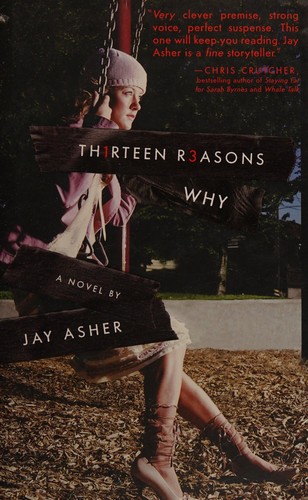
Thirteen Reasons Why
by Jay Asher
★ Top 25 book of 2007 · #13 on Best Books of 2007
Clay Jenkins finds a box of cassette tapes left by Hannah Baker, a classmate and crush who died by suicide two weeks earlier. Her recordings name thirteen reasons for her choice, and Clay is on the list.
Best for: Teen readers who want a heartfelt story told through two alternating voices
Thirteen Reasons Why is #13 on BookWard's Best Books of 2007, out of 53 2007 books that cleared our data bar.
What Thirteen Reasons Why is about
Clay Jensen comes home to find a mysterious package in the mail. Inside are seven double-sided cassette tapes, recorded by Hannah Baker, a classmate and his crush, who has recently killed herself. On them she names thirteen people and events she blames for her death, and she has arranged for the tapes to be passed from one person to the next. Clay is the ninth to receive them.
The story alternates between Hannah's recorded voice and Clay's own point of view as he listens, knowing that he is somewhere on the list himself. Along the way he begins to worry that another classmate, Skye Miller, may be struggling too. Jay Asher's 2007 young adult novel draws on his own experience of a close relative's suicide attempt. It is somber, suspenseful and emotional, about how actions affect others, guilt and responsibility, and the importance of reaching out. It deals directly with suicide, so readers should be ready for that.
Thirteen Reasons Why on the Best Books of 2007
Thirteen Reasons Why came out in 2007. Of the 53 books first published in 2007 that met BookWard's data bar, it ranks #13 on our Best Books of 2007 list.
Why it made the list: 1,237 readers have shelved it on Open Library; readers rate it 3.7 out of 5 (88 ratings); 66 are reading it right now. The list ranks each year’s books on how many readers have picked them up, how highly readers rate them, and how many are reading them right now.
Nearby on the 2007 list
- There Is a Bird on Your Head! Mo Willems, #11
- City of Bones Cassandra Clare, #12
- Eclipse Stephenie Meyer, #14
- Burned Ellen Hopkins, #15
See all Best Books of 2007 Best books by year
More years: Best Books of 2006 Best Books of 2008.
The numbers behind it
- Readers: 1,018 want to read it, 66 are reading it now and 153 have read it, according to Open Library.
- Ratings: 3.7 out of 5 from 88 Open Library ratings.
| Signal | This book (0 to 100) | Weight |
|---|---|---|
| Reach | 87 | 55% |
| Reader love | 17 | 25% |
| Being read right now | 87 | 20% |
Questions about Thirteen Reasons Why
When was Thirteen Reasons Why published?
Thirteen Reasons Why by Jay Asher was first published in 2007.
Was Thirteen Reasons Why one of the best books of 2007?
Thirteen Reasons Why is #13 on BookWard's Best Books of 2007, out of 53 2007 books that cleared our data bar. 1,237 readers have shelved it on Open Library; readers rate it 3.7 out of 5 (88 ratings); 66 are reading it right now.
Why is Thirteen Reasons Why on the Best Books of 2007 list?
1,237 readers have shelved it on Open Library; readers rate it 3.7 out of 5 (88 ratings); 66 are reading it right now.
More of the best books of 2007
- Dog Days Jeff Kinney, #1
- A Thousand Splendid Suns Khaled Hosseini, #2
- Harry Potter and the Deathly Hallows J. K. Rowling, #3
- The Titan's Curse Rick Riordan, #4
- The Name of the Wind Patrick Rothfuss, #5
- Rodrick Rules Jeff Kinney, #6
See the full Best Books of 2007, the Top 100, or new books on Rising.
How we know
This page uses public data: Open Library reader counts and ratings, and Wikipedia page views for recent years. The description is paraphrased from real source text. Rankings reflect reading interest, not quality or sales, and can be affected by data gaps. Lists update monthly.
It suits older teens and adults who can engage with a serious subject.
Depends on the edition you pick.
A cassette-tape mystery that hooks fast and carries real weight. 52% taste match
 BookWard’s take
A cassette-tape mystery that hooks fast and carries real weight
Thirteen Reasons Why opens with a package on a doorstep and a dead classmate's voice on cassette, and the hook lands almost at once. The dual structure, Hannah on tape and Clay listening, keeps the pace brisk and the middle from sagging, since each tape hands you a new person to look at. It is clearly driven by character rather than plot, and the split between two viewpoints gives it a distinctive shape. The prose is plain, and the exposition leans on explaining, with Hannah narrating her own account, which runs against a preference for scenes that show rather than tell. It is also a dark, challenging read. Its subject has made it one of the most banned books in the US, and it deserves a careful, informed reader.
A compact young adult novel built around thirteen tape sides, so it moves quickly without sprawl, which suits BookWard's preference for tight books.
Each tape side reveals a new person and event, which keeps the story moving at a steady clip in line with BookWard's taste.
The cassette-tape framing is a memorable device, even if the subject and setting are well-trodden young adult territory.
The writing is plain and accessible, a good fit for its young readership and a bit simpler than BookWard's middle ground.
The drive comes from Hannah's inner life and Clay's response to it, which sits comfortably with BookWard's character-led taste.
The subject is bleak, with only a small note of hope at the close as Clay reaches toward another struggling classmate.
Alternating Hannah's tapes with Clay's listening is an inventive frame that goes beyond a conventional straight telling.
This is a heavy, serious book with little room for humor.
Built around a young person's death by suicide and the events that led to it, this is dark material.
The tapes and Clay's reactions are built to hit hard emotionally.
See all 50 dialsEvery position, side by side with this book
Where it lines up
- PaceBookWard 8 · book 8
- Sagging middleBookWard 8 · book 8
- OpeningBookWard 10 · book 9
Where it pulls apart
- Familiar tropesBookWard 10 · book 5
- Internal logicBookWard 10 · book 6
- Shock for effectBookWard 9 · book 4
A compact young adult novel built around thirteen tape sides, so it moves quickly without sprawl, which suits BookWard's preference for tight books.
A mysterious box, seven cassettes and a dead classmate's voice put the central question in front of you immediately, matching BookWard's love of a fast start.
The teen high school setting and confessional frame are familiar, though the tape device gives it a recognizable hook rather than fresh ground.
The tapes and their chain of recipients give the story a clear internal mechanism, though the premise asks you to accept some contrivance.
Each tape side reveals a new person and event, which keeps the story moving at a steady clip in line with BookWard's taste.
The cassette-tape framing is a memorable device, even if the subject and setting are well-trodden young adult territory.
Hannah and Clay carry the story through two voices, though other classmates are drawn mainly through their role in Hannah's account.
The book closes with Clay reaching out to Skye, a resolved emotional beat rather than a fully tied-off plot.
It aims at raw feeling and heartbreak, leaning more toward emotional appeal than the restraint BookWard prefers.
The darkness is tied directly to its subject and purpose, though some of its choices have drawn debate.
This is a novel, so the rigor dial does not apply.
Hannah's recorded narration gives the book a clear, intimate voice, though it stays within a familiar young adult register.
Story comes first, driven by the tapes and Clay's reactions, with the ideas about cruelty and responsibility carried through events.
Hannah explains her reasons directly on tape, so much of the backstory is told outright, which cuts against BookWard's preference for scene.
The tape-by-tape structure keeps adding new people and events, so the middle holds its momentum, as BookWard likes.
The writing is plain and accessible, a good fit for its young readership and a bit simpler than BookWard's middle ground.
The drive comes from Hannah's inner life and Clay's response to it, which sits comfortably with BookWard's character-led taste.
The subject is bleak, with only a small note of hope at the close as Clay reaches toward another struggling classmate.
Alternating Hannah's tapes with Clay's listening is an inventive frame that goes beyond a conventional straight telling.
This is a heavy, serious book with little room for humor.
Easy to read in style, though the subject matter asks for emotional care.
The story moves between two voices, Hannah's tapes and Clay's perspective, which is fewer than BookWard's taste for many.
Hannah's past events on the tapes interleave with Clay's present, so time shifts more than BookWard's slight lean toward linear.
Entirely grounded in an ordinary high school world with no fantastical elements.
A modest circle of classmates, each tied to one tape side, keeps the cast contained.
The story is close and personal, centered on one town's school community.
Most of the weight sits in Hannah's recollections and Clay's reactions rather than outward action.
Hannah's recorded speech and Clay's reactions carry a fair share of the book, though it is not dialogue-heavy.
A lingering crush between Clay and Hannah sits in the background, important but not the main engine.
A familiar American high school setting that most readers will recognize.
Set in a recognizable contemporary world, with cassette tapes as the one dated touch.
Its themes endure, though the cassette device gives it a particular period feel.
Hannah tells her own story on tape and Clay listens, with no strong sense that either is deceiving us.
The book wants you to weigh cause and responsibility, and it leaves real room to argue over blame.
The prose stays spare, favoring voice and event over scenery.
This is a novel, so the nonfiction style dial does not apply.
This is a novel, so the perspective dial does not apply.
A standalone novel with a self-contained story.
Each tape adds a reveal about who contributed and how, though the overall shape is clear from the premise.
It confronts suicide and its causes directly, which makes it a challenging rather than comforting read.
Built around a young person's death by suicide and the events that led to it, this is dark material.
The tapes and Clay's reactions are built to hit hard emotionally.
Humor is largely absent, so there is little to place on a dry or broad scale.
The book deals with serious harm, though much of it is conveyed through account rather than constant onscreen action.
Some of the events Hannah describes involve sexual pressure and harm, handled through recounting.
The focus is on personal and social behavior rather than politics.
The language is plain and easy to follow.
Hannah's tapes are openly accusatory, assigning blame and telling listeners what she thinks.
The story looks backward, reconstructing what led to Hannah's death.
The mood is largely cynical about cruelty, with a small turn toward connection at the end.
Review written by BookWard, dial version 1, November 2026.
Who is Thirteen Reasons Why right for?
It suits older teens and adults who can engage with a serious subject. It centers on suicide and includes depictions of sexual assault and bullying, so readers may want to approach it with care and support.
Easy to read in style, though the subject matter asks for emotional care.
Built around a young person's death by suicide and the events that led to it, this is dark material.
The tapes and Clay's reactions are built to hit hard emotionally.
The book deals with serious harm, though much of it is conveyed through account rather than constant onscreen action.
Book CompanionThirteen Reasons Why: ideas, characters, themes
A teenager receives cassette tapes from a classmate who died by suicide, each side naming a person she holds responsible.
- The mysterious box. Clay Jensen finds a package of seven cassette tapes recorded by Hannah Baker, who recently died by suicide.
- Thirteen sides, thirteen people. Each side of the tapes is devoted to a person Hannah attributes a reason for her death to.
- The chain of tapes. Listeners are told to visit each person mentioned and pass the tapes to the next recipient.
- Two voices. The story alternates between Hannah's recorded account and Clay's reactions as he listens.
- Reaching out. The novel ends with Clay reaching out to Skye Miller, a classmate he suspects is also struggling.
Characters
Clay Jensen
Listener and narrator
The classmate who receives the tapes and follows Hannah's account while grappling with his own place in it.
Hannah Baker
Voice on the tapes
A high school sophomore who died by suicide and left recordings explaining her reasons.
Skye Miller
Classmate
A student Clay suspects may be suicidal, whom he reaches out to at the end.
Themes
How much our actions, large or small, shape what others go through.
The book treats a young person's death and the pain behind it as its central subject.
Small acts of unkindness can add up and affect someone deeply.
The cost of not noticing or not reaching out, and the value of doing so.
How those left behind cope with what they did or failed to do.
Discussion questions
- Hannah assigns blame to thirteen people. How fair is it to hold others responsible in this way?
- How does hearing the story through both Hannah and Clay change what you understand?
- What does the tape format add that a written diary might not?
- Why do you think Clay reaches out to Skye at the end, and what does it suggest?
- What are the strengths and risks of telling this story in a young adult novel?
Personalize your Book Companion
This is the general edition. In BookWard, the Companion is written for you: your reading profile, your notes, and spoiler-safe to the page you are on.
Buy, listen or borrow Thirteen Reasons Why
Each link opens a search for this book on that store, in a new tab.
Read on a device
Borrow
Reviews and community
If you liked Thirteen Reasons Why
A former child star reclaims her story, on her terms
Nineteen MinutesJodi PicoultA school shooting told through the town left behind
Then She Was GoneLisa JewellA missing-girl mystery that hooks fast and grips to the end
The House of My MotherShari FrankeA daughter's memoir of the family behind 8 Passengers
Find your own best books
Add what you have read, rate it, and BookWard will recommend what to read next.
Free to start. No credit card needed.