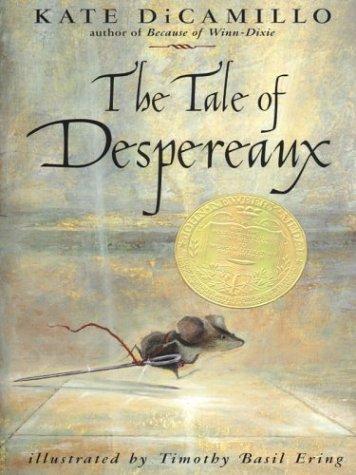
The Tale of Despereaux
by Kate DiCamillo
★ Top 10 book of 2003 · #8 on Best Books of 2003
The adventures of Despereaux Tilling, a small mouse of unusual talents, the princess he loves, a servant girl who longs to be a princess, and a devious rat determined to bring them all to ruin.
Best for: Children who like fairy-tale adventures with unlikely heroes.
The Tale of Despereaux is #8 on BookWard's Best Books of 2003, out of 52 2003 books that cleared our data bar.
What The Tale of Despereaux is about
Despereaux Tilling is a very small, sickly mouse who was born with his eyes open and would rather read than do almost anything else. When he speaks to Princess Pea, which mice are strictly forbidden to do, the mouse council sends him down to the dungeon. His rescue there comes from an unexpected place: a jailer who is won over by a nice story.
The tale then widens to follow others in the castle. There is Roscuro, a rat who loves the light and carries a grudge after a disaster involving the queen's soup, and Mig, a servant girl who longs to be a princess. Their wants and wounds begin to cross paths with the mouse's.
The Tale of Despereaux on the Best Books of 2003
The Tale of Despereaux came out in 2003. Of the 52 books first published in 2003 that met BookWard's data bar, it ranks #8 on our Best Books of 2003 list.
Why it made the list: 554 readers have shelved it on Open Library; readers rate it 4.1 out of 5 (54 ratings); 33 are reading it right now. The list ranks each year’s books on how many readers have picked them up, how highly readers rate them, and how many are reading them right now.
Nearby on the 2003 list
- The Da Vinci Code Dan Brown, #6
- The Curious Incident of the Dog in the Night-Time Mark Haddon, #7
- The Time Traveler's Wife Audrey Niffenegger, #9
- How to Train Your Dragon Cressida Cowell, #10
See all Best Books of 2003 Best books by year
More years: Best Books of 2002 Best Books of 2004.
The numbers behind it
- Readers: 436 want to read it, 33 are reading it now and 85 have read it, according to Open Library.
- Ratings: 4.1 out of 5 from 54 Open Library ratings.
| Signal | This book (0 to 100) | Weight |
|---|---|---|
| Reach | 83 | 55% |
| Reader love | 54 | 25% |
| Being read right now | 79 | 20% |
Questions about The Tale of Despereaux
When was The Tale of Despereaux published?
The Tale of Despereaux by Kate DiCamillo was first published in 2003.
Was The Tale of Despereaux one of the best books of 2003?
The Tale of Despereaux is #8 on BookWard's Best Books of 2003, out of 52 2003 books that cleared our data bar. 554 readers have shelved it on Open Library; readers rate it 4.1 out of 5 (54 ratings); 33 are reading it right now.
Why is The Tale of Despereaux on the Best Books of 2003 list?
554 readers have shelved it on Open Library; readers rate it 4.1 out of 5 (54 ratings); 33 are reading it right now.
More of the best books of 2003
- Harry Potter and the Order of the Phoenix J. K. Rowling, #1
- Into the Wild Erin Hunter, #2
- The Kite Runner Khaled Hosseini, #3
- Don't Let the Pigeon Drive the Bus! Mo Willems, #4
- A Short History of Nearly Everything Bill Bryson, #5
- The Da Vinci Code Dan Brown, #6
See the full Best Books of 2003, the Top 100, or new books on Rising.
How we know
This page uses public data: Open Library reader counts and ratings, and Wikipedia page views for recent years. The description is paraphrased from real source text. Rankings reflect reading interest, not quality or sales, and can be affected by data gaps. Lists update monthly.
Suits readers around eight to twelve, and works well read aloud to younger children.
Depends on the edition you pick.
A mouse, a rat, a princess, and a narrator who talks to you. 65% taste match
 BookWard’s take
A mouse, a rat, a princess, and a narrator who talks to you
DiCamillo's Newbery winner is a short fairy tale that hooks at once: a mouse born with his eyes open, a taste for books, and a forbidden love of music. It runs in four parts, and the second goes back to tell the rat Roscuro's side, which keeps the middle sustained instead of sagging. The narrator speaks straight to the reader, and that voice is the book's signature. It trades on the knight-and-princess shape but bends it, so the familiar tropes get questioned rather than leaned on. The darkness is real, with a dungeon, a death and a grudge, and it is earned rather than staged for shock. Quick to read, tidy at the close, and warm without going soft.
A short children's novel in brisk chapters, which fits BookWard's love of tight books.
Short chapters keep things moving, though the narrator's asides slow it a touch compared with BookWard's fast pace.
A reading mouse, a light-loving rat and a chatty narrator feel fresh, if not wholly new.
The language is clear and musical but plain enough for young readers, near BookWard's middle ground.
The quest drives events, but the characters' longings matter as much, so it leans plot more than BookWard does.
Light wins out and forgiveness matters, so it is more hopeful than BookWard's slightly guarded outlook.
Four books with a prequel strand give it more shape than a plain straight line, close to BookWard's middle.
Gentle wit in the narrator's asides, though the story itself stays fairly earnest, so it is less funny than BookWard likes.
A dungeon, a death and a vow of revenge give it real shadow without turning grim.
It carries real feeling about love, loss and forgiveness, near BookWard's level.
See all 50 dialsEvery position, side by side with this book
Where it lines up
- Authorial voiceBookWard 9 · book 9
- Story or ideasBookWard 3 · book 3
- Sagging middleBookWard 8 · book 8
Where it pulls apart
- Familiar tropesBookWard 10 · book 6
- Internal logicBookWard 10 · book 7
- OpeningBookWard 10 · book 8
A short children's novel in brisk chapters, which fits BookWard's love of tight books.
A mouse born with his eyes open sets the strangeness going on page one, close to how BookWard likes to begin.
It borrows the knight-and-princess frame but plays with it, so it sits in the middle, less fresh than BookWard prefers.
Its fairy-tale world follows consistent rules, with consequences that trace back to earlier choices, though it is looser than BookWard's airtight ideal.
Short chapters keep things moving, though the narrator's asides slow it a touch compared with BookWard's fast pace.
A reading mouse, a light-loving rat and a chatty narrator feel fresh, if not wholly new.
Despereaux and Roscuro are drawn with real inner wants, though some figures are closer to fable types than BookWard's deeply drawn ideal.
The threads are gathered and resolved in a satisfying close, in line with BookWard's taste.
It is openly tender and sometimes sweet, so it sits more sentimental than BookWard's restrained taste.
The dark turns serve the story and are not there for effect, which BookWard values.
This is a novel, so the nonfiction dial does not apply.
The narrator's direct address to the reader gives it a voice that could not be mistaken for another book's.
It is led by story and quest, much like BookWard's own preference.
The narrator often stops to explain and comment outright, so it is more explained than BookWard likes.
Shifting to the rat's story in the second part keeps energy up through the middle, as BookWard wants.
The language is clear and musical but plain enough for young readers, near BookWard's middle ground.
The quest drives events, but the characters' longings matter as much, so it leans plot more than BookWard does.
Light wins out and forgiveness matters, so it is more hopeful than BookWard's slightly guarded outlook.
Four books with a prequel strand give it more shape than a plain straight line, close to BookWard's middle.
Gentle wit in the narrator's asides, though the story itself stays fairly earnest, so it is less funny than BookWard likes.
Easy to read for its audience, a little easier than BookWard's mildly demanding taste.
It moves between a mouse, a rat, a servant girl and others, matching BookWard's many-voiced taste.
A prequel section steps back in time before rejoining the main thread, so time shifts a bit.
Talking mice and rats in a castle make a clear fairy-tale fantasy, more fantastical than BookWard's middle.
A handful of central figures with a few more around them, a little larger than a tiny cast.
Despite the castle and kingdom, the stakes feel personal and small, so it sits intimate.
Quest and longing share the stage fairly evenly.
Scenes mix talk and narration, with the narrator doing much of the telling, so it is lighter on dialogue than BookWard's taste.
Despereaux's devotion to the princess drives his quest, but it is a courtly, minor thread overall.
A made-up kingdom of castles, dungeons and rodent societies is unfamiliar ground.
Set in an invented, long-ago fairy-tale world, far from the present day.
Its fable shape and Newbery recognition suggest it will keep being read.
The narrator is open about being a storyteller and is easy to trust.
Right and wrong are mostly clear, though Roscuro's longing for light adds some nuance.
Castle and dungeon scenes are drawn with some color but the focus stays on events.
This is fiction, so the nonfiction style dial does not apply.
This is fiction, so the nonfiction perspective dial does not apply.
A standalone novel with no sequels needed to finish it.
A few turns arrive as the threads converge, but it is not built around surprises.
Mostly warm and reassuring for young readers, so it sits on the comforting side.
A dungeon, a death and a vow of revenge give it real shadow without turning grim.
It carries real feeling about love, loss and forgiveness, near BookWard's level.
The humor is wry and dry, delivered through the narrator's asides.
There is menace and some peril, but little is shown graphically.
Nothing sexual appears, as befits a children's book.
There are laws and bans, but no political argument drives the story.
The language is plain and clear, easily followed by young readers.
The narrator comments, scolds and addresses the reader constantly, making it highly opinionated.
The story looks back toward old fairy-tale patterns, though its hope points forward.
It believes in light, forgiveness and courage, which makes it a strongly idealistic book.
Review written by BookWard, dial version 1, November 2026.
Who is The Tale of Despereaux right for?
Suits readers around eight to twelve, and works well read aloud to younger children. It contains a dungeon, a death and some scenes of peril that sensitive readers may want to be ready for.
Easy to read for its audience, a little easier than BookWard's mildly demanding taste.
A dungeon, a death and a vow of revenge give it real shadow without turning grim.
It carries real feeling about love, loss and forgiveness, near BookWard's level.
There is menace and some peril, but little is shown graphically.
Book CompanionThe Tale of Despereaux: ideas, characters, themes
Even the smallest and most unlikely creature can choose light, courage and forgiveness over fear, and stories help us do it.
- A mouse who reads. Despereaux is born with his eyes open and loves books, especially a tale of a knight saving a princess.
- Music and the forbidden. He follows music to the king and princess and speaks to her, breaking a rule that mice must not address humans.
- Sent to the dungeon. The mouse council condemns him to the dungeon, where he meets the jailer Gregory.
- The rat's story. A second part tells of Roscuro, a rat who loves light and whose fall into the queen's soup sets off a vow of revenge.
- A narrator who addresses you. The storyteller speaks straight to the reader throughout, shaping how each part is framed.
Characters
Despereaux Tilling
A small mouse who loves books and music
Born with his eyes open, he breaks the rules of mouse life out of devotion and curiosity.
Roscuro (Chiaroscuro)
A rat drawn to the light
His longing for light and his grudge against the princess make him the story's shadow-side hero.
Princess Pea
The human princess Despereaux admires
She is the object of his devotion and a target of Roscuro's revenge.
Gregory
The dungeon jailer
He spares Despereaux after hearing a story.
Mig Sow
A young servant girl
Her own history with loss and longing is told in an earlier thread of the book.
Themes
Characters are drawn toward goodness or revenge, and the choice shapes who they become.
Hurt can be answered with grudges or with mercy, and the book weighs both.
Being small does not stop anyone from acting bravely.
Tales comfort, inspire and sometimes save people.
Following love or conscience can mean defying what everyone expects.
Discussion questions
- Why does the narrator speak directly to the reader, and how does it change the story?
- Is Roscuro a villain, or someone who has been wronged?
- What does the book say about rules that keep different kinds of creatures apart?
- How does Gregory's reaction to Despereaux's story show the power of storytelling?
- Do light and dark feel like opposites in this book, or are they connected?
Personalize your Book Companion
This is the general edition. In BookWard, the Companion is written for you: your reading profile, your notes, and spoiler-safe to the page you are on.
Buy, listen or borrow The Tale of Despereaux
Each link opens a search for this book on that store, in a new tab.
Read on a device
Borrow
Reviews and community
If you liked The Tale of Despereaux
A boy raised by ghosts, with a murderer still looking
StardustNeil GaimanA modern fairy tale with an old, wry heart
The Princess BrideWilliam GoldmanA fairy tale that winks at you and still lands
Ella EnchantedGail Carson LevineA Cinderella retelling where obedience is the curse, and Ella fights back
Find your own best books
Add what you have read, rate it, and BookWard will recommend what to read next.
Free to start. No credit card needed.