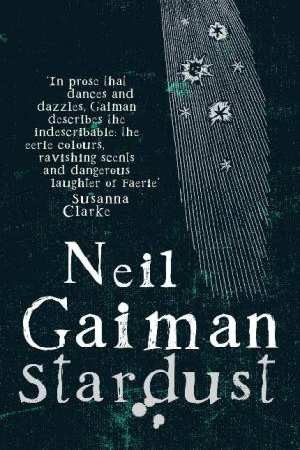
Stardust
by Neil Gaiman
★ Top 25 book of 1999 · #12 on Best Books of 1999
In the English hamlet of Wall, young Tristran Thorn, smitten with the beautiful Victoria Forester, makes an impulsive promise to her. His vow sends him through the gap in the village's wall and into a thrilling adventure.
Best for: Readers who like fairy-tale style fantasy adventures driven by young love
Stardust is #12 on BookWard's Best Books of 1999, out of 52 1999 books that cleared our data bar.
What Stardust is about
In the English village of Wall, a high stone barrier divides the ordinary world from the realm of Faerie, and every nine years a market springs up on the far side. Young Tristran Thorn is the son of Dunstan Thorn and Una, a fairy, though he doesn't know it. To win the hand of the proud Victoria Forester, he promises to fetch her a fallen star.
The star turns out to be a young woman named Yvaine, and Tristran is not the only one chasing her. A trio of ancient witches want her heart to win back their youth, and the sons of a dying lord are searching for his pendant too. Written in the style of older English fantasy, with a wry, romantic touch, this is a fairy tale for adults and curious older readers, often found with Charles Vess's illustrations.
Stardust on the Best Books of 1999
Stardust came out in 1999. Of the 52 books first published in 1999 that met BookWard's data bar, it ranks #12 on our Best Books of 1999 list.
Why it made the list: 587 readers have shelved it on Open Library; readers rate it 3.9 out of 5 (86 ratings). The list ranks each year’s books on how many readers have picked them up, how highly readers rate them, and how many are reading them right now.
Nearby on the 1999 list
- The Pragmatic Programmer Andy Hunt, #10
- A Walk to Remember Nicholas Sparks, #11
- Artemis Fowl Eoin Colfer, #13
- The Code Book Simon Singh, #14
See all Best Books of 1999 Best books by year
More years: Best Books of 1998 Best Books of 2000.
The numbers behind it
- Readers: 439 want to read it, 13 are reading it now and 135 have read it, according to Open Library.
- Ratings: 3.9 out of 5 from 86 Open Library ratings.
| Signal | This book (0 to 100) | Weight |
|---|---|---|
| Reach | 85 | 55% |
| Reader love | 50 | 25% |
| Being read right now | 56 | 20% |
Questions about Stardust
When was Stardust published?
Stardust by Neil Gaiman was first published in 1999.
Was Stardust one of the best books of 1999?
Stardust is #12 on BookWard's Best Books of 1999, out of 52 1999 books that cleared our data bar. 587 readers have shelved it on Open Library; readers rate it 3.9 out of 5 (86 ratings).
Why is Stardust on the Best Books of 1999 list?
587 readers have shelved it on Open Library; readers rate it 3.9 out of 5 (86 ratings).
More of the best books of 1999
- Harry Potter and the Prisoner of Azkaban J. K. Rowling, #1
- Wings of Fire A. P. J. Abdul Kalam, #2
- The Perks of Being a Wallflower Stephen Chbosky, #3
- On Writing Stephen King, #4
- The Bad Beginning Lemony Snicket, #5
- The Coldest Winter Ever Sister Souljah, #6
See the full Best Books of 1999, the Top 100, or new books on Rising.
How we know
This page uses public data: Open Library reader counts and ratings, and Wikipedia page views for recent years. The description is paraphrased from real source text. Rankings reflect reading interest, not quality or sales, and can be affected by data gaps. Lists update monthly.
Suits older teens and adults who enjoy fairy tales, and works well for confident younger readers.
Depends on the edition you pick.
A modern fairy tale with an old, wry heart. 56% taste match
 BookWard’s take
A modern fairy tale with an old, wry heart
Stardust sends a young man from the village of Wall into Faerie on a promise made to win a girl, and it keeps him moving from there. It is short for a fantasy, which suits a reader who likes a tale that doesn't overstay its welcome, and the quest gives it a steady, forward-leaning pace. Gaiman writes deliberately in the pre-Tolkien tradition of Dunsany and Mirrlees, and that is where it parts company with me: witches, lost heirs and a fallen star are old furniture, though he handles them with a dry wink. The voice is the real draw, wry and unmistakable, with a storyteller's easy confidence. The ending ties things up cleanly, and the sentiment stays lightly restrained beneath the whimsy. A charming read, though not a groundbreaking one.
A compact fantasy novel that never sprawls, which suits BookWard's preference for tight books.
The quest keeps moving with several threads chasing the star, close to BookWard's brisk preference.
Deliberately written in the old English fantasy tradition, it is fresh in voice but familiar in shape.
Lightly ornate in an old-fashioned, fairy-tale register, but clear and readable.
The quest and its events carry the book more than inner change.
A warm, adventurous tale that leans toward wonder and a good outcome.
A conventional quest arc told in linear fashion, with little structural experiment.
Dry humour and a wry narrator lighten the fairy tale, though it is not a comedy.
Murderous rivals and cruel witches add shadow, but the tone stays largely gentle.
Feeling is present and warm without being overwhelming.
See all 50 dialsEvery position, side by side with this book
Where it lines up
- EndingBookWard 8 · book 8
- Authorial voiceBookWard 9 · book 9
- Story or ideasBookWard 3 · book 3
Where it pulls apart
- Familiar tropesBookWard 10 · book 4
- Internal logicBookWard 10 · book 6
- OpeningBookWard 10 · book 7
A compact fantasy novel that never sprawls, which suits BookWard's preference for tight books.
It opens with the market at Wall and moves into the story quickly, with a clear setup and no slow warm-up.
Witches, rival heirs and a quest for love are familiar fairy-tale stock, knowingly used, so it sits well short of BookWard's tropes-avoiding ideal.
Fairy-tale rules govern events and mostly hold together, though magic bends to the story's needs rather than strict airtight rules.
The quest keeps moving with several threads chasing the star, close to BookWard's brisk preference.
Deliberately written in the old English fantasy tradition, it is fresh in voice but familiar in shape.
Characters are drawn with charm and economy, closer to fable figures than deeply interior portraits.
Threads are brought to a satisfying, largely resolved close, in line with BookWard's taste.
Warmth and romance sit under a wry, knowing tone, so it never turns syrupy, though it is gentler than BookWard's restraint.
Darker moments, such as the rivals' murderous scheming, serve the tale rather than shock for effect.
This is a novel, so the nonfiction rigor dial does not apply.
Gaiman's wry, storyteller's voice is the book's signature and a strong match for BookWard's love of distinct voices.
This is firmly story-led, built on a quest and its adventures rather than an argument.
Much is conveyed through scene and incident, with the narrator occasionally explaining Faerie's customs outright.
The journey stays lively with new encounters and rivals, so the middle holds up.
Lightly ornate in an old-fashioned, fairy-tale register, but clear and readable.
The quest and its events carry the book more than inner change.
A warm, adventurous tale that leans toward wonder and a good outcome.
A conventional quest arc told in linear fashion, with little structural experiment.
Dry humour and a wry narrator lighten the fairy tale, though it is not a comedy.
An easy, inviting read that asks little of the reader.
The narrative moves between Tristran, the star, the witch and the rival brothers.
Events unfold in order after the brief prologue set in 1839.
Faerie, witches and a fallen star make this thoroughly fantastical.
A moderately sized cast of heirs, witches and travellers, easy to keep track of.
A personal journey set against a succession struggle, more tale than epic.
Driven by travel, pursuit and encounters rather than rumination.
A balanced mix of conversation and narration, with neither dominating.
Love is the spark for the quest and a real thread, though not the only focus.
Faerie beyond the wall is a richly unfamiliar setting contrasted with a small English village.
Set in Victorian England and a timeless Faerie, well away from the present.
Written to feel like an old fairy tale, it stands outside its moment.
A knowing storyteller narrates reliably, with no deception about events.
Good and bad are fairly legible, though some characters carry shades of grey.
Faerie is drawn with vivid, pleasing detail without overloading the story.
This is a novel, so the nonfiction style dial does not apply.
This is a novel, so the nonfiction perspective dial does not apply.
Reads as a complete standalone story, despite occasional talk of a sequel.
Revelations about heritage and the star's nature add a fair few surprises.
A comforting, easy-going adventure rather than a challenging one.
Murderous rivals and cruel witches add shadow, but the tone stays largely gentle.
Feeling is present and warm without being overwhelming.
The humour is mostly dry and wry rather than broad.
Some killings and menace occur, but they are not dwelt on.
One brief encounter in the opening is handled lightly, not as a focus.
Concerns are personal and dynastic, with no political agenda.
The language is plain and accessible throughout.
The narrator has a distinct, amused attitude toward events and characters.
Rooted in the past and in old fairy-tale traditions rather than looking forward.
Leans toward the idea that love and decency win out.
Review written by BookWard, dial version 1, November 2026.
Who is Stardust right for?
Suits older teens and adults who enjoy fairy tales, and works well for confident younger readers. It includes some murder, menace and a brief sexual encounter early on.
An easy, inviting read that asks little of the reader.
Murderous rivals and cruel witches add shadow, but the tone stays largely gentle.
Feeling is present and warm without being overwhelming.
Some killings and menace occur, but they are not dwelt on.
Book CompanionStardust: ideas, characters, themes
A young man from the village of Wall crosses into Faerie to fetch a fallen star for the girl he loves, and finds the journey changes him.
- A market every nine years. The village of Wall borders Faerie, and a fairy market held on the far side of the wall sets the whole story in motion.
- A promise made for love. Tristran vows to bring Victoria Forester a fallen star, and she agrees to reward him if he does.
- A succession struggle. The dying Lord of Stormhold throws out his pendant, and his surviving sons race to claim it and the title.
- The witches' hunt. The ancient Lilim want the star's heart to regain their youth, and the witch-queen sets out after it.
- The star is a person. Tristran finds the fallen star is a young woman named Yvaine, which complicates his plan to deliver her.
Characters
Tristran Thorn
Young protagonist
A young man from Wall who sets off into Faerie to win Victoria's favour.
Yvaine
The fallen star
The star Tristran finds, in the form of a young woman.
Victoria Forester
The object of his love
The girl whose promise sends Tristran in search of the star.
Dunstan Thorn
Tristran's father
A man from Wall whose meeting with a fairy at the market shapes his son's origins.
The witch-queen
Antagonist
The eldest of the Lilim, who hunts the star to regain her youth.
Themes
What a person will risk for love, and whether what they chase is what they truly want.
How family, origins and heritage shape who we become.
The witches' hunger to regain lost youth drives much of the danger.
The wall between village and Faerie marks the border between the mundane and the marvellous.
Discussion questions
- Why does Tristran's quest for Victoria change in meaning as the journey goes on?
- How does Gaiman use the old fairy-tale tradition, and where does he play against it?
- What does the wall between Wall and Faerie represent?
- Are the rival brothers and the witches true villains, or do they have grim logic of their own?
- Does the book's wry narrator make the story feel lighter or more affecting?
Personalize your Book Companion
This is the general edition. In BookWard, the Companion is written for you: your reading profile, your notes, and spoiler-safe to the page you are on.
Buy, listen or borrow Stardust
Each link opens a search for this book on that store, in a new tab.
Read on a device
Borrow
Reviews and community
If you liked Stardust
Gaiman retells the Norse myths in clean, witty, storyteller's prose
The Tale of DespereauxKate DiCamilloA mouse, a rat, a princess, and a narrator who talks to you
The House SaphirMarissa MeyerA fake witch, a real ghost, and a murder to solve
Anansi BoysNeil GaimanA comic fantasy of two brothers and one trickster father
Find your own best books
Add what you have read, rate it, and BookWard will recommend what to read next.
Free to start. No credit card needed.