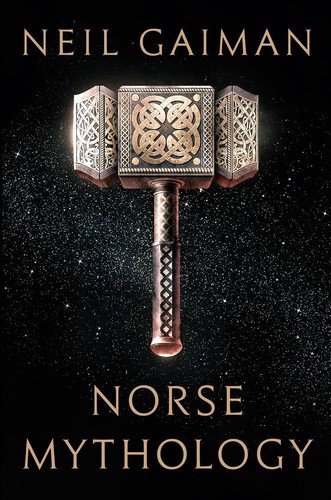
Norse Mythology
by Neil Gaiman
★ Top 25 book of 2017 · #11 on Best Books of 2017
Neil Gaiman retells the great northern myths, following Odin, Thor, and trickster Loki from the creation of the nine worlds through Ragnarok. His witty prose shapes the old tales into a novelistic arc of competitive, easily fooled gods.
Best for: Myth lovers and Gaiman fans who enjoy witty, accessible retellings of ancient stories
Norse Mythology is #11 on BookWard's Best Books of 2017, out of 73 2017 books that cleared our data bar.
What Norse Mythology is about
Neil Gaiman retells the old Norse myths as a connected story, beginning with the creation of the nine worlds and moving toward the twilight of the gods and the birth of a new age. Along the way we meet Odin, wise, daring and cunning; his son Thor, enormously strong but not the sharpest of the gods; and Loki, a giant's son, Odin's blood brother and a born trickster. There are comic episodes, such as Thor having to disguise himself as a woman to get his stolen hammer back, and stranger ones, like the blood of Kvasir becoming a mead that gives drinkers the gift of poetry.
In his introduction, Gaiman explains where his fondness for these tales comes from. The book received positive reviews from critics. Its tone is witty and earthy, and it suits anyone who wants a lively way into the myths without needing any background in them.
Norse Mythology on the Best Books of 2017
Norse Mythology came out in 2017. Of the 73 books first published in 2017 that met BookWard's data bar, it ranks #11 on our Best Books of 2017 list.
Why it made the list: 504 readers have shelved it on Open Library; readers rate it 4.4 out of 5 (37 ratings); 25 are reading it right now. The list ranks each year’s books on how many readers have picked them up, how highly readers rate them, and how many are reading them right now.
Nearby on the 2017 list
- The Sun and Her Flowers Rupi Kaur, #9
- Dog Man and Cat Kid Dav Pilkey, #10
- Nightfall Shannon Messenger, #12
- Refugee Alan Gratz, #13
See all Best Books of 2017 Best books by year
More years: Best Books of 2016 Best Books of 2018.
The numbers behind it
- Readers: 420 want to read it, 25 are reading it now and 59 have read it, according to Open Library.
- Ratings: 4.4 out of 5 from 37 Open Library ratings.
| Signal | This book (0 to 100) | Weight |
|---|---|---|
| Reach | 78 | 55% |
| Reader love | 85 | 25% |
| Being read right now | 79 | 20% |
Questions about Norse Mythology
When was Norse Mythology published?
Norse Mythology by Neil Gaiman was first published in 2017.
Was Norse Mythology one of the best books of 2017?
Norse Mythology is #11 on BookWard's Best Books of 2017, out of 73 2017 books that cleared our data bar. 504 readers have shelved it on Open Library; readers rate it 4.4 out of 5 (37 ratings); 25 are reading it right now.
Why is Norse Mythology on the Best Books of 2017 list?
504 readers have shelved it on Open Library; readers rate it 4.4 out of 5 (37 ratings); 25 are reading it right now.
More of the best books of 2017
- The Hate U Give Angie Thomas, #1
- The Seven Husbands of Evelyn Hugo Taylor Jenkins Reid, #2
- A Court of Wings and Ruin Sarah J. Maas, #3
- One of Us Is Lying Karen M. McManus, #4
- Why We Sleep Matthew P. Walker, #5
- The Dark Prophecy Rick Riordan, #6
See the full Best Books of 2017, the Top 100, or new books on Rising.
How we know
This page uses public data: Open Library reader counts and ratings, and Wikipedia page views for recent years. The description is paraphrased from real source text. Rankings reflect reading interest, not quality or sales, and can be affected by data gaps. Lists update monthly.
Suits teens and adults who enjoy myth and fantasy.
Depends on the edition you pick.
Gaiman retells the Norse myths in clean, witty, storyteller's prose. 57% taste match
 BookWard’s take
Gaiman retells the Norse myths in clean, witty, storyteller's prose
Gaiman takes the old northern tales and strings them into a novelistic arc, from the making of the nine worlds to Ragnarok. It is short and episodic, and each story gets going quickly. The pace is brisk because the myths are told plainly rather than padded. The voice is dry, sly and unmistakably Gaiman, with humour running through the tricks and blunders of the gods. Whether it leans on familiar tropes is harder to say, since these are the source stories themselves, so the originality here lives in the telling, not the material. The internal logic is looser than I usually like, because myths follow dream rules, but the book stays faithful to them. It is warm, funny and easy to pick up in pieces.
Compact and episodic, each myth told in a few pages, which matches BookWard's love of tight books.
Short tales move briskly and rarely linger, close to BookWard's quick tempo.
Retelling established myths limits novelty, but the sly voice makes them feel freshly told.
Clear, plain and rhythmic with a spoken feel, more storyteller than ornament.
Driven by events and escapades, with character emerging through what the gods do.
Ends in twilight and renewal, so the outlook is mixed but leans toward rebirth.
Linked stories form a conventional collection that builds to a single arc.
Plenty of humour, especially in the gods' schemes, vanities and slapstick predicaments.
Doom hangs over the tales and Ragnarok is grim, but the tone stays playful.
Moments of loss and poignancy appear, balanced by humour and brisk telling.
See all 50 dialsEvery position, side by side with this book
Where it lines up
- PaceBookWard 8 · book 8
- EndingBookWard 8 · book 8
- Authorial voiceBookWard 9 · book 9
Where it pulls apart
- Familiar tropesBookWard 10 · book 5
- Internal logicBookWard 10 · book 5
- OriginalityBookWard 9 · book 5
Compact and episodic, each myth told in a few pages, which matches BookWard's love of tight books.
Each tale starts with a story already moving, so there is little wind-up before things happen.
The material is ancient and well known, so freshness comes from the telling, not the plots.
Myth runs on dream logic and divine whim, looser than BookWard's airtight preference, though internally consistent.
Short tales move briskly and rarely linger, close to BookWard's quick tempo.
Retelling established myths limits novelty, but the sly voice makes them feel freshly told.
Gods are drawn through vivid traits like Thor's strength and Loki's cunning, not deep inner lives.
The collection builds to Ragnarok and a rebirth, giving the whole a clear, resolved close.
Warm and wry in tone, with some tenderness, but not heavily sentimental.
Dark moments belong to the myths themselves and feel part of the tradition, not added for effect.
Not applicable; this is a literary retelling, not a work of argument or research.
Gaiman's dry, mischievous storyteller voice is the main reason to read it, and it is unmistakable.
Story-led throughout; the tales are the point, and ideas arrive through what the gods do.
Events are mostly told as a narrator relating a tale, with little stopping to explain.
Short self-contained stories and a rising arc toward the end keep momentum up.
Clear, plain and rhythmic with a spoken feel, more storyteller than ornament.
Driven by events and escapades, with character emerging through what the gods do.
Ends in twilight and renewal, so the outlook is mixed but leans toward rebirth.
Linked stories form a conventional collection that builds to a single arc.
Plenty of humour, especially in the gods' schemes, vanities and slapstick predicaments.
Easy to read, with a light touch and short stretches suited to dipping in.
A single storyteller's voice, though the tales follow various gods and giants in turn.
Moves in broadly chronological order, from creation to the end of the gods.
Gods, giants, dwarfs and nine worlds make this wholly fantastical.
A sizeable pantheon of gods, giants and dwarfs, though a few figures dominate.
From the genesis of the worlds to Ragnarok, the canvas is mythic in scope.
Action and incident carry the book more than introspection.
Spoken exchanges drive many scenes, but narration carries a good share.
Romance is a minor thread at most beside schemes, quests and feuds.
The nine worlds and their beings are far from everyday experience.
Rooted in ancient northern lore, far from the present day.
These stories have lasted for centuries, and the retelling keeps them current.
A frank, trustworthy storyteller who relates the tales plainly.
Gods act from pride, passion and trickery, so right and wrong are rarely tidy.
Evocative images of the worlds and creatures, kept brief within a short tale.
A standalone retelling that needs no other book.
Tricks, disguises and reversals are common, though the myths are well known.
A gentle, entertaining read that asks little of the reader.
Doom hangs over the tales and Ragnarok is grim, but the tone stays playful.
Moments of loss and poignancy appear, balanced by humour and brisk telling.
Wry and mischievous with some broad comic set pieces.
Battles, killings and doom appear, but they are not dwelt on at length.
Sex is sparse and handled lightly.
Power struggles among gods exist, but there is no modern political agenda.
Plain, readable language without dense or archaic phrasing.
The narrator's wit and asides give the telling a distinct point of view.
Looks back to ancient stories, ending on a rebirth rather than the future.
Neither cynical nor naive, it accepts the gods' flaws and still finds renewal.
Review written by BookWard, dial version 1, November 2026.
Who is Norse Mythology right for?
Suits teens and adults who enjoy myth and fantasy. It includes battles, killings and the coming doom of the gods, handled with a light touch.
Easy to read, with a light touch and short stretches suited to dipping in.
Doom hangs over the tales and Ragnarok is grim, but the tone stays playful.
Moments of loss and poignancy appear, balanced by humour and brisk telling.
Battles, killings and doom appear, but they are not dwelt on at length.
Book CompanionNorse Mythology: ideas, characters, themes
Gaiman retells the Norse myths as a connected arc, from creation through the exploits of the gods to Ragnarok.
- Creation of the worlds. The book opens with the genesis of the legendary nine worlds.
- The major gods. Odin, Thor and Loki anchor the stories as wise, strong and cunning figures.
- Thor's stolen hammer. Thor must disguise himself as a woman to steal his hammer back.
- The mead of poetry. Kvasir's blood becomes a mead that gives drinkers the gift of poetry.
- Ragnarok. The tales build to the twilight of the gods and the rebirth of a new time and people.
Characters
Odin
Highest of the gods
Wise, daring and cunning, he rules the pantheon.
Thor
Odin's son
Incredibly strong but not the wisest of the gods.
Loki
Trickster
Son of a giant, blood brother to Odin and a skilled manipulator.
Kvasir
Wisest of gods
His blood becomes the mead that inspires poetry.
Themes
The gods trick and are tricked in turn.
Ragnarok shapes the whole arc toward an unavoidable end.
Competitive natures and strong feelings drive the gods' actions.
Knowledge and verse are treasures worth winning.
The end of one age gives way to a new time.
Discussion questions
- Why might Gaiman have chosen to tell these myths in such a plain, spoken voice?
- How does Loki's role change the way the other gods behave?
- Which story stood out most, and what made it memorable?
- How does knowing Ragnarok is coming shape the earlier tales?
- Do the gods feel more human or more alien, and why?
Personalize your Book Companion
This is the general edition. In BookWard, the Companion is written for you: your reading profile, your notes, and spoiler-safe to the page you are on.
Buy, listen or borrow Norse Mythology
Each link opens a search for this book on that store, in a new tab.
Read on a device
Borrow
Reviews and community
If you liked Norse Mythology
A modern fairy tale with an old, wry heart
The WitchesRoald DahlDahl's brisk, dark fable of a boy, a grandmother and witches
The Last HeroTerry PratchettCohen's last ride, in Pratchett's most lavishly illustrated Discworld
Charlie and the Chocolate FactoryRoald DahlA sharp, funny fable about greed, with a factory you remember
Find your own best books
Add what you have read, rate it, and BookWard will recommend what to read next.
Free to start. No credit card needed.