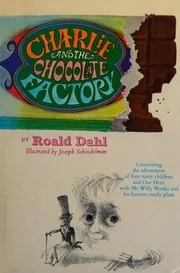
Charlie and the Chocolate Factory
by Roald Dahl · 1964
It suits middle grade readers and works well as a read-aloud for younger children.
174 pages, about 3 to 4 hours.
A sharp, funny fable about greed, with a factory you remember. 55% taste match
About the book
Charlie and the Chocolate Factory is a children's fantasy novel by the British author Roald Dahl, first published in 1964. It is written for middle grade readers and sits in the tradition of humorous adventure stories, running to roughly 174 pages in its usual editions. The book centers on Charlie Bucket, a boy who lives with his parents and his grandparents, and on Willy Wonka, an eccentric chocolatier who runs a famous chocolate factory.
The story takes Charlie inside Wonka's factory, where he joins a small group of children that includes Augustus Gloop, Veruca Salt, Violet Beauregarde, and Mike Teavee. Grandpa Joe is part of Charlie's circle, and the Oompa-Loompas, who come from Loompaland, work in the factory. Readers move through rooms such as the Chocolate Room, the Inventing Room, the Nut Room, and the Television Room. Greed and the conduct of the children are recurring concerns, handled with comic exaggeration. The novel has appeared in 245 editions, and it has also been issued as a media tie-in and in picture book formats.
This is Charlie.
Characters
Charlie BucketWilly WonkaAugustus GloopVeruca SaltViolet BeauregardeMike Teavee
Setting
Willy Wonka's Chocolate FactoryLoompalandChocolate RoomInventing RoomNut Room
Period
2011
Themes
Childrens Media Tie-In BooksChildren's Picture BooksAvariceBehaviorChocolatChocolateChocolate factoriesConducta
- Want to read 2,398
- Reading now 209
- Read 417
- Stopped 2
Most people shelving it are saving it for later.
Of 3026 readers who put it on a shelf, 79% want to read it, 7% are reading it now, 14% have finished it and 0% stopped before the end.
By the numbers
- The median edition runs 174 pages. Counting about 275 words a page and an adult reading pace of 250 words a minute, that is about 3.2 hours of reading.
- Open Library tracks 245 editions from 125 publishers, the earliest dated 1964 and the latest 2024, across 19 languages.
- On reader demand it ranks in the top 1% of the classic books in our catalog (8,749 of them).
- Libraries shelve it under Dewey 823.912 and Library of Congress class PZ-0007.00000000.D1515Ch.
 BookWard’s take
A sharp, funny fable about greed, with a factory you remember
Charlie and the Chocolate Factory runs to about 174 pages, and it moves like it knows that. The hook is immediate: a poor boy, a famous factory, and a handful of children who each carry one glaring flaw. Dahl handles the pace well, sending Charlie and the others through rooms like the Chocolate Room and the Inventing Room, each one a fresh set piece, so the middle never sags. The voice is distinctive and opinionated, and the humor is broad where I tend to prefer it dry. The cast is made of types by design, which is the point of a fable, so don't come looking for deep characterization. What it offers instead is invention and a clean, resolved ending. Greed and conduct are the recurring concerns, handled with comic exaggeration rather than a lecture.
At 174 pages it is about as short and tight as a novel gets, which matches BookWard's taste exactly.
Each room brings a new set piece, keeping things brisk and close to BookWard's preferred speed.
Wonka's factory and its inventions are strikingly imaginative, close to what BookWard rewards.
The language is plain and clear, kept simple for middle grade readers, a little plainer than BookWard's usual taste.
Events and the set pieces drive the story, leaning well toward plot over inner life.
Kindness and good conduct are rewarded, giving the book a bright, hopeful outlook.
It moves forward room by room in a straightforward line, more conventional than BookWard's usual taste.
Comic exaggeration runs through the whole book, well above BookWard's already playful setting.
The comeuppance is comic and cartoonish, so the tone stays on the gentler side.
Feeling is present around Charlie's family, but the comic tone keeps it from running intense.
See all 50 dialsEvery position, side by side with this book
Where it lines up
- LengthBookWard 1 · book 1
- PaceBookWard 8 · book 8
- Sagging middleBookWard 8 · book 8
Where it pulls apart
- Internal logicBookWard 10 · book 5
- Familiar tropesBookWard 10 · book 6
- Character depthBookWard 8 · book 4
At 174 pages it is about as short and tight as a novel gets, which matches BookWard's taste exactly.
A poor boy and a famous factory set the story moving almost at once, as BookWard prefers.
It uses familiar fable shapes, but the factory and its inventions feel fresh, so it only partly clears BookWard's bar.
The factory runs on dream logic and comic exaggeration, which is looser than the airtight rules BookWard favors.
Each room brings a new set piece, keeping things brisk and close to BookWard's preferred speed.
Wonka's factory and its inventions are strikingly imaginative, close to what BookWard rewards.
The children are drawn as types by design, a fable choice that sits below BookWard's taste for depth.
The story closes with a clear, satisfying resolution, which suits BookWard well.
There is warmth around Charlie's family, but the comedy keeps it from turning syrupy, so it lands near BookWard's middle ground.
The darkness serves the comic moral and earns its place, though it is played for effect somewhat more than BookWard likes.
This is a novel, so rigor does not apply.
Dahl's tone is unmistakable, playful and opinionated, which BookWard values highly.
It is story-led, built on adventure through the factory rooms, which fits BookWard's preference.
Much is shown through the rooms and the children's behavior, with the narrator stepping in to comment now and then.
Each room brings something new, so the middle stays lively throughout, as BookWard prefers.
The language is plain and clear, kept simple for middle grade readers, a little plainer than BookWard's usual taste.
Events and the set pieces drive the story, leaning well toward plot over inner life.
Kindness and good conduct are rewarded, giving the book a bright, hopeful outlook.
It moves forward room by room in a straightforward line, more conventional than BookWard's usual taste.
Comic exaggeration runs through the whole book, well above BookWard's already playful setting.
Written for middle grade readers, it is very easy to read, easier than BookWard typically seeks.
The story stays with Charlie's side of events, a narrower view than BookWard's usual spread.
Events unfold in a simple forward line, with no time shifts.
A factory with an Inventing Room and a land called Loompaland places it firmly in fantasy.
Charlie's family and four other children make a modest cast, a touch larger than a purely intimate story.
The action stays inside one factory and one family, so it feels intimate rather than epic.
The pleasure is in what happens room to room, so action leads over inner thought.
Conversation among Wonka, Charlie and the other children carries a good share of the story.
Romance does not feature in this story.
Wonka's factory is a strange and unfamiliar place, which BookWard enjoys.
It was first published in 1964 and reads as a story of its own time rather than the present day.
Its long life across 245 editions shows how well the fable has held up.
The narrator is a plain, open guide, so the telling is reliable.
Greed and good conduct are judged clearly, so the book is far from ambiguous on right and wrong.
Wonka's rooms are described vividly, with plenty of colorful detail.
This is fiction, so nonfiction style does not apply.
This is fiction, so perspective as defined for nonfiction does not apply.
It reads as a self-contained story, though it sits within Dahl's wider body of work.
Each room brings a small reversal, though the overall shape of the fable is easy to follow.
It is an easy, entertaining read for young people rather than a challenging one.
The comeuppance is comic and cartoonish, so the tone stays on the gentler side.
Feeling is present around Charlie's family, but the comic tone keeps it from running intense.
The humor is broad and exaggerated, pitched to make young readers laugh out loud.
Mishaps happen to the children, but they are played as cartoon comedy, so violence stays light.
There is no sexual content in this children's book.
It is not a political book, though the story does comment on bad behavior.
The language is plain and clear, written for middle grade readers.
The narrator freely takes sides and comments on the children's behavior, which gives it a strong point of view.
It looks neither backward nor forward, concerned with the fable's timeless lessons.
Charlie's goodness is rewarded, giving the story a fairly idealistic bent.
Review written by BookWard, dial version 1, November 2026.
Who is Charlie and the Chocolate Factory right for?
It suits middle grade readers and works well as a read-aloud for younger children. Some parents may want to talk through the children's comic mishaps, which are played for laughs but are not entirely gentle.
Written for middle grade readers, it is very easy to read, easier than BookWard typically seeks.
The comeuppance is comic and cartoonish, so the tone stays on the gentler side.
Feeling is present around Charlie's family, but the comic tone keeps it from running intense.
Mishaps happen to the children, but they are played as cartoon comedy, so violence stays light.
Book CompanionCharlie and the Chocolate Factory: ideas, characters, themes
A kind boy enters a magical factory alongside four spoiled children, and the story weighs each of them by how they behave.
- A modest boy. Charlie Bucket lives with his parents and grandparents, and his circle includes Grandpa Joe.
- An eccentric host. Willy Wonka is a famous and strange chocolatier who runs the factory.
- Four contrasting children. Augustus Gloop, Veruca Salt, Violet Beauregarde and Mike Teavee join Charlie inside the factory.
- A tour of rooms. The story moves through places such as the Chocolate Room, the Inventing Room, the Nut Room and the Television Room.
- Comic exaggeration. Greed and conduct are handled through humor rather than lecture.
Characters
Charlie Bucket
Protagonist
A young boy who lives with his parents and grandparents.
Willy Wonka
Eccentric chocolatier
The owner and creator of the famous chocolate factory.
Grandpa Joe
Charlie's grandfather
Part of Charlie's family circle.
Augustus Gloop
Fellow visitor
One of the children who tours the factory with Charlie.
Veruca Salt
Fellow visitor
Another child in the group visiting the factory.
Themes
The book shows what excessive wanting does to people, played for comedy.
How people behave is the measure the story uses to judge its characters.
Wonka's oddness is part of the book's charm and its mystery.
The factory's rooms invite readers to enjoy sheer invention.
Discussion questions
- Why do you think Dahl chose to give each child one dominant flaw?
- How does Charlie differ from the other children on the tour?
- Is Willy Wonka a trustworthy host, and does it matter?
- Which room in the factory stuck with you most, and why?
- Does the humor make the children's fates easier or harder to accept?
Personalize your Book Companion
This is the general edition. In BookWard, the Companion is written for you: your reading profile, your notes, and spoiler-safe to the page you are on.
Buy, listen or borrow Charlie and the Chocolate Factory
Each link opens a search for this book on that store, in a new tab.
Read on a device
Borrow
Reviews and community
If you liked Charlie and the Chocolate Factory
Dahl's brisk, dark fable of a boy, a grandmother and witches
The Wonderful Wizard of OzL. Frank BaumA short, odd, restless road-trip fairy tale that earned its classic status
The Silver ChairC. S. LewisA quest through Narnia that rewards the sharp-eyed and the stubborn
The Thief of AlwaysClive BarkerA short, sharp fable about boredom, bargains and stolen youth
Sources: Open Library.
Track Charlie and the Chocolate Factory and find your next favorite
Add it to your shelf, rate what you have read, and BookWard will recommend what fits you.
Free to start. No credit card needed.