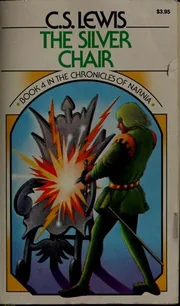
It suits young readers, roughly the middle-grade range, and is also enjoyed by adults who grew up with Narnia.
217 pages, about 3.5 to 5 hours.
A quest through Narnia that rewards the sharp-eyed and the stubborn. 58% taste match
The story
The Silver Chair is a children's portal fantasy by C. S. Lewis, first published in 1953. It belongs to The Chronicles of Narnia, where it was the fourth novel to appear, though many recent editions place it sixth to follow the chronology of Narnian history. Pauline Baynes illustrated the book, and her drawings have been kept in many later editions.
Jill Pole and Eustace Scrubb are sent on a quest to rescue Prince Rilian of Narnia from the evil Witch who holds him captive. Their journey takes them through Narnia, with a stop at Cair Paravel, and brings them into contact with King Caspian, Trumpkin the Dwarf, Glimfeather the Owl, the marsh-wiggle Puddleglum, and Aslan the Lion. The Lady of the Green Kirtle also figures in the story. The book opens on a dull autumn day with Jill crying behind the gym. It draws on magic, imaginary voyages, and the struggle between good and evil, and runs to roughly 217 pages in its median edition.
It was a dull autumn day and Jill Pole was crying behind the gym.
Characters
Eustace ScrubbJill PoleAslan the LionPrince Rilian of NarniaKing CaspianTrumpkin the Dwarf
Setting
NarniaCair Paravel
Themes
Imaginary VoyagesMagicPrincesChildren's stories, EnglishCaptivesGood and evilBrujasViajes
- Want to read 376
- Reading now 22
- Read 103
Most people shelving it are saving it for later.
Of 501 readers who put it on a shelf, 75% want to read it, 4% are reading it now, 21% have finished it and 0% stopped before the end.
By the numbers
- The median edition runs 217 pages. Counting about 275 words a page and an adult reading pace of 250 words a minute, that is about 4.0 hours of reading.
- Open Library tracks 142 editions from 71 publishers, the earliest dated 1953 and the latest 2021, across 9 languages.
- On reader demand it ranks in the top 2% of the classic books in our catalog (8,749 of them).
- Libraries shelve it under Dewey 823.912 and Library of Congress class PR-6023.00000000.E926 S5 1967.
 BookWard’s take
A quest through Narnia that rewards the sharp-eyed and the stubborn
The Silver Chair opens with Jill Pole crying behind the gym, and it never wastes a page getting to the point: two children sent to rescue Prince Rilian from a Witch. At 217 pages it is tight and quick, and it hooks you at once. The internal logic is firm, because the quest runs on clear instructions and the story keeps asking whether the travelers will follow them. Puddleglum gives the book its dry humor and its strongest character work, and the ending resolves cleanly. The weak spot is familiarity: the portal fantasy and the good-versus-evil frame are well-worn, though the execution holds up. The narrator also explains more than some readers will like.
At 217 pages it is short and moves briskly, which BookWard values.
The journey keeps moving from one stage to the next, a little slower than BookWard's taste in places.
The frame is classic, but the marsh-wiggle and the Witch's schemes give it a distinct shape.
Plain, clear sentences with only occasional flourish.
The quest drives events, with character growth following along beside it.
Hardship is real, but the book leans toward courage and faith that things can be put right.
A straightforward quest told in order.
Puddleglum's gloomy remarks bring real laughs to a serious journey.
Captivity and an evil Witch bring menace, but it stays within a children's-book range.
Feelings run strong at moments but are kept brisk and controlled.
See all 50 dialsEvery position, side by side with this book
Where it lines up
- Authorial voiceBookWard 9 · book 9
- LengthBookWard 1 · book 2
- OpeningBookWard 10 · book 9
Where it pulls apart
- Familiar tropesBookWard 10 · book 4
- ExpositionBookWard 2 · book 6
- Internal logicBookWard 10 · book 8
At 217 pages it is short and moves briskly, which BookWard values.
Jill crying behind the gym puts a child in trouble on the first line, and the quest follows fast.
Portal fantasy and a good-versus-evil quest are familiar ground, though the details keep it lively.
The quest runs on clear instructions, so the story's rules are easy to follow and the consequences hold together.
The journey keeps moving from one stage to the next, a little slower than BookWard's taste in places.
The frame is classic, but the marsh-wiggle and the Witch's schemes give it a distinct shape.
Jill, Eustace and especially Puddleglum are drawn with clear flaws and habits, though in a children's-book register.
The quest reaches a firm resolution, which BookWard likes.
Warm in places but not syrupy; the feeling is held in check by the plot.
Dark moments belong to the quest and carry real stakes rather than being there for effect.
Not applicable to a work of fiction.
Lewis's narrator speaks to the reader directly and is unmistakable from the first page.
The story leads, though moral and spiritual ideas run through it.
The narrator often explains outright, which runs against BookWard's preference for showing in scene.
The quest keeps tightening, and the middle holds attention better than most books in the series.
Plain, clear sentences with only occasional flourish.
The quest drives events, with character growth following along beside it.
Hardship is real, but the book leans toward courage and faith that things can be put right.
A straightforward quest told in order.
Puddleglum's gloomy remarks bring real laughs to a serious journey.
Easy to read and suited to young readers.
The tale follows the children's side of events rather than moving among many minds.
Events unfold in a straight line.
Talking animals, a witch and a magical land make this fully fantastical.
A manageable group of travelers and rulers, not a sprawling roster.
The stakes concern a prince and a kingdom, personal but with a land at risk.
Mostly journeys, encounters and action, with some inner struggle.
Much of the story moves through conversation, especially with Puddleglum.
Romance is not part of this story.
Narnia is an invented land, though the series makes it familiar to many readers.
Published in 1953, and its frame of a school and a portal feels of its time.
The quest and its themes have held up for generations of young readers.
The narrator is open and trustworthy in guiding the reader.
Good and evil are drawn sharply, with little doubt about which is which.
Landscapes are sketched with some color, but the book stays focused on the journey.
Not applicable to a work of fiction.
Not applicable to a work of fiction.
It is the fourth published Narnia novel, though it can be read on its own.
The quest holds a few reversals, though the shape of the story is clear.
A gentle read overall, with some demanding moral tests for its young heroes.
Captivity and an evil Witch bring menace, but it stays within a children's-book range.
Feelings run strong at moments but are kept brisk and controlled.
The humor is dry and character-based rather than broad slapstick.
Peril is present but handled lightly for a young audience.
There is no sexual content.
Political themes sit in the background of a kingdom story.
The language is plain and accessible, with a few archaic touches.
The narrator freely offers asides and judgments to the reader.
The story looks both back to Narnian history and ahead to the quest's outcome.
Courage, faith and loyalty are treated as worth the cost.
Review written by BookWard, dial version 1, November 2026.
Who is The Silver Chair right for?
It suits young readers, roughly the middle-grade range, and is also enjoyed by adults who grew up with Narnia. It includes a captive prince, an evil Witch and some peril, which sensitive younger children may find a little frightening.
Easy to read and suited to young readers.
Captivity and an evil Witch bring menace, but it stays within a children's-book range.
Feelings run strong at moments but are kept brisk and controlled.
Peril is present but handled lightly for a young audience.
Book CompanionThe Silver Chair: ideas, characters, themes
Two children on a quest must keep hold of their instructions and their courage to free a captive prince from a Witch.
- A quest with a clear goal. Jill and Eustace are sent to rescue Prince Rilian of Narnia, which gives the story a strong, simple drive.
- A school-yard beginning. The book opens with Jill Pole crying behind the gym, grounding the fantasy in ordinary unhappiness.
- A traveling company. The children are joined by Puddleglum the marsh-wiggle and meet figures such as Glimfeather the Owl and Trumpkin the Dwarf.
- An evil Witch. The Lady of the Green Kirtle is the danger the quest is built around, holding the Prince captive.
- A place in the series. Published fourth, it is placed sixth in many recent editions that follow Narnian chronology, with Pauline Baynes's illustrations kept in many editions.
Characters
Jill Pole
One of the two young heroes
She begins the story in tears behind the gym and is drawn into the quest.
Eustace Scrubb
The other young hero
He travels with Jill on the mission to find the missing Prince.
Puddleglum
Marsh-wiggle companion
A gloomy but loyal traveler who joins the quest.
Prince Rilian
The captive Prince of Narnia
The prince whom the children are sent to rescue.
The Lady of the Green Kirtle
The evil Witch
The figure who holds Rilian captive and stands against the quest.
Themes
The story sets a clear struggle between rescue and captivity.
The children must act bravely in a strange and dangerous land.
Companions stick together through a hard journey.
The quest depends on following instructions from Aslan.
The Prince's imprisonment drives the whole adventure.
Discussion questions
- Why do you think the story opens with Jill crying rather than with Narnia itself?
- How does Puddleglum's outlook change the mood of the journey?
- What makes the Witch a convincing danger in a children's book?
- Which part of the quest depends most on trust, and why?
- Does the book work as a standalone, or does it need the rest of the series?
Personalize your Book Companion
This is the general edition. In BookWard, the Companion is written for you: your reading profile, your notes, and spoiler-safe to the page you are on.
Buy, listen or borrow The Silver Chair
Each link opens a search for this book on that store, in a new tab.
Read on a device
Borrow
Reviews and community
If you liked The Silver Chair
A brisk Narnia road trip with a talking horse
The Wonderful Wizard of OzL. Frank BaumA short, odd, restless road-trip fairy tale that earned its classic status
The Book Of ThreeLloyd AlexanderA brisk, warm Celtic-flavored quest about wanting to be a hero
The Lightning ThiefRick RiordanA fast, funny Greek-myth quest that hooks in chapter one
Sources: Open Library.
Track The Silver Chair and find your next favorite
Add it to your shelf, rate what you have read, and BookWard will recommend what fits you.
Free to start. No credit card needed.