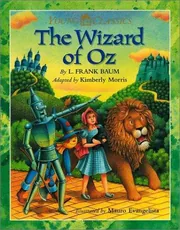
The Wonderful Wizard of Oz
by L. Frank Baum · 1899
It suits young readers and anyone wanting a classic children's adventure, and it is easy to read aloud.
159 pages, about 2.5 to 3.5 hours.
A short, odd, restless road-trip fairy tale that earned its classic status. 54% taste match
The story
The Wonderful Wizard of Oz is a children's fantasy novel by L. Frank Baum, first published in 1899 and illustrated by W. W. Denslow. It is the opening book of the Oz series and has stayed in print in a great many editions, running to about 159 pages in its usual form. The story belongs to the tradition of imaginary voyages, with witches, a wizard and a far-off magical country at its centre.
Dorothy Gale is a girl raised on the Kansas prairies by her Uncle Henry, a farmer, and her Aunt Em. A cyclone carries her and her dog Toto away to the Land of Oz. To find a way back to Kansas she must deal with the Wicked Witch of the West. Along the road to the Emerald City she is joined by the Scarecrow, the Tin Woodman and the Cowardly Lion, and together they hope to reach the Wizard of Oz. The book suits young readers looking for an American adventure story and is regarded as a classic of children's literature.
Orothy lived in the midst of the great Kansas prairies, with Uncle Henry, who was a farmer, and Aunt Em, who was the farmer's wife.
Characters
Dorothy GaleDorothyTin ManScarecrow
Setting
OzKansasUnited StatesOz (Imaginary place)Etats-Unis
Period
20th Century
Themes
WitchesSpanish language materialsWizardsChildren's stories, RussianSpecimensClassic LiteratureImaginary VoyagesChildren's stories, American
- Want to read 1,273
- Reading now 97
- Read 218
Most people shelving it are saving it for later.
Of 1588 readers who put it on a shelf, 80% want to read it, 6% are reading it now, 14% have finished it and 0% stopped before the end.
By the numbers
- The median edition runs 159 pages. Counting about 275 words a page and an adult reading pace of 250 words a minute, that is about 2.9 hours of reading.
- Open Library tracks 2049 editions from 601 publishers, the earliest dated 1899 and the latest 2024, across 34 languages.
- On reader demand it ranks in the top 1% of the classic books in our catalog (8,749 of them).
- Libraries shelve it under Dewey 813.52 and Library of Congress class PS-3503.00000000.A923 W59 1982.
 BookWard’s take
A short, odd, restless road-trip fairy tale that earned its classic status
At 159 pages, The Wonderful Wizard of Oz is the tight, quick kind of book that's easy to love. It hooks at once: a cyclone lifts a Kansas farm girl out of her gray life and drops her somewhere new. The pace stays brisk, and the road to the Emerald City never sags, because every stop brings a fresh problem and a fresh companion. The familiar elements are the interesting part. Witches, wizards and a quest are old furniture now, but this book is where much of that furniture came from, and the details still feel odd and inventive. Characters are drawn simply, closer to types than to deep portraits, and the prose is plain and clear. The ending is fully resolved. It is a gentle, hopeful adventure, a fine fit for readers who want speed and clean logic, and a softer one for those who want depth.
At 159 pages it is short and quick, right in BookWard's preferred territory.
Each stop on the road brings a new companion or obstacle, keeping the pace brisk, as BookWard prefers.
Much of it was fresh when published, and it still reads as inventive even after a century of imitators.
The prose is plain and clear, written to be easy for young readers.
Events drive the book far more than inner change in the characters.
It is a hopeful adventure about friendship and getting home, brighter than BookWard's own lean.
A straight journey from home to Oz and back, with no formal experiments.
There is light, gentle humor in the companions' quirks, though it is not a comedy.
There are witches and real dangers, but the tone stays gentle overall.
Feelings are warm but light, not overwhelming.
See all 50 dialsEvery position, side by side with this book
Where it lines up
- LengthBookWard 1 · book 1
- PaceBookWard 8 · book 8
- Sagging middleBookWard 8 · book 8
Where it pulls apart
- Familiar tropesBookWard 10 · book 6
- Internal logicBookWard 10 · book 6
- Character depthBookWard 8 · book 4
At 159 pages it is short and quick, right in BookWard's preferred territory.
A cyclone carries Dorothy away early, so the story is moving almost immediately, which suits BookWard well.
Its witches, wizard and quest became standard fantasy furniture, though the book itself still feels distinctive, so BookWard sees it as partly familiar.
The magical rules are simple and mostly consistent, though fairy-tale logic bends when the story needs it.
Each stop on the road brings a new companion or obstacle, keeping the pace brisk, as BookWard prefers.
Much of it was fresh when published, and it still reads as inventive even after a century of imitators.
The companions are vivid but built around single traits, so depth sits below what BookWard usually wants.
The journey closes with its central question answered, which BookWard values.
It is warm and sometimes tender, but the telling stays brisk rather than syrupy.
Its peril is played straightforwardly for the story, not for shock value.
This is a novel, so the rigor dial does not apply.
Baum's plain, friendly storytelling voice is recognizable, a match for BookWard's taste in distinctive voice.
This is a story-led book; adventure and incident carry it, not argument.
Scenes mostly show action, with occasional plain explanations of Oz's people and places.
The road structure keeps fresh episodes arriving, so the middle stays lively.
The prose is plain and clear, written to be easy for young readers.
Events drive the book far more than inner change in the characters.
It is a hopeful adventure about friendship and getting home, brighter than BookWard's own lean.
A straight journey from home to Oz and back, with no formal experiments.
There is light, gentle humor in the companions' quirks, though it is not a comedy.
Short sentences and a clear story make it very easy to read.
The story follows Dorothy and her party from one close vantage, not many perspectives.
Events unfold in order, with no jumps in time.
Witches, talking animals and a magical land make it thoroughly fantastical.
A modest traveling party plus the figures met along the road, not a sprawling cast.
A single journey across one land, with big imagery but a personal goal.
Action and travel dominate over interior reflection.
Conversation among the travelers carries a good share of the book, balanced with narration.
Romance plays no real part; friendship and getting home are the heart of it.
Oz is an invented land with its own peoples and rules, unfamiliar by design.
A nineteenth-century children's novel, set in a Kansas and an Oz far from the present day.
Over a century on, it is still in print and widely read, which speaks to its staying power.
A straightforward storyteller, plain and trustworthy.
Good and wicked are clearly marked, in the way of a classic fairy tale.
Colors and places are described with some care, but briefly and in service of the plot.
Surprises arrive along the road, though they are gentle, not elaborate.
A comforting, welcoming read pitched to young readers.
There are witches and real dangers, but the tone stays gentle overall.
Feelings are warm but light, not overwhelming.
Humor leans toward playful and broad, drawn from the odd companions.
There are threats and a few fights, kept brief and mild.
No sexual content at all.
The story is not about politics.
Language is plain and approachable throughout.
Narration mostly tells the story without pushing views, apart from a friendly storyteller's tone.
It looks back toward home even as the plot pushes forward through Oz.
Courage, kindness and home are treated sincerely, with little cynicism.
Review written by BookWard, dial version 1, November 2026.
Who is The Wonderful Wizard of Oz right for?
It suits young readers and anyone wanting a classic children's adventure, and it is easy to read aloud. It includes threats and a few mild fights, which most children handle fine.
Short sentences and a clear story make it very easy to read.
There are witches and real dangers, but the tone stays gentle overall.
Feelings are warm but light, not overwhelming.
There are threats and a few fights, kept brief and mild.
Book CompanionThe Wonderful Wizard of Oz: ideas, characters, themes
A homesick Kansas girl crosses a strange land with three odd friends, discovering what she and they already had.
- The cyclone. A storm carries Dorothy and Toto out of Kansas and into the Land of Oz.
- The witch problem. To get home, Dorothy must deal with the Wicked Witch of the West.
- The Yellow Brick Road. The road to the Emerald City gives the book its journey structure.
- Three companions. The Scarecrow, the Tin Woodman and the Cowardly Lion join her, each wanting something.
- The Wizard. The group travels to the Great Oz, hoping he alone can send Dorothy home.
Characters
Dorothy Gale
Protagonist
A girl from the Kansas prairies raised by her aunt and uncle, who is carried to Oz and wants to return.
Toto
Dorothy's dog
Her pet dog, who is swept away with her.
The Scarecrow
Companion
One of the three friends who join Dorothy on the road.
The Tin Woodman
Companion
Another traveler who joins Dorothy's party.
The Cowardly Lion
Companion
The third friend who travels with Dorothy to the Emerald City.
Themes
The pull of the familiar place and the people who belong to it.
Strangers becoming a team by helping one another.
Bravery that is already present before it is recognized.
Growth through travel, where each stop tests the travelers.
Goals pursued that turn out to be closer than expected.
Discussion questions
- Why does Dorothy want to go home so badly, given how her Kansas life is described?
- What does each of the three companions want, and why do their wishes matter to the story?
- How does the road to the Emerald City shape the way the book is paced?
- What makes the witches and the Wizard feel different from fairy-tale figures elsewhere?
- Why do you think this story has stayed popular for over a century?
Personalize your Book Companion
This is the general edition. In BookWard, the Companion is written for you: your reading profile, your notes, and spoiler-safe to the page you are on.
Buy, listen or borrow The Wonderful Wizard of Oz
Each link opens a search for this book on that store, in a new tab.
Read on a device
Borrow
Reviews and community
If you liked The Wonderful Wizard of Oz
A cosy, inventive 1939 gateway into tree-top magic
The Book Of ThreeLloyd AlexanderA brisk, warm Celtic-flavored quest about wanting to be a hero
The Silver ChairC. S. LewisA quest through Narnia that rewards the sharp-eyed and the stubborn
The Horse and His BoyC. S. LewisA brisk Narnia road trip with a talking horse
Sources: Open Library.
Track The Wonderful Wizard of Oz and find your next favorite
Add it to your shelf, rate what you have read, and BookWard will recommend what fits you.
Free to start. No credit card needed.