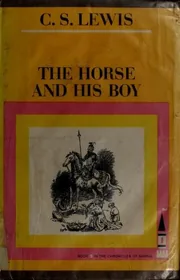
It suits middle-grade readers and anyone who enjoys classic adventure fantasy.
208 pages, about 3.5 to 5 hours.
A brisk Narnia road trip with a talking horse. 55% taste match
The story
The Horse and His Boy is a fantasy novel for young readers by C. S. Lewis, first published in 1954. It is the fifth of the seven books in The Chronicles of Narnia, and it blends adventure, magic, and allegory in the imaginary land of Narnia and the lands around it. The story takes place in Narnia, Calormen, and the countries that lie between them, during the Golden Age, when Peter reigns as High King and his brother and two sisters rule beneath him.
The central figures are two children and two talking horses who flee Calormen and make their way north toward Narnia. Along the way they learn that a Calormene prince is planning an attack on Archenland, and they set out to warn its king before the strike comes. Three of the Pevensie children appear in smaller roles, since the book's events fall within the years covered at the close of The Lion, the Witch and the Wardrobe. It runs to roughly 208 pages and has appeared in 186 editions, and it suits readers who enjoy long journeys, talking animals, and an imagined world with its own kingdoms and rulers.
To je zgodba o dogodivščinah, ki so se dogajale v Narniji in Kalormenu ter deželah med njima v Zlatem obdobju, ko je bil Peter Veliki kralj v Narniji, njegov brat podkralj ter obe njegovi sestri podkraljici.
Themes
FantasyAllegoryAventuresMagieFrères et soeursRoman pour la jeunesseChevauxNarnia (Lieu imaginaire)
- Want to read 353
- Reading now 18
- Read 183
Readers are split between finishing it and saving it for later.
Of 554 readers who put it on a shelf, 64% want to read it, 3% are reading it now, 33% have finished it and 0% stopped before the end.
By the numbers
- The median edition runs 208 pages. Counting about 275 words a page and an adult reading pace of 250 words a minute, that is about 3.8 hours of reading.
- Open Library tracks 186 editions from 90 publishers, the earliest dated 1954 and the latest 2023, across 13 languages.
- On reader demand it ranks in the top 1% of the classic books in our catalog (8,749 of them).
- Libraries shelve it under Dewey 823.912 and Library of Congress class PZ-0007.00000000.L58474 Ho 2000.
 BookWard’s take
A brisk Narnia road trip with a talking horse
At 208 pages, The Horse and His Boy is short and quick, which suits a reader who likes a brisk book. It moves from escape to journey to warning with little padding, and the chase never loses its urgency. Where it falters is in its familiar tropes and its habit of explaining rather than dramatizing: Lewis leans on the shape of the chosen-boy adventure, and the narrator often tells us what a scene means instead of letting it play out. It is part of a series, though it stands comfortably alone, set in the Golden Age of Narnia and the lands of Calormen between. The prose is plain and the voice is warm and opinionated, and that voice is a real pleasure. Treat it as a compact adventure with a strong narrator, not a subtle one.
At 208 pages it is tight and brisk, which BookWard likes.
A flight north with a warning to deliver keeps things moving, in line with BookWard.
Calormen and talking horses add freshness, but the frame is familiar fantasy adventure.
The language is plain and clear, close to what BookWard enjoys.
Events and the journey carry the book more than inner change.
It ends in courage and rightful restoration, more hopeful than BookWard usually runs.
A straightforward quest with a warning to deliver, more conventional than BookWard's middle.
Gentle wit shows up in the horses' talk and the narrator's asides.
Danger exists but the tone stays gentle for young readers.
Feeling is present but kept measured and warm.
See all 50 dialsEvery position, side by side with this book
Where it lines up
- PaceBookWard 8 · book 8
- Shock for effectBookWard 9 · book 9
- Sagging middleBookWard 8 · book 8
Where it pulls apart
- Familiar tropesBookWard 10 · book 4
- ExpositionBookWard 2 · book 7
- OpeningBookWard 10 · book 7
At 208 pages it is tight and brisk, which BookWard likes.
It opens by naming its adventure and setting, then gets a boy and a horse moving quickly.
The destined-hero and hidden-identity shapes are well worn, which cuts against BookWard's wish to avoid tropes.
The journey and its stakes follow cleanly from one another, close to what BookWard wants.
A flight north with a warning to deliver keeps things moving, in line with BookWard.
Calormen and talking horses add freshness, but the frame is familiar fantasy adventure.
The children and horses have clear personalities and grow, though they are drawn more simply than BookWard prefers.
The threads close firmly and satisfyingly, matching BookWard's taste for resolution.
Warmth is present but handled with a light touch, a little more tender than BookWard likes.
The darkness stays mild and serves the adventure rather than shocking for effect.
Lewis's chatty, confident narrator is unmistakable, which BookWard rewards.
Story drives the book, with faith and allegory running beneath the plot.
The narrator often explains customs and background outright, against BookWard's preference for scene.
The journey keeps its momentum with few lulls.
The language is plain and clear, close to what BookWard enjoys.
Events and the journey carry the book more than inner change.
It ends in courage and rightful restoration, more hopeful than BookWard usually runs.
A straightforward quest with a warning to deliver, more conventional than BookWard's middle.
Gentle wit shows up in the horses' talk and the narrator's asides.
It reads easily and suits young readers, lighter than BookWard's usual effort.
The story follows a few travelers, mostly the boy and the horses.
Events unfold in order, more linear than BookWard's lean.
Talking animals and a magical land make it clearly fantastical.
A handful of core travelers plus a few royals keeps the cast small.
The stakes cover kingdoms but the journey stays close to its travelers.
Action and travel lead, with feelings kept in the background.
Talk between the boy and the horses carries a good share of the story.
Romance is a minor thread beside the adventure.
Calormen and the lands between feel new even within a known series.
It is set in an imagined past, far from the present day.
Children's fantasy like this has lasted for generations.
The narrator is open and trustworthy, not unreliable.
Right and wrong are drawn clearly, more so than BookWard likes.
Settings are sketched with moderate detail rather than lavish colour.
It is the fifth Chronicles of Narnia book, though it stands alone well.
A few reveals land along the way without dominating.
It is a comforting, accessible adventure.
Danger exists but the tone stays gentle for young readers.
Feeling is present but kept measured and warm.
Humor is mild and wry rather than broad.
Peril and fighting appear lightly and without grisly detail.
There is no sexual content to speak of.
Kingdoms and rulers feature, but politics stays in the background of the adventure.
The language is plain and easy to follow.
Lewis's narrator openly shares views and asides.
The story is set in the past yet moves toward a hopeful future.
Courage, loyalty and faith are treated sincerely.
Review written by BookWard, dial version 1, November 2026.
Who is The Horse and His Boy right for?
It suits middle-grade readers and anyone who enjoys classic adventure fantasy. Peril and some fighting appear, but nothing is graphic.
It reads easily and suits young readers, lighter than BookWard's usual effort.
Danger exists but the tone stays gentle for young readers.
Feeling is present but kept measured and warm.
Peril and fighting appear lightly and without grisly detail.
Book CompanionThe Horse and His Boy: ideas, characters, themes
Two children and two talking horses flee Calormen for Narnia and race to warn a king of an invasion.
- A story told in the Golden Age. It is set while Peter reigns as High King, within the years closing The Lion, the Witch and the Wardrobe.
- Escape north. The central figures flee Calormen and travel toward Narnia.
- A warning to deliver. They learn of a Calormene prince's plan to attack Archenland and set out to alert its king.
- Pevensies in small roles. Three of the Pevensie children appear as minor characters.
- Part of a longer series. It is the fifth of seven Chronicles of Narnia novels, first published in 1954.
Themes
The escape from Calormen drives the journey north.
The travelers push on despite danger to deliver their warning.
Child and horse stay together through a hard journey.
The story carries a layer of faith-based meaning beneath the adventure.
Discussion questions
- Why does Lewis tell this story from the edges of the better-known Narnia tale?
- How do the talking horses change the feel of the journey?
- What does fleeing Calormen cost the travelers, and what do they gain?
- Does the narrator's open commentary help or hinder the story for you?
- How does the book work as a standalone within a series?
Personalize your Book Companion
This is the general edition. In BookWard, the Companion is written for you: your reading profile, your notes, and spoiler-safe to the page you are on.
Buy, listen or borrow The Horse and His Boy
Each link opens a search for this book on that store, in a new tab.
Read on a device
Borrow
Reviews and community
If you liked The Horse and His Boy
A quest through Narnia that rewards the sharp-eyed and the stubborn
The Book Of ThreeLloyd AlexanderA brisk, warm Celtic-flavored quest about wanting to be a hero
The Ruins of GorlanJohn FlanaganA brisk, classic fantasy apprenticeship that rewards young readers
The Wonderful Wizard of OzL. Frank BaumA short, odd, restless road-trip fairy tale that earned its classic status
Sources: Open Library.
Track The Horse and His Boy and find your next favorite
Add it to your shelf, rate what you have read, and BookWard will recommend what fits you.
Free to start. No credit card needed.