Suits teens and adults, and fans of comic fantasy of any age.
174 pages, about 3 to 4 hours.
Cohen's last ride, in Pratchett's most lavishly illustrated Discworld. 62% taste match
The story
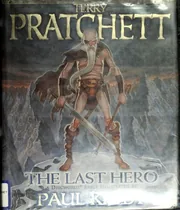
The Last Hero is a fantasy novel by Terry Pratchett, first published in 2001. It is the twenty-seventh title in his Discworld sequence, a series set on a flat world carried by four elephants standing on the back of an enormous turtle. This volume was produced in a bigger format than its companions, and Paul Kidby supplied artwork for every page, so the book reads partly as an illustrated work. At about 174 pages, it is a compact entry in the series.
The cast draws on familiar Discworld figures. Cohen the Barbarian, Havelock Vetinari, Rincewind, Leonard of Quirm, Carrot Ironfoundersson and the Librarian all appear. Readers who already know the series will recognise them, though the book also stands as a self-contained piece of Discworld fiction. It has appeared in 19 editions. The setting is the Discworld itself, an invented place that Pratchett returned to across many novels, and this book belongs to that long-running imaginary world.
The place where the story happened was a world on the back of four elephants perched on the shell of a giant turtle.
- Want to read 68
- Reading now 2
- Read 53
Readers are split between finishing it and saving it for later.
Of 123 readers who put it on a shelf, 55% want to read it, 2% are reading it now, 43% have finished it and 0% stopped before the end.
By the numbers
- The median edition runs 174 pages. Counting about 275 words a page and an adult reading pace of 250 words a minute, that is about 3.2 hours of reading.
- Open Library tracks 19 editions from 14 publishers, the earliest dated 2001 and the latest 2020, across 7 languages.
- On reader demand it ranks in the top 8% of the modern books in our catalog (15,152 of them).
- Libraries shelve it under Dewey 823.914 and Library of Congress class PR-6066.00000000.R34.
 BookWard’s take
Cohen's last ride, in Pratchett's most lavishly illustrated Discworld
The Last Hero is a short, quick Discworld entry that leaves the usual novel format behind for a large page and Paul Kidby artwork on every spread. It's tightly built, and the pace stays brisk with no sagging middle, which is a real pleasure. Pratchett's voice is unmistakable, dry and joke-dense, and the humour carries the book. The story is driven by character and set pieces rather than big ideas, and it draws on a broad Discworld cast: Cohen the Barbarian, Vetinari, Rincewind, Leonard of Quirm, Carrot and the Librarian. All those familiar faces mean it leans on series knowledge, so it's a less natural starting point than a true standalone would be. Expect warmth over bleakness, and a book you can finish in one sitting.
At 174 pages in a big illustrated format it is a quick read, matching BookWard's love of tight books.
It moves briskly with little downtime, in line with BookWard's preference for speed.
The Discworld premise and comic take on fantasy are distinctive, though this entry builds on established ideas.
The prose is witty and polished without being ornate, somewhat richer than BookWard's plainer leaning.
An ensemble adventure balances plot and personalities, tilting slightly to plot against BookWard's character lean.
Discworld humour is generous toward its people, so the outlook is warm, matching BookWard's lean.
The book follows a conventional adventure shape, with the illustration the main formal novelty.
Comedy is central to the book, well above BookWard's already humorous lean.
Despite its barbarian heroes it is a gentle comic book, lighter than BookWard's middle.
Feeling shows through the humour but stays measured, near BookWard's middle.
See all 50 dialsEvery position, side by side with this book
Where it lines up
- PaceBookWard 8 · book 8
- EndingBookWard 8 · book 8
- Shock for effectBookWard 9 · book 9
Where it pulls apart
- Familiar tropesBookWard 10 · book 6
- OpeningBookWard 10 · book 7
- Internal logicBookWard 10 · book 7
At 174 pages in a big illustrated format it is a quick read, matching BookWard's love of tight books.
Pratchett's comic voice grabs from the first pages, close to BookWard's wish for an immediate hook.
It plays with heroic fantasy conventions rather than avoiding them, so it sits below BookWard's high bar.
Discworld's rules are consistent and the jokes follow them, which BookWard rewards, though comedy loosens things a little.
It moves briskly with little downtime, in line with BookWard's preference for speed.
The Discworld premise and comic take on fantasy are distinctive, though this entry builds on established ideas.
Familiar Discworld figures are drawn with affection and wit, though the short length keeps depth moderate.
A compact adventure like this resolves its story cleanly, which suits BookWard's taste for closure.
Pratchett lets warmth show, but wryly, so it is somewhat less restrained than BookWard prefers.
Its comedy is the draw and it does not lean on shock, which BookWard welcomes.
Pratchett's dry, footnote-friendly voice is one of the most recognisable in fantasy, a strong match for BookWard.
The book is built around a story and its characters, though satire on heroism runs through it.
Pratchett explains with wit in narration, a little more than BookWard's show-it-in-scene preference.
At this length there is no room for a slack stretch, which BookWard values.
The prose is witty and polished without being ornate, somewhat richer than BookWard's plainer leaning.
An ensemble adventure balances plot and personalities, tilting slightly to plot against BookWard's character lean.
Discworld humour is generous toward its people, so the outlook is warm, matching BookWard's lean.
The book follows a conventional adventure shape, with the illustration the main formal novelty.
Comedy is central to the book, well above BookWard's already humorous lean.
It reads easily and quickly, lighter than BookWard's middling tolerance for effort.
A large cast means the story moves between many characters, a little more than BookWard's lean.
The adventure runs straight ahead with no timeline games, more linear than BookWard's middle.
It is set on a flat world on elephants and a turtle, fully fantastical, beyond BookWard's middle.
Cohen, Vetinari, Rincewind, Leonard, Carrot and the Librarian make for a big ensemble, above BookWard's middle.
A gathering of Discworld's famous names gives it a larger canvas than BookWard's intimate-to-epic middle.
Action and incident drive it more than introspection, leaning outward past BookWard's centre.
Pratchett's banter does a lot of the work, matching BookWard's liking for dialogue.
Romance is not a focus of this adventure, so it sits well below BookWard's middle.
Discworld is an invented place with its own rules, though regular readers will find it familiar.
It is a secondary-world fantasy outside any real era, so the present-day dial barely applies.
Pratchett's humour about heroes and ageing travels well beyond its 2001 release.
The narrator is a reliable guide whose wry commentary can be trusted, far from unreliable.
The book tends toward clear sympathies with some wry grey areas, less ambiguous than BookWard's lean.
Kidby's art on every page supplies much of the richness, matching BookWard's middle on description.
It is the twenty-seventh Discworld book, well into series territory, though it also works as a self-contained story.
Comic reversals and surprises appear, a little under BookWard's love of twists.
It is a light, comforting read rather than a challenging one, gentler than BookWard's taste.
Despite its barbarian heroes it is a gentle comic book, lighter than BookWard's middle.
Feeling shows through the humour but stays measured, near BookWard's middle.
Pratchett's humour is dry and clever yet delivered with broad comic setups, landing just above middle.
Fantasy adventure brings some action, but the tone keeps it mild.
Sexual content is essentially absent from this comic adventure.
Satire of power and heroism is present but never front and centre.
The language is plain and accessible, easier than BookWard's middle.
Pratchett's narration is full of opinion and wry asides, a good fit for BookWard's lean.
A story about heroes at the end of their era looks back more than BookWard's forward lean.
Beneath the jokes sits a fondness for decency, near BookWard's idealistic lean.
Review written by BookWard, dial version 1, November 2026.
Who is The Last Hero right for?
Suits teens and adults, and fans of comic fantasy of any age. It is mild overall, with some fantasy action and humour about heroic violence.
It reads easily and quickly, lighter than BookWard's middling tolerance for effort.
Despite its barbarian heroes it is a gentle comic book, lighter than BookWard's middle.
Feeling shows through the humour but stays measured, near BookWard's middle.
Fantasy adventure brings some action, but the tone keeps it mild.
Book CompanionThe Last Hero: ideas, characters, themes
A short, illustrated Discworld adventure gathers favourite characters around the fate of an ageing hero.
- A bigger format. The book was published larger than other Discworld novels, with Paul Kidby art on every page.
- Compact length. At about 174 pages it is one of the quicker entries in the series.
- A gathered cast. Cohen, Vetinari, Rincewind, Leonard of Quirm, Carrot and the Librarian all appear.
- Part of Discworld. It is the twenty-seventh book in the long-running series.
- Readable on its own. It works as self-contained Discworld fiction even without the earlier books.
Characters
Cohen the Barbarian
Legendary hero
A famous figure from Discworld lore who sits at the centre of the story.
Havelock Vetinari
Ruler of Ankh-Morpork
The city's calculating Patrician, a regular series presence.
Rincewind
Wizard
A recurring Discworld wizard known to series readers.
Leonard of Quirm
Inventor
The inventive genius of the Discworld.
Carrot Ironfoundersson
City Watch officer
A well-loved member of the Ankh-Morpork Watch.
Themes
What it means to be a hero, and who gets remembered as one.
How famous figures are judged as their era draws to a close.
Gentle mockery of fantasy conventions and of power.
Loyalty among an unlikely group of allies.
Discussion questions
- How does the illustrated format change the way you read a Discworld story?
- Which of the familiar characters did you most enjoy seeing together?
- Does the book work for someone new to Discworld?
- What is Pratchett saying about heroes through humour?
- How does a short length shape the pacing compared with longer Discworld novels?
Personalize your Book Companion
This is the general edition. In BookWard, the Companion is written for you: your reading profile, your notes, and spoiler-safe to the page you are on.
Buy, listen or borrow The Last Hero
Each link opens a search for this book on that store, in a new tab.
Read on a device
Borrow
Reviews and community
If you liked The Last Hero
A dragon, a doomed Watch, and Pratchett's sharpest early satire
Wyrd SistersTerry PratchettPratchett's Macbeth-flavored Discworld comedy, sharp and quick, with three unforgettable witches
Feet of ClayTerry PratchettPratchett's Watch novel pairs a golem murder with a poisoned Patrician
MaskeradeTerry PratchettDiscworld's witches crash the opera in a witty Phantom spoof
Sources: Open Library.
Track The Last Hero and find your next favorite
Add it to your shelf, rate what you have read, and BookWard will recommend what fits you.
Free to start. No credit card needed.