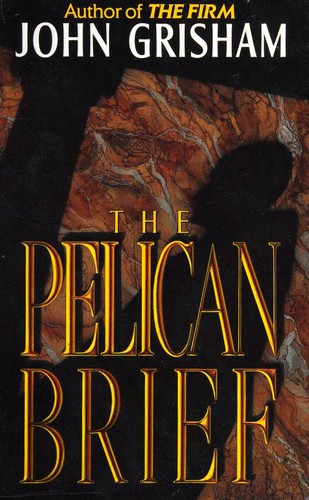
The Pelican Brief
by John Grisham
★ Top 25 book of 1992 · #19 on Best Books of 1992
John Grisham's third novel, following A Time to Kill and The Firm, is a legal-suspense thriller first published by Doubleday in 1992.
Best for: Readers who enjoy legal suspense and have followed Grisham's earlier novels
The Pelican Brief is #19 on BookWard's Best Books of 1992, out of 43 1992 books that cleared our data bar.
What The Pelican Brief is about
Two Supreme Court justices are assassinated within a short time of each other, one a liberal, the other a Republican-appointed swing vote, and the killer turns out to be the most wanted hitman in the world. Darby Shaw, a law student at Tulane, writes a speculative legal brief arguing that politics had nothing to do with it. She suspects the answer lies in money, oil, and a stretch of Louisiana marshland that is home to an endangered pelican.
Then the people close to her start paying for what she has written, and she is forced to run. Gray Grantham, a Washington Post reporter, offers to help her prove it, while the White House works to bury its connection to a powerful oil tycoon. John Grisham's third novel is a fast, tense legal thriller about corruption, the press, and how far the powerful will go to protect their interests. It suits readers who like a smart, hunted heroine and a conspiracy that keeps widening.
The Pelican Brief on the Best Books of 1992
The Pelican Brief came out in 1992. Of the 43 books first published in 1992 that met BookWard's data bar, it ranks #19 on our Best Books of 1992 list.
Why it made the list: 253 readers have shelved it on Open Library; readers rate it 3.8 out of 5 (27 ratings). The list ranks each year’s books on how many readers have picked them up, how highly readers rate them, and how many are reading them right now.
Nearby on the 1992 list
- All the Pretty Horses Cormac McCarthy, #17
- Red Mars Kim Stanley Robinson, #18
- Dragonfly in Amber Diana Gabaldon, #20
- Dolores Claiborne Stephen King, #21
See all Best Books of 1992 Best books by year
More years: Best Books of 1991 Best Books of 1993.
The numbers behind it
- Readers: 181 want to read it, 11 are reading it now and 61 have read it, according to Open Library.
- Ratings: 3.8 out of 5 from 27 Open Library ratings.
| Signal | This book (0 to 100) | Weight |
|---|---|---|
| Reach | 58 | 55% |
| Reader love | 28 | 25% |
| Being read right now | 56 | 20% |
Questions about The Pelican Brief
When was The Pelican Brief published?
The Pelican Brief by John Grisham was first published in 1992.
Was The Pelican Brief one of the best books of 1992?
The Pelican Brief is #19 on BookWard's Best Books of 1992, out of 43 1992 books that cleared our data bar. 253 readers have shelved it on Open Library; readers rate it 3.8 out of 5 (27 ratings).
Why is The Pelican Brief on the Best Books of 1992 list?
253 readers have shelved it on Open Library; readers rate it 3.8 out of 5 (27 ratings).
More of the best books of 1992
- Welcome to Dead House Robert Lawrence Stine, #1
- The Secret History Donna Tartt, #2
- Snow Crash Neal Stephenson, #3
- The Indispensable Calvin and Hobbes Bill Watterson, #4
- The Shadow Rising Robert Jordan, #5
- The Artist's Way Julia Cameron, #6
See the full Best Books of 1992, the Top 100, or new books on Rising.
How we know
This page uses public data: Open Library reader counts and ratings, and Wikipedia page views for recent years. The description is paraphrased from real source text. Rankings reflect reading interest, not quality or sales, and can be affected by data gaps. Lists update monthly.
Suits adult and older teen readers who enjoy fast thrillers.
Depends on the edition you pick.
A fast legal thriller where a law student's brief becomes a death sentence. 51% taste match
 BookWard’s take
A fast legal thriller where a law student's brief becomes a death sentence
The Pelican Brief opens with two Supreme Court justices assassinated, and it never gives the reader time to settle. The hook is where it earns its place: the murders land on page one, and within a few chapters a law student's speculative brief has turned her into a target. The pace stays high and the middle never sags, since the chase keeps tightening. Familiar tropes are the weak spot. The lone innocent on the run, the reporter ally and the oil tycoon villain are well-worn shapes, so the book feels less original than I'd like. The internal logic is strong, because the conspiracy is built step by step from the brief itself. Politics is front and center without turning into a lecture. It's Grisham's third novel, and a clean, quick read.
Pursuit and revelation keep alternating, so the story rarely slows, which suits BookWard well.
The legal-conspiracy framing is competent but sits within an established thriller mold, short of BookWard's originality bar.
The prose is plain and functional, built for momentum rather than ornament.
Events drive everything; character exists to move through the plot.
The tone is tense and cynical about power, though the heroine's survival offers some lift.
A conventional thriller structure of crime, investigation, flight and confrontation.
This is a serious thriller with very little humor.
See all 50 dialsEvery position, side by side with this book
Where it lines up
- PaceBookWard 8 · book 8
- Story or ideasBookWard 3 · book 3
- OpeningBookWard 10 · book 9
Where it pulls apart
- Familiar tropesBookWard 10 · book 4
- Rigor (nonfiction)BookWard 9 · book 2
- LengthBookWard 1 · book 4
Two justices are assassinated at the start, so the stakes are set immediately, exactly the kind of opening BookWard rewards.
The student on the run, the journalist ally and the oil-money villain are familiar shapes, which cuts against BookWard's taste.
The conspiracy is traced step by step from the brief's theory, so cause and effect hold together well.
Pursuit and revelation keep alternating, so the story rarely slows, which suits BookWard well.
The legal-conspiracy framing is competent but sits within an established thriller mold, short of BookWard's originality bar.
Characters serve the plot more than they deepen, so Darby and the rest read as capable types.
The threads are largely resolved by the close, which fits BookWard's preference for payoff.
The book keeps emotion at arm's length in favor of plot, which BookWard finds a good fit.
The killings drive the story rather than decorate it, though some violence is there mainly to raise tension.
This is a novel; the legal and political detail serves the plot rather than argument.
Grisham's plain, efficient style is recognizable but not strikingly distinctive.
The story leads, with the conspiracy idea serving as engine for the chase.
Legal and political background is explained to the reader fairly directly, more than BookWard usually likes.
The chase structure keeps tension up through the middle, with little slack.
The prose is plain and functional, built for momentum rather than ornament.
Events drive everything; character exists to move through the plot.
The tone is tense and cynical about power, though the heroine's survival offers some lift.
A conventional thriller structure of crime, investigation, flight and confrontation.
This is a serious thriller with very little humor.
The legal intrigue is easy to follow and reads quickly.
The story moves between the student, the reporter and the hunters, giving a handful of viewpoints.
Events unfold in straightforward chronological order.
The setting is grounded in contemporary Washington and Louisiana.
A mid-sized cast of lawyers, officials, killers and press fits the conspiracy plot.
The plot reaches the Supreme Court and the White House, so the stakes are national.
Action and pursuit dominate over interior reflection.
Conversations, briefings and confrontations carry much of the story.
A relationship is part of the setup but not the center of the book.
Law schools, courts and Washington politics are familiar territory to most readers.
Set in the early 1990s, so it reads as recent past rather than the present day.
The conspiracy-thriller template ages reasonably well, though the book carries its early-90s stamp.
A straightforward third-person narration with no sign of unreliability.
The heroes and the corrupt powerful are drawn in fairly clear terms.
Description stays lean, in service of movement and plot.
Review written by BookWard, dial version 1, November 2026.
Who is The Pelican Brief right for?
Suits adult and older teen readers who enjoy fast thrillers. It includes assassinations, a car bombing and other violence, and a plot involving political corruption.
The legal intrigue is easy to follow and reads quickly.
Book CompanionThe Pelican Brief: ideas, characters, themes
A law student's speculative brief about why two Supreme Court justices were killed makes her the target of the people behind it.
- The murders. Two ideologically opposed justices are assassinated by the hitman Khamel, shocking a divided nation.
- The brief. Darby Shaw researches their records and writes a brief proposing the killings were not political.
- The danger. After the brief reaches others, people close to Darby are killed and she goes on the run.
- The reporter. Gray Grantham of The Washington Post becomes her ally as she shares her findings.
- The motive. The theory points to an oil tycoon seeking access to Louisiana marshland that shelters an endangered pelican.
Characters
Darby Shaw
Tulane law student
Writes the brief and is hunted because of it.
Gray Grantham
Washington Post reporter
Investigates the killings and teams up with Darby.
Thomas Callahan
Law professor
Darby's professor and lover, who passes her brief along.
Gavin Verheek
FBI lawyer
Callahan's friend, who receives the brief.
Khamel
Hitman
The assassin behind the killings.
Themes
How wealth can bend law and politics to its ends.
The struggle to expose a conspiracy others want buried.
Whether legal institutions can serve justice when corrupted.
An ordinary person staying alive against professional killers.
Journalism as a check on hidden power.
Discussion questions
- Is Darby's theory believable from the evidence she has, and why does it matter that it is only a theory?
- How does the book use the Supreme Court to raise the stakes?
- What makes the journalist and the student a workable partnership?
- Does the oil-and-environment motive feel plausible as a reason to kill?
- How does the story balance legal detail with the demands of a chase?
Personalize your Book Companion
This is the general edition. In BookWard, the Companion is written for you: your reading profile, your notes, and spoiler-safe to the page you are on.
Buy, listen or borrow The Pelican Brief
Each link opens a search for this book on that store, in a new tab.
Read on a device
Borrow
Reviews and community
If you liked The Pelican Brief
A fast, twisty Arctic thriller that trades subtlety for momentum
The PartnerJohn GrishamA faked death, a missing fortune, and a fugitive in Brazil
Digital FortressDan BrownA fast codebreaking thriller that trades polish for momentum
The ClientJohn GrishamA boy, a dead body, and a lawyer worth rooting for
Find your own best books
Add what you have read, rate it, and BookWard will recommend what to read next.
Free to start. No credit card needed.