It suits older teens and adults who enjoy fast thrillers.
447 pages, about 7 to 10.5 hours.
A fast codebreaking thriller that trades polish for momentum. 39% taste match
The story
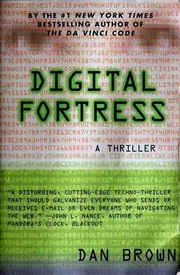
Digital Fortress is a techno-thriller by American author Dan Brown, first published in 1998 by St. Martin's Press. It belongs to the mystery and thriller category and centers on cryptographers, intelligence officers and supercomputers, with computer security running through the story. The novel runs to roughly 447 pages in its median edition, and it has appeared in 86 editions.
The book takes up the matter of government surveillance of electronic information about private citizens, along with the civil liberties and ethical questions raised by using such technology. Its cast includes Susan Fletcher, David Becker, Ensei Tankado, Trevor Strathmore, Greg Hale, Leland Fontaine, Midge Milken and Chad Brinkerhoff, among others. The action moves between the United States and Spain, with Seville and Tokyo among the places that figure in the story. Readers who enjoy contemporary American fiction about codes, intelligence work and the reach of the state into everyday digital life will find the subject matter familiar territory.
They were in the Smoky Mountains at their favorite bed-and-breakfast.
Characters
Susan FletcherEnsei TankadoDavid BeckerTrevor StrathmoreGreg HaleLeland Fontaine
Setting
USASevillaTokyoSevilleSpain
Themes
techno-thrillersupercomputersSe curite informatiqueIntelligence officersCryptographersComputer securityRomans, nouvellesOfficiers de renseignements
- Want to read 391
- Reading now 41
- Read 103
Most people shelving it are saving it for later.
Of 535 readers who put it on a shelf, 73% want to read it, 8% are reading it now, 19% have finished it and 0% stopped before the end.
By the numbers
- The median edition runs 447 pages. Counting about 275 words a page and an adult reading pace of 250 words a minute, that is about 8.2 hours of reading.
- Open Library tracks 86 editions from 64 publishers, the earliest dated 1998 and the latest 2023, across 15 languages.
- On reader demand it ranks in the top 1% of the modern books in our catalog (15,152 of them).
- Libraries shelve it under Dewey 813.54 and Library of Congress class PS-3552.00000000.R685434 D54 1998.
 BookWard’s take
A fast codebreaking thriller that trades polish for momentum
Digital Fortress is Dan Brown's 1998 techno-thriller about cryptographers, intelligence officers and a supercomputer, set against a debate over government surveillance. It moves quickly and hooks early, which is a real pleasure in a book like this. The cast is small and the story is firmly plot-led, so character depth is where it falls short. Familiar tropes are plentiful: the genius heroine, the shadowy agency, the ticking clock. The book is only moderately original, and its internal logic is stretched by convenient technical leaps. Where it earns its keep is the question underneath: how much privacy a society should trade for safety. That idea gives a brisk page-turner more weight than its plotting alone would. Read it for speed and a live debate, not for subtlety.
At 447 pages it is longer than its single-night premise needs, which sits against BookWard's love of tight books.
Short chapters and a countdown drive it forward relentlessly, matching BookWard's liking for speed.
The surveillance-versus-privacy premise has bite, but the thriller machinery around it is well worn.
Plain, functional sentences keep attention on the plot, close to BookWard's mid-low preference.
Events and the ticking clock drive everything, so it sits well toward plot rather than character.
The outlook is neither bleak nor sunny, a measured thriller mood.
It runs as a conventional thriller with cross-cut scenes, safer than BookWard's middle ground.
It plays almost entirely straight, tension over humor.
Stakes and some killing give it an edge, though it stays within standard thriller bounds.
Tension is high, but deep feeling is held in check.
See all 50 dialsEvery position, side by side with this book
Where it lines up
- PaceBookWard 8 · book 9
- EndingBookWard 8 · book 7
- Story or ideasBookWard 3 · book 4
Where it pulls apart
- Familiar tropesBookWard 10 · book 3
- Internal logicBookWard 10 · book 4
- LengthBookWard 1 · book 6
At 447 pages it is longer than its single-night premise needs, which sits against BookWard's love of tight books.
It opens straight into a crisis at a secret agency, which is exactly the immediate pull BookWard rewards.
Genius cryptographer, rogue insider, secretive agency: the genre furniture is mostly stock, which BookWard marks down.
The codebreaking premise leans on convenient technical leaps, so it falls short of the airtight plotting BookWard wants.
Short chapters and a countdown drive it forward relentlessly, matching BookWard's liking for speed.
The surveillance-versus-privacy premise has bite, but the thriller machinery around it is well worn.
Characters serve the plot more than they deepen, which is thinner than BookWard prefers.
The central problem is settled and the threads close, which BookWard values in a thriller.
A love interest adds some warmth, but the book stays mostly cool and mechanical.
Its jolts serve the puzzle rather than shock for its own sake, a neutral fit for BookWard.
The prose is serviceable and genre-standard rather than distinctive, short of BookWard's taste for strong voice.
Story clearly leads, though the surveillance question gives the plot a real idea to chew on.
Technical concepts are often explained outright in dialogue, the opposite of BookWard's show-it-in-scene preference.
The brisk structure keeps it moving, though a few stretches of explanation loosen the grip.
Plain, functional sentences keep attention on the plot, close to BookWard's mid-low preference.
Events and the ticking clock drive everything, so it sits well toward plot rather than character.
The outlook is neither bleak nor sunny, a measured thriller mood.
It runs as a conventional thriller with cross-cut scenes, safer than BookWard's middle ground.
It plays almost entirely straight, tension over humor.
Easy to read at speed, a touch easier than BookWard's comfortable middle.
The story cuts between several people in different places, which fits BookWard's taste for many viewpoints.
Events unfold in a straightforward line, more linear than BookWard typically prefers.
The story stays grounded in a plausible-seeming world of computers and intelligence work.
A compact core of cryptographers and officials keeps the cast manageable.
A national-security stake raises the scale, though the action stays tightly contained.
Action and plot mechanics dominate, with little time spent inside heads.
Conversation carries much of the explanation and tension, which fits BookWard's taste for dialogue.
A romantic thread runs alongside the crisis without taking over.
The agency and cryptography world will be unfamiliar to many readers, a point BookWard likes.
Its late-1990s setting reads as a few decades back rather than today.
Its technology and anxieties are tied to the late 1990s, so it dates more than BookWard prefers.
A straightforward third-person narrator, reliable throughout, which sits below BookWard's taste for unreliability.
Both surveillance and privacy get a hearing, giving it moderate ambiguity.
Description stays lean and functional, serving the pace over atmosphere.
It stands on its own, matching BookWard's lean toward standalone books.
Reversals and reveals come steadily, well matched to BookWard's appetite for surprises.
It entertains more than it unsettles, a comfortable read despite the serious theme.
Stakes and some killing give it an edge, though it stays within standard thriller bounds.
Tension is high, but deep feeling is held in check.
Deaths occur as part of the plot, at a moderate thriller level.
Romance is present but sexual content is minimal.
Government surveillance and civil liberties sit at the core of the plot.
Language is plain, with technical terms explained as they come up.
The narration mostly reports events, with the debate carried by the characters.
The concerns it raises about surveillance point forward, making it future-minded.
It leans on a belief in doing right by privacy while acknowledging real threats.
Review written by BookWard, dial version 1, November 2026.
Who is Digital Fortress right for?
It suits older teens and adults who enjoy fast thrillers. It contains violence and threats typical of the genre, though little sexual content.
Easy to read at speed, a touch easier than BookWard's comfortable middle.
Stakes and some killing give it an edge, though it stays within standard thriller bounds.
Tension is high, but deep feeling is held in check.
Deaths occur as part of the plot, at a moderate thriller level.
Book CompanionDigital Fortress: ideas, characters, themes
A thriller built on the question of how far a state should go in reading private electronic life, and what happens when the tools meet their limits.
- Surveillance as the engine. The plot turns on government monitoring of private data, giving the action a live ethical question.
- Cryptographers at the center. Codebreaking and computer security shape both the puzzle and the people in it.
- Two locations, one clock. The story moves between the United States and Spain, with Seville and Tokyo figuring in it.
- A small, tied-together cast. A handful of agency staff and specialists carry the story, each tied to the central crisis.
- Speed over subtlety. Short, tense scenes keep the reading fast, favoring momentum over nuance.
Characters
Susan Fletcher
Cryptographer
One of the story's central figures, working within the world of codebreaking.
David Becker
Key figure in the plot
A significant character whose actions connect to the central crisis.
Ensei Tankado
Figure tied to the central puzzle
A name closely linked to the codes at the heart of the story.
Trevor Strathmore
Intelligence official
An agency figure with authority inside the story's secretive setting.
Themes
How much personal freedom a society should give up in the name of safety.
Who watches the watchers when a government can read private data.
What happens when people inside a closed institution cannot rely on one another.
The idea that even the most powerful machines can be outmaneuvered.
Discussion questions
- Where should the line fall between public safety and private communication?
- Which parts of the technical puzzle felt convincing, and which felt convenient?
- How does the Seville setting change the feel of the story?
- Did the characters feel like people or like roles in a plot?
- Does the book's late-1990s view of technology still hold up today?
Personalize your Book Companion
This is the general edition. In BookWard, the Companion is written for you: your reading profile, your notes, and spoiler-safe to the page you are on.
Buy, listen or borrow Digital Fortress
Each link opens a search for this book on that store, in a new tab.
Read on a device
Borrow
Reviews and community
If you liked Digital Fortress
A fast, twisty Arctic thriller that trades subtlety for momentum
The Pelican BriefJohn GrishamA fast legal thriller where a law student's brief becomes a death sentence
The PartnerJohn GrishamA faked death, a missing fortune, and a fugitive in Brazil
Angels & DemonsDan BrownA one-day Vatican chase that runs on clues and speed
Sources: Open Library.
Track Digital Fortress and find your next favorite
Add it to your shelf, rate what you have read, and BookWard will recommend what fits you.
Free to start. No credit card needed.