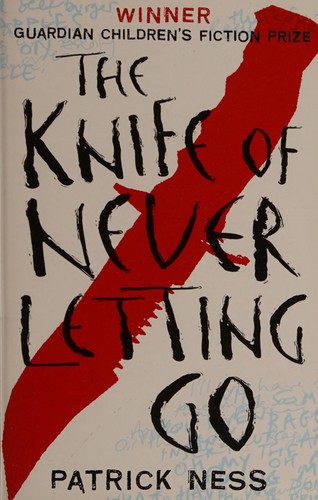
The Knife of Never Letting Go
by Patrick Ness
★ Top 25 book of 2008 · #15 on Best Books of 2008
Todd Hewitt is a month from becoming a man in a town where he is the only boy and the men can hear each other's thoughts. Secrets kept from him force him to run in this unflinching novel about growing up's impossible choices.
Best for: Readers who like unflinching novels about the hard choices of growing up
The Knife of Never Letting Go is #15 on BookWard's Best Books of 2008, out of 46 2008 books that cleared our data bar.
What The Knife of Never Letting Go is about
Todd Hewitt is the last boy in Prentisstown, a settlement on New World, a planet humans have only recently colonized. In a matter of days he will turn thirteen, the age when boys there count as men. On this world a germ called the Noise makes every thought of men and animals audible, so nothing stays private, and Todd has learned to live inside the constant din with his dog, Manchee.
Then, in the swamp, he stumbles on something impossible: a patch of silence. It turns out to be a girl named Viola, whose scout ship has crashed. Todd's adoptive parents have long prepared for the day he would have to flee, and soon he and Viola are on the run from Aaron, the town preacher, and the forces of Mayor Prentiss. They head for Haven, where a cure for the Noise is rumored. Urgent and emotionally raw, this first book of the Chaos Walking series explores secrets, violence and what it means to become a man.
The Knife of Never Letting Go on the Best Books of 2008
The Knife of Never Letting Go came out in 2008. Of the 46 books first published in 2008 that met BookWard's data bar, it ranks #15 on our Best Books of 2008 list.
Why it made the list: 295 readers have shelved it on Open Library; readers rate it 4.2 out of 5 (25 ratings). The list ranks each year’s books on how many readers have picked them up, how highly readers rate them, and how many are reading them right now.
Nearby on the 2008 list
- In Defense of Food Michael Pollan, #13
- Predictably Irrational Dan Ariely, #14
- The Tales of Beedle the Bard J. K. Rowling, #16
- Duma Key Stephen King, #17
See all Best Books of 2008 Best books by year
More years: Best Books of 2007 Best Books of 2009.
The numbers behind it
- Readers: 237 want to read it, 16 are reading it now and 42 have read it, according to Open Library.
- Ratings: 4.2 out of 5 from 25 Open Library ratings.
| Signal | This book (0 to 100) | Weight |
|---|---|---|
| Reach | 57 | 55% |
| Reader love | 65 | 25% |
| Being read right now | 70 | 20% |
Questions about The Knife of Never Letting Go
When was The Knife of Never Letting Go published?
The Knife of Never Letting Go by Patrick Ness was first published in 2008.
Was The Knife of Never Letting Go one of the best books of 2008?
The Knife of Never Letting Go is #15 on BookWard's Best Books of 2008, out of 46 2008 books that cleared our data bar. 295 readers have shelved it on Open Library; readers rate it 4.2 out of 5 (25 ratings).
Why is The Knife of Never Letting Go on the Best Books of 2008 list?
295 readers have shelved it on Open Library; readers rate it 4.2 out of 5 (25 ratings).
More of the best books of 2008
- The Hunger Games Suzanne Collins, #1
- End of Days Sylvia Browne, #2
- The Last Straw Jeff Kinney, #3
- Amulet Kazu Kibuishi, #4
- Outliers Malcolm Gladwell, #5
- Michelle Obama in Her Own Words Michelle Obama, #6
See the full Best Books of 2008, the Top 100, or new books on Rising.
How we know
This page uses public data: Open Library reader counts and ratings, and Wikipedia page views for recent years. The description is paraphrased from real source text. Rankings reflect reading interest, not quality or sales, and can be affected by data gaps. Lists update monthly.
Suited to older teens and adults who enjoy fast, character-led science fiction.
Depends on the edition you pick.
A boy, a dog and a world with no silence. 62% taste match
 BookWard’s take
A boy, a dog and a world with no silence
Patrick Ness drops you into Prentisstown, where every man's thoughts spill out loud, and gives you a twelve-year-old who has never known a private moment. The hook is immediate: Todd finds a patch of silence in the swamp and everything starts moving. The pace stays high because the book keeps Todd running, which also keeps the middle from sagging. Originality is the real draw. The Noise is a fresh device for a story about secrets, and Viola's silence set against it gives the book its tension. The voice is distinctive and rough-edged, shaped by Todd's own way of speaking. Familiar tropes are easy to spot in a chase story, but the premise lifts it clear of them. It is the first of the Chaos Walking series, and it won the Booktrust Teenage Prize, the Guardian Award and the James Tiptree, Jr. Award.
A full-length novel with a long road to cover, though never padded. BookWard prefers shorter, so this sits a little above its taste.
Todd is almost always moving or being pursued, so the book rarely slows. That suits BookWard's appetite for speed.
A world where men hear each other's thoughts is a fresh idea, and it shapes every scene, which BookWard rewards.
The language is deliberately plain and spoken, built from Todd's voice instead of ornament.
Plot and character are tightly bound, with Todd's growth running alongside the chase.
The world is harsh and threatening, though connection and loyalty offer some light, leaning gloomier than BookWard's outlook.
The structure is a straightforward journey, with the distinctive Noise typography as its main formal quirk.
There is dry, bleak humor from Todd's voice, but the book is mostly serious and tense.
Burned towns and killing make this a dark book, a bit heavier than BookWard's usual middle ground.
Todd's fear, loyalty and grief come through strongly, making this more intense than restrained.
See all 50 dialsEvery position, side by side with this book
Where it lines up
- OpeningBookWard 10 · book 10
- OriginalityBookWard 9 · book 9
- PaceBookWard 8 · book 9
Where it pulls apart
- LengthBookWard 1 · book 6
- EndingBookWard 8 · book 3
- Familiar tropesBookWard 10 · book 7
A full-length novel with a long road to cover, though never padded. BookWard prefers shorter, so this sits a little above its taste.
Todd finds a hole in the Noise early and the story is off, which is exactly the instant grip BookWard wants.
A chase across a colonized planet has familiar bones, but the Noise keeps it from feeling like a standard dystopia.
The Noise, the settlement and the secrets hang together well enough to drive the plot, close to the rigor BookWard prizes.
Todd is almost always moving or being pursued, so the book rarely slows. That suits BookWard's appetite for speed.
A world where men hear each other's thoughts is a fresh idea, and it shapes every scene, which BookWard rewards.
Todd's fears and loyalties are drawn with real care, with his dog Manchee adding warmth. It lands close to BookWard's level.
This is the first book in a series, so it leaves threads hanging. That is more open than BookWard likes.
The book is emotional and sometimes tender, but it keeps its feeling tied to hard events rather than sweetness.
The darkness grows out of the premise and the stakes, rather than being used for effect, though it can hit hard.
Todd narrates in a rough, dialect-flavored voice that is unmistakable from the first page, matching BookWard's love of distinctive voice.
The concept is striking, but the book is driven by Todd's flight, so story leads ideas, as BookWard prefers.
The world is revealed through Todd's ignorance and what he discovers, not through lectures, which suits BookWard well.
The road structure keeps new threats and reveals arriving, so momentum mostly holds through the middle.
The language is deliberately plain and spoken, built from Todd's voice instead of ornament.
Plot and character are tightly bound, with Todd's growth running alongside the chase.
The world is harsh and threatening, though connection and loyalty offer some light, leaning gloomier than BookWard's outlook.
The structure is a straightforward journey, with the distinctive Noise typography as its main formal quirk.
There is dry, bleak humor from Todd's voice, but the book is mostly serious and tense.
Todd's phonetic voice takes a few pages to settle into, but the story pulls you along.
Everything is told through Todd's single point of view.
The story moves forward in a straight line as Todd runs.
Set on a colonized alien planet with a thought-sharing germ, it is firmly science fiction, though grounded in human emotion.
A small core group travels together, with a larger cast of pursuers and townsfolk in the background.
The story stays close to Todd's journey, though the stakes for whole settlements raise the scale somewhat.
Todd's thoughts matter, but constant flight and confrontation push the focus toward action.
Conversation drives much of the story, and the Noise makes talk and unspoken thought equally important.
The bond between Todd and Viola is about trust and survival rather than romance.
A colonized alien planet where men hear each other's thoughts is deeply unfamiliar, which BookWard enjoys.
It is a future and off-world setting, neither past nor present day.
The central idea of a world with no privacy feels increasingly relevant and should last.
Todd is honest but young and kept in the dark, so he is reliable, though he does not know everything.
Todd faces hard, murky choices about violence and loyalty, and the book resists easy answers.
The world is sketched through Todd's practical eye, with enough detail to place you without lingering.
This is the opening book in the Chaos Walking series, followed by The Ask and the Answer and Monsters of Men.
Secrets about Prentisstown, the Spackle and the Noise germ keep revealing themselves, matching BookWard's liking for surprises.
It takes on hard questions about violence, secrets and growing up, and does not offer comfort.
Burned towns and killing make this a dark book, a bit heavier than BookWard's usual middle ground.
Todd's fear, loyalty and grief come through strongly, making this more intense than restrained.
What humor there is comes from Todd's blunt, wry observations rather than broad comedy.
Pursuit, attack and the burning of a town put real violence on the page.
The book is aimed at teens and keeps sexual content essentially absent.
Questions of power, truth and who controls information run through the story, though not as a political tract.
Todd's phonetic, non-standard spelling and grammar make the language a little dense at first.
Todd narrates with strong, unfiltered opinions, so the telling is far from neutral.
It looks ahead to a new world being built, though the past hangs heavily over the plot.
The book is wary of institutions and adults, yet trusts that loyalty and honesty can matter.
Review written by BookWard, dial version 1, November 2026.
Who is The Knife of Never Letting Go right for?
Suited to older teens and adults who enjoy fast, character-led science fiction. It contains violence, including an attack and the burning of a town, and some intense scenes involving death.
Todd's phonetic voice takes a few pages to settle into, but the story pulls you along.
Burned towns and killing make this a dark book, a bit heavier than BookWard's usual middle ground.
Todd's fear, loyalty and grief come through strongly, making this more intense than restrained.
Pursuit, attack and the burning of a town put real violence on the page.
Book CompanionThe Knife of Never Letting Go: ideas, characters, themes
Todd Hewitt flees a town where every man's thoughts are broadcast aloud, and learns that what he was told about his world is not true.
- The Noise. Men and animals on New World can hear each other's thoughts, which removes privacy and makes every secret hard to keep.
- A hole in the Noise. Todd and his dog Manchee find a patch of silence in the swamp, which sets his escape in motion.
- Viola. Todd meets Viola, a girl whose scout ship crash-landed, and her silence marks her as different from everyone he knows.
- Prentisstown's story. Todd has been told the women and most men were killed in a war with the Spackle, but this account comes under strain as he travels.
- The road to Haven. With a map from his mother's diary, Todd travels toward other settlements while Mayor Prentiss and his men pursue.
Characters
Todd Hewitt
Narrator and protagonist
A boy a month from becoming a man in Prentisstown, who is forced to run.
Viola
Companion
A girl from a crash-landed scout ship, whose silence sets her apart from Todd's world.
Manchee
Todd's dog
Todd's loyal dog, whose thoughts are part of the Noise.
Aaron
Pursuer
The town preacher who attacks Todd and his companions in the swamp.
Mayor Prentiss
Antagonist
The leader of Prentisstown, who hunts Todd and the settlements that shelter him.
Themes
What it costs to live where nothing can be hidden, and what is lost when truths are kept.
The pressure of becoming a man and the choices that come with it.
How the stories a community tells can hide what really happened.
The bonds between Todd, his dog and his companions that keep him going.
Whether survival can justify harming others, and what that does to a person.
Discussion questions
- How would you cope if everyone could hear your thoughts at all times?
- Why do you think Todd's town kept the truth about the Noise from him?
- What does Viola's silence change about how Todd sees the world?
- How does Todd's way of speaking shape your view of him?
- Does the book make you trust or distrust the stories adults tell Todd?
Personalize your Book Companion
This is the general edition. In BookWard, the Companion is written for you: your reading profile, your notes, and spoiler-safe to the page you are on.
Buy, listen or borrow The Knife of Never Letting Go
Each link opens a search for this book on that store, in a new tab.
Read on a device
Borrow
Reviews and community
If you liked The Knife of Never Letting Go
A sequel that raises the stakes and widens the story
The Drawing of the ThreeStephen KingDoorways on a beach, and a gunslinger who needs allies
The Amulet of SamarkandJonathan StroudA sarcastic djinni steals the show in magical London
Red RisingPierce BrownA fast, brutal sci-fi revenge story that hooks from page one
Find your own best books
Add what you have read, rate it, and BookWard will recommend what to read next.
Free to start. No credit card needed.