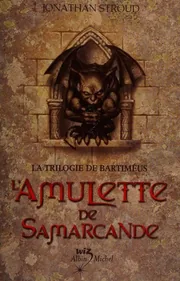
The Amulet of Samarkand
by Jonathan Stroud · 2003
It suits younger teens and up, and adults who enjoy witty fantasy.
462 pages, about 7.5 to 11 hours.
A sarcastic djinni steals the show in magical London. 63% taste match
The story
The Amulet of Samarkand is a fantasy novel for young readers by Jonathan Stroud, first published in 2003 and opening the Bartimaeus Sequence. It blends alternate history with magic and sits in the adventure tradition, following a young magician in training and the spirit he calls into service.
Nathaniel is an apprentice who summons the djinni Bartimaeus and sends him on a theft: taking the Amulet of Samarkand from Simon Lovelace, a powerful magician. The artifact was created in the ancient Central Asian city of Samarkand, and the story turns on it. The setting is London, England, in a dystopian world where magicians hold power and struggles over that power shape events. Ancient and mythological elements sit alongside present-day ones, giving the world a layered feel. Wizards, genies and apprenticeship are central to the book, which runs to roughly 462 pages in its median edition and has appeared in 33 editions. The first paperback came out in September 2003 from Doubleday in the United Kingdom.
The temperature of the room dropped fast.
Characters
Jonathan Stroud
Setting
EnglandLondon (England)
Themes
GeniesMagicApprenticesWizardsRecetasCocinaNovela juvenilMagia
- Want to read 176
- Reading now 4
- Read 62
Most people shelving it are saving it for later.
Of 242 readers who put it on a shelf, 73% want to read it, 2% are reading it now, 26% have finished it and 0% stopped before the end.
By the numbers
- The median edition runs 462 pages. Counting about 275 words a page and an adult reading pace of 250 words a minute, that is about 8.5 hours of reading.
- Open Library tracks 33 editions from 25 publishers, the earliest dated 2003 and the latest 2016, across 7 languages.
- On reader demand it ranks in the top 3% of the modern books in our catalog (15,152 of them).
- Libraries shelve it under Dewey 741.5942 and Library of Congress class PZ-0007.00000000.S92475Am 2003.
 BookWard’s take
A sarcastic djinni steals the show in magical London
Jonathan Stroud's first Bartimaeus book opens with a sharp premise: a young apprentice summons a djinni and sends him to steal an amulet from a powerful magician. It hooks at once, and that opening grip is where the book earns much of its keep. The magic runs on clear rules about summoning and binding, so the internal logic holds firm throughout. It also sidesteps the usual chosen-one wizard school routine, which keeps it from leaning on familiar tropes and gives it real freshness. Its London, where magicians rule, carries a dystopian edge. Be aware that it is a long novel and the first of a series, which may not suit readers who prefer something short and self-contained. Still, the pace stays brisk, and the humor gives it character.
At 462 pages it runs well over BookWard's preference for tight, short books, though the story keeps moving.
The heist-driven plot keeps things moving, a little below BookWard's fast preference but comfortably brisk.
A cynical djinni and a scheming apprentice in a magician-ruled London feel fresher than standard young-wizard fare.
The writing is lively and clear rather than ornate, a bit plainer than BookWard's middle position.
Events push the story along more than inner change does, leaning plot-driven against BookWard's character tilt.
The world is oppressive but the tone stays spirited, landing near the middle of the scale.
A mix of narrators and footnote-style asides adds some play, a touch more experimental than BookWard's norm.
Bartimaeus is wisecracking and sarcastic, matching BookWard's liking for humor in the mix.
Magical menace and danger run through it without tipping into heavy grimness, near BookWard's level.
Feeling surfaces through Nathaniel's ambition and resentment but never overwhelms the wit.
See all 50 dialsEvery position, side by side with this book
Where it lines up
- Authorial voiceBookWard 9 · book 9
- Story or ideasBookWard 3 · book 3
- PaceBookWard 8 · book 7
Where it pulls apart
- LengthBookWard 1 · book 7
- Familiar tropesBookWard 10 · book 7
- OpeningBookWard 10 · book 8
At 462 pages it runs well over BookWard's preference for tight, short books, though the story keeps moving.
A summoning and a theft assignment arrive early, which suits BookWard's liking for books that grab you at once.
It plays with wizard and genie conventions rather than leaning on them, close to what BookWard wants.
Summoning, binding and the magical hierarchy follow clear rules, which BookWard values highly.
The heist-driven plot keeps things moving, a little below BookWard's fast preference but comfortably brisk.
A cynical djinni and a scheming apprentice in a magician-ruled London feel fresher than standard young-wizard fare.
Nathaniel and Bartimaeus are drawn with real personality, though not as deeply as BookWard would ideally like.
The first volume resolves its central heist while leaving the larger story open for the sequence.
The tone leans on wit and edge over tenderness, which sits well with BookWard's restraint.
Darker turns serve the story and the world's harshness rather than existing for effect.
Bartimaeus's sardonic narration gives the book a distinctive voice, a strong match for BookWard.
Story clearly leads, with ideas about power and servitude carried inside the adventure, close to BookWard's story-first taste.
The world is mostly revealed through action, with some explaining where the magic needs it.
The heist structure keeps momentum fairly steady, though a book this long has some slower stretches.
The writing is lively and clear rather than ornate, a bit plainer than BookWard's middle position.
Events push the story along more than inner change does, leaning plot-driven against BookWard's character tilt.
The world is oppressive but the tone stays spirited, landing near the middle of the scale.
A mix of narrators and footnote-style asides adds some play, a touch more experimental than BookWard's norm.
Bartimaeus is wisecracking and sarcastic, matching BookWard's liking for humor in the mix.
Easy to follow for its audience, so it asks less of the reader than BookWard tolerates.
The story alternates between a couple of main perspectives rather than a wide spread.
The story moves forward in order without time jumps, more linear than BookWard's mild lean.
Djinn, demons and a magical ruling class make this firmly fantastical.
A modest core of magicians and spirits drives the story, near BookWard's comfortable cast size.
The stakes are personal and political within London rather than world-ending epic.
Theft, pursuit and confrontation push the action to the outside, more than BookWard's inward lean.
Banter between master and spirit carries much of the book's energy.
Romance is not part of the story.
A magician-ruled alternate London is unfamiliar enough to feel new, in line with BookWard's taste.
Its sharp humor and clean premise should age well, in line with BookWard's staying power preference.
Bartimaeus is cocky and self-serving, which bends the account without making him a pure liar.
Nobody is purely good in this world, including the hero, which suits BookWard's comfort with ambiguity.
London and its magic are drawn with vivid, specific detail, richer than BookWard's middle.
It opens the Bartimaeus Sequence, so it sits at the far end from standalone.
Plot reversals and double-crosses are frequent, close to what BookWard enjoys.
It entertains first and challenges lightly through its themes of power and servitude.
Magical menace and danger run through it without tipping into heavy grimness, near BookWard's level.
Feeling surfaces through Nathaniel's ambition and resentment but never overwhelms the wit.
Dry wit and sarcasm sit alongside broader comic moments, landing mid-scale like BookWard.
Magical combat and danger appear regularly but are pitched for young readers, matching BookWard's middle.
The book has no meaningful sexual content.
Magician rule and power struggles give the book a political backbone, a bit stronger than BookWard's middle.
The language is clean and accessible with some period flavor.
Bartimaeus is loud with opinions and commentary, more than BookWard's slight lean.
The alternate-past setting and ancient artifacts pull the story backward more than forward.
The world is cynical about power, with idealism only a small counterweight.
Review written by BookWard, dial version 1, November 2026.
Who is The Amulet of Samarkand right for?
It suits younger teens and up, and adults who enjoy witty fantasy. Expect magical danger and conflict at a level pitched for young readers.
Easy to follow for its audience, so it asks less of the reader than BookWard tolerates.
Magical menace and danger run through it without tipping into heavy grimness, near BookWard's level.
Feeling surfaces through Nathaniel's ambition and resentment but never overwhelms the wit.
Magical combat and danger appear regularly but are pitched for young readers, matching BookWard's middle.
Book CompanionThe Amulet of Samarkand: ideas, characters, themes
A young apprentice magician commands a sarcastic djinni to steal a powerful artifact in a London where magicians rule.
- The summoning. Nathaniel calls up the djinni Bartimaeus and gives him a dangerous theft to carry out.
- The target. The goal is to take the Amulet of Samarkand from the powerful magician Simon Lovelace.
- The setting. The story unfolds in a dystopian London where magicians hold power and fight over it.
- Layered world. Ancient and mythological elements sit beside present-day ones, giving the setting texture.
- Series opener. It begins the Bartimaeus Sequence, first published in the UK in 2003.
Characters
Nathaniel
Apprentice magician
A young magician in training who summons the djinni and sets the theft in motion.
Bartimaeus
Djinni
The spirit Nathaniel summons and sends to steal the amulet.
Simon Lovelace
Powerful magician
The magician who holds the Amulet of Samarkand.
Themes
Who holds it, who is bound by it, and how struggles over it shape a society.
The relationship between a master and the spirit he commands.
How a young apprentice's drive pushes him into dangerous choices.
How ancient myth blends with a modern, alternate-history London.
Discussion questions
- Why does the story put a sarcastic djinni at the center rather than only the apprentice?
- How does the magician-ruled London compare to other fantasy worlds you know?
- What does the book suggest about people who hold power over others?
- Is Nathaniel someone you root for, and why?
- How does the artifact's ancient origin shape the way the story feels?
Personalize your Book Companion
This is the general edition. In BookWard, the Companion is written for you: your reading profile, your notes, and spoiler-safe to the page you are on.
Buy, listen or borrow The Amulet of Samarkand
Each link opens a search for this book on that store, in a new tab.
Read on a device
Borrow
Reviews and community
If you liked The Amulet of Samarkand
A Holmes-and-Watson murder mystery inside a leviathan-haunted fantasy empire
The Raven ScholarAntonia HodgsonA murder mystery inside a succession contest, narrated with a wink
Feet of ClayTerry PratchettPratchett's Watch novel pairs a golem murder with a poisoned Patrician
Night WatchTerry PratchettVimes, thrown thirty years back, must teach his younger self to police
Sources: Open Library.
Track The Amulet of Samarkand and find your next favorite
Add it to your shelf, rate what you have read, and BookWard will recommend what fits you.
Free to start. No credit card needed.