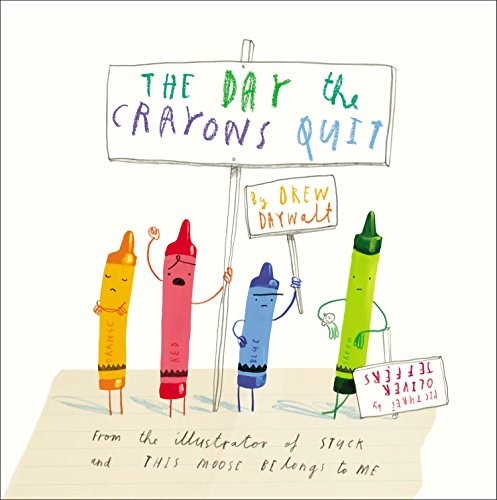
The Day the Crayons Quit
by Drew Daywalt
★ Top 25 book of 2013 · #19 on Best Books of 2013
Duncan finds a pile of letters waiting for him at school, and each one comes from a different crayon with a complaint about how he has been treating it. A funny picture book premise built around colorful grievances.
Best for: Young children and parents who enjoy playful, humorous picture books about everyday objects
The Day the Crayons Quit is #19 on BookWard's Best Books of 2013, out of 46 2013 books that cleared our data bar.
What The Day the Crayons Quit is about
Duncan arrives at school and finds a pile of letters, and every one is from a crayon. None of them are happy. One feels overused, another feels ignored, and others object to the jobs they are given. Each has its own voice and its own grievance, so a box of colors turns into a cast of distinct personalities.
Duncan has to read the complaints and decide how to answer them. Drew Daywalt's text and Oliver Jeffers's illustrations make the premise funny, and underneath the jokes sits a gentle lesson about listening, fairness and making room for other points of view. A good read-aloud for young children who enjoy silliness and anyone who likes creative play with art supplies. A sequel followed in 2015.
The Day the Crayons Quit on the Best Books of 2013
The Day the Crayons Quit came out in 2013. Of the 46 books first published in 2013 that met BookWard's data bar, it ranks #19 on our Best Books of 2013 list.
Why it made the list: 291 readers have shelved it on Open Library; readers rate it 4.4 out of 5 (29 ratings). The list ranks each year’s books on how many readers have picked them up, how highly readers rate them, and how many are reading them right now.
Nearby on the 2013 list
- Contagious Jonah Berger, #17
- A Knight of the Seven Kingdoms George R. R. Martin, #18
- The First 20 Hours Josh Kaufman, #20
- Fangirl Rainbow Rowell, #21
See all Best Books of 2013 Best books by year
More years: Best Books of 2012 Best Books of 2014.
The numbers behind it
- Readers: 230 want to read it, 8 are reading it now and 53 have read it, according to Open Library.
- Ratings: 4.4 out of 5 from 29 Open Library ratings.
| Signal | This book (0 to 100) | Weight |
|---|---|---|
| Reach | 50 | 55% |
| Reader love | 91 | 25% |
| Being read right now | 26 | 20% |
Questions about The Day the Crayons Quit
When was The Day the Crayons Quit published?
The Day the Crayons Quit by Drew Daywalt was first published in 2013.
Was The Day the Crayons Quit one of the best books of 2013?
The Day the Crayons Quit is #19 on BookWard's Best Books of 2013, out of 46 2013 books that cleared our data bar. 291 readers have shelved it on Open Library; readers rate it 4.4 out of 5 (29 ratings).
Why is The Day the Crayons Quit on the Best Books of 2013 list?
291 readers have shelved it on Open Library; readers rate it 4.4 out of 5 (29 ratings).
More of the best books of 2013
- House of Hades Rick Riordan, #1
- Hard Luck Jeff Kinney, #2
- Crown of Midnight Sarah J. Maas, #3
- The Screaming Staircase Jonathan Stroud, #4
- Unravel Me Tahereh Mafi, #5
- The Goldfinch Donna Tartt, #6
See the full Best Books of 2013, the Top 100, or new books on Rising.
How we know
This page uses public data: Open Library reader counts and ratings, and Wikipedia page views for recent years. The description is paraphrased from real source text. Rankings reflect reading interest, not quality or sales, and can be affected by data gaps. Lists update monthly.
Best for young children and the grown-ups who read aloud to them, with gentle humor throughout.
Depends on the edition you pick.
A picture book told in crayon complaint letters, brief and funny. 60% taste match
 BookWard’s take
A picture book told in crayon complaint letters, brief and funny
This is a picture book, so it is short by nature and gets to its premise on the first page: a boy named Duncan finds letters from his own crayons, each with a grievance. The hook is immediate and the idea feels fresh. The letter format gives every crayon a distinct personality without a single scene of setup, which is where the book's originality really shows. Character depth is naturally light, but each crayon is sharply drawn for its size. The tone is funny from start to finish, and the ending is tidy: Duncan answers the complaints with a clever solution. Very small readers will enjoy it, and so will the adults reading aloud. It runs on charm rather than darkness, and it stays gentle throughout.
A picture book that finishes in minutes, which suits BookWard's love of tight, short reads.
Each letter is short and moves quickly, so the book never lingers, matching BookWard's taste for speed.
The language is plain, conversational and aimed at young listeners, not ornate.
Plot and character share the work, with the crayons' personalities and Duncan's solution both mattering.
The grievances are resolved cheerfully, leaving a bright, optimistic mood.
Humor drives the whole book, from the crayons' absurd complaints to their personalities.
See all 50 dialsEvery position, side by side with this book
Where it lines up
- LengthBookWard 1 · book 1
- OpeningBookWard 10 · book 10
- PaceBookWard 8 · book 8
Where it pulls apart
- Internal logicBookWard 10 · book 7
- Familiar tropesBookWard 10 · book 8
- Character depthBookWard 8 · book 5
A picture book that finishes in minutes, which suits BookWard's love of tight, short reads.
Talking crayons are a familiar idea, but writing complaint letters from them feels fresh and avoids stock beats.
The crayons' grievances follow their colors and uses sensibly, and the playful premise stays consistent throughout.
Each letter is short and moves quickly, so the book never lingers, matching BookWard's taste for speed.
Each crayon has a distinct voice and grievance, though depth is limited by the format's small scale.
Duncan's multi-colored solution wraps up the complaints neatly, which BookWard values in a resolved ending.
Warm in spirit but kept light and wry, with little syrupy sweetness.
Nothing here relies on shock; the book stays gentle and funny from start to finish.
The crayons' distinct, comic voices give the book a strong personality of its own.
The letter conceit carries it, but a real story with Duncan still moves things along.
The grievances are voiced by the crayons themselves, with little need for explanation outside the letters.
With so few pages and a fresh letter each time, there is no room for a middle to slump.
The language is plain, conversational and aimed at young listeners, not ornate.
Plot and character share the work, with the crayons' personalities and Duncan's solution both mattering.
The grievances are resolved cheerfully, leaving a bright, optimistic mood.
Humor drives the whole book, from the crayons' absurd complaints to their personalities.
Easy for young children and adults reading aloud, with nothing hard to follow.
Each crayon speaks in its own voice, so the book is built from many perspectives.
The events unfold in a simple, straightforward sequence of reading the letters.
Crayons that write letters make it clearly fantastical, though played for fun in an ordinary classroom world.
A box of crayons gives it a sizable cast for such a short book, each one distinct.
The stakes are small and personal, about a boy and his crayons.
The crayons voice feelings in their letters, but Duncan's response gives it light action too.
The story runs on letters, not spoken exchanges, so there is little conventional dialogue.
No romance appears anywhere in the book.
A boy, his school and his crayons make for a very familiar setting.
A contemporary, everyday classroom setting that reads as present day.
The premise is simple and universal enough to stay fresh for each new group of young readers.
The book is plainly told through the crayons' letters and has no deceptive narrator.
The crayons' complaints and Duncan's fix point to a clear, friendly lesson about fairness and creativity.
Details lean on the crayons' colors and what they are used for rather than lavish description.
Review written by BookWard, dial version 1, November 2026.
Who is The Day the Crayons Quit right for?
Best for young children and the grown-ups who read aloud to them, with gentle humor throughout. Nothing here is sensitive or upsetting.
Easy for young children and adults reading aloud, with nothing hard to follow.
Book CompanionThe Day the Crayons Quit: ideas, characters, themes
A boy's crayons write him letters of complaint about how he uses them, and he finds a creative way to answer them all.
- The letters drive everything. The whole book is built from crayon letters, which gives each color its own voice and gripe.
- Distinct personalities. Some crayons feel overused, some feel ignored, and some object to being used for the wrong purposes.
- Duncan's role. Duncan reads the letters and responds to the concerns the crayons raise.
- A resolved ending. He mixes all the crayons into one multi-colored creation and uses it in a drawing.
- A reward at school. His teacher awards him for the drawing, closing the story on a bright note.
Characters
Duncan
The boy who owns the crayons
He finds the letters and finds a creative way to respond to every complaint.
The crayons
The letter writers
Each writes with its own complaint and personality about how it has been treated.
Duncan's teacher
The classroom adult
She awards Duncan for the drawing at the end.
Themes
Everyone, even a crayon, wants to be treated well and used in ways that suit them.
The crayons write letters because they want their feelings acknowledged.
Duncan solves the problem with an inventive new way of drawing.
Each crayon sees the same boy and the same box very differently.
Discussion questions
- Which crayon's complaint made you laugh the most, and why?
- How would you have answered the crayons' letters if you were Duncan?
- Why do you think the author chose to tell the story through letters?
- Is mixing all the crayons into one a fair answer to everyone's problem?
- Have you ever felt overused or ignored, like one of the crayons?
Personalize your Book Companion
This is the general edition. In BookWard, the Companion is written for you: your reading profile, your notes, and spoiler-safe to the page you are on.
Buy, listen or borrow The Day the Crayons Quit
Each link opens a search for this book on that store, in a new tab.
Read on a device
Borrow
Reviews and community
If you liked The Day the Crayons Quit
A joyful, hands-on comics class for young readers and would-be makers
Sideways Stories from Wayside SchoolLouis SacharA sideways school and thirty floors of delightful nonsense
The Wild RobotPeter BrownA robot on a wild island, told with quiet nerve
Dog Man and Cat KidDav PilkeyA silly, fast graphic novel with a surprisingly big heart
Find your own best books
Add what you have read, rate it, and BookWard will recommend what to read next.
Free to start. No credit card needed.