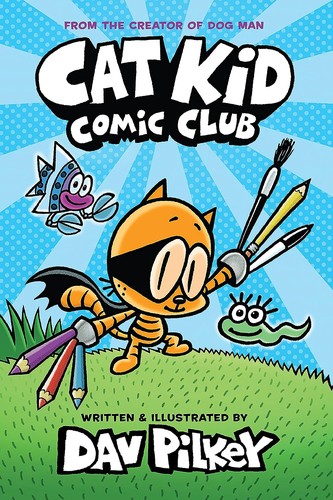
Cat Kid Comic Club
by Dav Pilkey
★ Top 25 book of 2020 · #15 on Best Books of 2020
Twenty-one baby frogs learn to tell their own stories through comics in a class guided by Li'l Petey, Molly and Flippy. The book is packed with mini-comics in many styles and art materials, all celebrating creativity and practice.
Best for: Young readers and families who like Dav Pilkey's humor and want to make comics
Cat Kid Comic Club is #15 on BookWard's Best Books of 2020, out of 65 2020 books that cleared our data bar.
What Cat Kid Comic Club is about
Li'l Petey, known as Cat Kid, runs a comic club for a lively group of young frogs. Molly the tadpole, her 21 frog siblings and their adoptive father, Flippy the Fish, are all part of it, and Naomi, Melvin, Pedro and Poppy are among the baby frogs who get stuck in. Together with Molly and Flippy, Petey helps each student find a way to say what they want through comics.
The frogs make their own mini-comics inside the story, such as "Baby Frog Squad" and "Monster Cheese Sandwich," each in a different style. Some are drawn, while others use clay, photographs, pipe cleaners or even cookies. Along the way they run into mistakes and slow progress that come with practice and persistence. Dav Pilkey, creator of Dog Man and Captain Underpants, offers a silly, encouraging graphic novel for children who love to draw and invent.
Cat Kid Comic Club on the Best Books of 2020
Cat Kid Comic Club came out in 2020. Of the 65 books first published in 2020 that met BookWard's data bar, it ranks #15 on our Best Books of 2020 list.
Why it made the list: 335 readers have shelved it on Open Library; readers rate it 4.2 out of 5 (31 ratings). The list ranks each year’s books on how many readers have picked them up, how highly readers rate them, and how many are reading them right now.
Nearby on the 2020 list
- From Blood and Ash Jennifer L. Armentrout, #13
- The Happiest Man on Earth Eddie Jaku, #14
- Heart Bones Colleen Hoover, #16
- Beach Read Emily Henry, #17
See all Best Books of 2020 Best books by year
More years: Best Books of 2019 Best Books of 2021.
The numbers behind it
- Readers: 297 want to read it, 14 are reading it now and 24 have read it, according to Open Library.
- Ratings: 4.2 out of 5 from 31 Open Library ratings.
| Signal | This book (0 to 100) | Weight |
|---|---|---|
| Reach | 60 | 55% |
| Reader love | 71 | 25% |
| Being read right now | 72 | 20% |
Questions about Cat Kid Comic Club
When was Cat Kid Comic Club published?
Cat Kid Comic Club by Dav Pilkey was first published in 2020.
Was Cat Kid Comic Club one of the best books of 2020?
Cat Kid Comic Club is #15 on BookWard's Best Books of 2020, out of 65 2020 books that cleared our data bar. 335 readers have shelved it on Open Library; readers rate it 4.2 out of 5 (31 ratings).
Why is Cat Kid Comic Club on the Best Books of 2020 list?
335 readers have shelved it on Open Library; readers rate it 4.2 out of 5 (31 ratings).
More of the best books of 2020
- Good Girl, Bad Blood Holly Jackson, #1
- The Inheritance Games Jennifer Lynn Barnes, #2
- The Psychology of Money Morgan Housel, #3
- The Ballad of Songbirds and Snakes Suzanne Collins, #4
- Heartstopper, Volume 3 Alice Oseman, #5
- The Midnight Library Matt Haig, #6
See the full Best Books of 2020, the Top 100, or new books on Rising.
How we know
This page uses public data: Open Library reader counts and ratings, and Wikipedia page views for recent years. The description is paraphrased from real source text. Rankings reflect reading interest, not quality or sales, and can be affected by data gaps. Lists update monthly.
This suits young readers and fans of Dog Man and Captain Underpants, and it is friendly to read aloud or alongside a parent or teacher.
Depends on the edition you pick.
A joyful, hands-on comics class for young readers and would-be makers. 53% taste match
 BookWard’s take
A joyful, hands-on comics class for young readers and would-be makers
Cat Kid Comic Club is a Dog Man spinoff built around a classroom of twenty-one baby frogs learning to make comics, guided by Li'l Petey, Molly and Flippy the Fish. Its strongest card is variety: the stories-within-the-story shift style and medium, from haiku photo comics to clay, cardboard, pipe cleaners and cookies, and the book is more inventive in structure and richer in visual detail than most children's graphic novels. The pace is quick and the opening hooks almost at once, which is exactly what a book like this needs. The familiar school-lesson frame is well worn, though the art techniques keep it feeling fresh. The humor runs broad and warm rather than dry, and the sentiment is openly heartfelt, which is sweet, though I tend to prefer a more restrained touch.
A quick, picture-heavy graphic novel that reads fast, which fits BookWard's taste for tight books.
Short comic panels and mini-stories move briskly, in line with BookWard's fast-paced taste.
Stories built from clay, cookies, photographs and cardboard feel inventive within children's comics, close to what BookWard values.
Plain, kid-friendly language carried largely by pictures; BookWard sits a little higher, but this suits the format.
Classroom episodes and personalities carry it about equally, close to even.
Encouraging and upbeat about practice, persistence and self-expression, even more hopeful than BookWard.
Stories-within-the-story and varied mini-comics make it more experimental than a standard children's graphic novel.
Humor drives the whole book, comfortably more comic than BookWard's already light-leaning taste.
Gentle and silly throughout, far gentler than BookWard's midpoint.
Warm and heartfelt without being heavy, about in line with BookWard's moderate emotion.
See all 50 dialsEvery position, side by side with this book
Where it lines up
- PaceBookWard 8 · book 8
- Shock for effectBookWard 9 · book 9
- Authorial voiceBookWard 9 · book 9
Where it pulls apart
- Familiar tropesBookWard 10 · book 6
- Internal logicBookWard 10 · book 6
- SentimentBookWard 8 · book 3
A quick, picture-heavy graphic novel that reads fast, which fits BookWard's taste for tight books.
Funny frogs and mini-comics start straight away, matching BookWard's preference for an immediate hook.
The classroom-lesson frame is familiar, but the mix of art techniques gives it a fresh feel; BookWard wants fewer tropes.
A cartoon world with its own playful rules; it stays consistent enough, though not airtight like BookWard prefers.
Short comic panels and mini-stories move briskly, in line with BookWard's fast-paced taste.
Stories built from clay, cookies, photographs and cardboard feel inventive within children's comics, close to what BookWard values.
Twenty-one frogs and a few guides are drawn in broad, lively strokes, lighter than the depth BookWard prefers.
Openly heartfelt and encouraging, which is warmer than BookWard's restrained preference.
Nothing here relies on shock; the stakes are gentle and the humor is the point, which BookWard appreciates.
Pilkey's voice and drawing style are unmistakable and playful, a strength BookWard values.
Story and creative lessons share the stage, leaning slightly toward story and the joy of making comics.
Short mini-comics keep energy up throughout, matching BookWard's wish for sustained momentum.
Plain, kid-friendly language carried largely by pictures; BookWard sits a little higher, but this suits the format.
Classroom episodes and personalities carry it about equally, close to even.
Encouraging and upbeat about practice, persistence and self-expression, even more hopeful than BookWard.
Stories-within-the-story and varied mini-comics make it more experimental than a standard children's graphic novel.
Humor drives the whole book, comfortably more comic than BookWard's already light-leaning taste.
Easy and inviting for young readers, a bit lighter than BookWard's middling effort level.
The frog students each share stories, so many voices appear, matching BookWard's liking for variety.
The class story runs forward in a simple line, more linear than BookWard's mixed preference.
Talking frogs and a cat kid teaching comics put it in a cartoon world, more fantastical than BookWard's middle.
Twenty-one baby frogs plus Li'l Petey, Molly and Flippy make a big ensemble, larger than BookWard's norm.
A single classroom and its projects keep the stakes small and intimate, more so than BookWard's middle.
Comics and classroom antics are mostly visible action rather than inner thought, slightly outward-leaning.
Speech bubbles carry much of the story, a good match for BookWard's love of dialogue.
Romance does not figure in a class of comics-making frogs, well below BookWard's middle.
A cartoon classroom world of frogs and fish is unfamiliar enough, in line with BookWard's taste.
Light touches of contemporary school life, similar to BookWard's lean toward the present.
Creativity and learning from mistakes are lasting themes, near BookWard's staying-power taste.
Straightforward storytelling with no tricks, more reliable than BookWard's more slippery taste.
Its lessons about persistence and expression are clear and encouraging, clearer than BookWard prefers.
Art made from acrylics, clay, photographs and cookies makes it visually rich, above BookWard's usual.
A spinoff in the Dog Man and Captain Underpants family, firmly part of a series, unlike a standalone.
Gags and surprises appear in the mini-comics, but there are few plot twists; a bit under BookWard's liking.
A comforting, encouraging read, easier going than BookWard's taste for challenge.
Gentle and silly throughout, far gentler than BookWard's midpoint.
Warm and heartfelt without being heavy, about in line with BookWard's moderate emotion.
Broad, silly slapstick-style humor, well past BookWard's balance toward dry.
Cartoon humor keeps any violence minimal, below BookWard's midpoint.
No sexual content in a children's comic, below BookWard's midpoint.
Politics are absent from this classroom story, well under BookWard's midpoint.
Simple language aimed at young readers, plainer than BookWard's midpoint.
The characters' enthusiasm and teachers' encouragement give it a confident point of view, close to BookWard.
Focused on children learning and growing into makers, leaning toward the future like BookWard.
Confident that creativity and practice pay off, more idealistic than BookWard's lean.
Review written by BookWard, dial version 1, November 2026.
Who is Cat Kid Comic Club right for?
This suits young readers and fans of Dog Man and Captain Underpants, and it is friendly to read aloud or alongside a parent or teacher. Content is gentle and silly, with nothing especially sensitive.
Easy and inviting for young readers, a bit lighter than BookWard's middling effort level.
Gentle and silly throughout, far gentler than BookWard's midpoint.
Warm and heartfelt without being heavy, about in line with BookWard's moderate emotion.
Cartoon humor keeps any violence minimal, below BookWard's midpoint.
Book CompanionCat Kid Comic Club: ideas, characters, themes
A class of baby frogs learns, through mistakes and practice, that making comics is a way to express yourself.
- A comics class. Li'l Petey, Molly and Flippy the Fish help twenty-one baby frogs create comic books and other projects.
- Stories within the story. Mini-comics such as Squid Kid and Katydid, Baby Frog Squad and Monster Cheese Sandwich appear inside the main narrative.
- Many art styles. Different pieces use acrylics, pastels, colored pencils, markers, clay, cardboard sculpture, photographs, pipe cleaners, collage and cookies.
- Humor and drama together. The mini-comics mix funny stories with more dramatic ones, and also include prose and poetry such as a haiku photo comic.
- Practice and persistence. The frogs experience mistakes and progress, showing that skill grows with effort.
Characters
Li'l Petey (Cat Kid)
Guide and teacher
Helps the baby frogs express themselves through comics.
Molly
Tadpole friend
Molly the tadpole is one of the frog siblings, and a friend of Li'l Petey.
Flippy the Fish
Adoptive father
The adoptive father of the twenty-one frog siblings.
Naomi, Melvin, Pedro and Poppy
Baby frog students
A few of the twenty-one frogs who share their stories.
Themes
Making things in your own way and finding your own style.
Improving through practice and learning from mistakes.
Using comics to say what you think and feel.
Learning together in a class of friends and family.
Humor and silliness as a path into serious creative work.
Discussion questions
- Which mini-comic or art style would you most like to try making, and why?
- How do the different materials, like clay or cookies, change how a story feels?
- What mistakes do the frogs make, and what do they learn from them?
- Why might Pilkey include stories-within-the-story rather than one single plot?
- How does humor help the book teach about creativity and persistence?
Personalize your Book Companion
This is the general edition. In BookWard, the Companion is written for you: your reading profile, your notes, and spoiler-safe to the page you are on.
Buy, listen or borrow Cat Kid Comic Club
Each link opens a search for this book on that store, in a new tab.
Read on a device
Borrow
Reviews and community
If you liked Cat Kid Comic Club
A silly, fast graphic novel with a surprisingly big heart
The Demigod FilesRick RiordanA bonus-feature grab bag for Percy Jackson completists
Aru Shah and the End of TimeRoshani ChokshiA fib lights a lamp and frees a demon
The Red PyramidRick RiordanEgyptian gods wake up and a London sibling pair runs
Find your own best books
Add what you have read, rate it, and BookWard will recommend what to read next.
Free to start. No credit card needed.