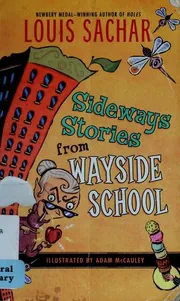
Sideways Stories from Wayside School
by Louis Sachar · 1978
It suits young independent readers and anyone reading aloud to them, thanks to its short chapters and plain language.
128 pages, about 2 to 3 hours.
A sideways school and thirty floors of delightful nonsense. 66% taste match
About the book
Sideways Stories from Wayside School is a children's book by American author Louis Sachar, first published in 1978. It is a collection of short stories that work together as a single connected work, and it opens the Wayside School series. The book runs to about 128 pages and has appeared in 31 editions.
The stories are humorous and set in a school, following the students and teachers of one classroom. Wayside School was built sideways by mistake, with a single classroom on each story, and the class at the center of these episodes is the one on the thirtieth floor. The first chapter begins with Mrs. Gorf, a teacher with a long tongue and pointed ears. Each chapter is a self-contained episode of classroom life, and together they form a picture of a school day after day, with its pupils and the odd circumstances of the building they attend. It is a book for young readers who enjoy funny school fiction told in short, separate pieces.
Mrs. Gorf had a long tongue and pointed ears.
Themes
SchoolsHumorous storiesShort stories
- Want to read 248
- Reading now 14
- Read 41
Most people shelving it are saving it for later.
Of 303 readers who put it on a shelf, 82% want to read it, 5% are reading it now, 14% have finished it and 0% stopped before the end.
By the numbers
- The median edition runs 128 pages. Counting about 275 words a page and an adult reading pace of 250 words a minute, that is about 2.3 hours of reading.
- Open Library tracks 31 editions from 26 publishers, the earliest dated 1978 and the latest 2021, across 3 languages.
- On reader demand it ranks in the top 2% of the modern books in our catalog (15,152 of them).
- Libraries shelve it under Dewey [Fic] and Library of Congress class PZ-0007.00000000.S1185 Si 1990.
 BookWard’s take
A sideways school and thirty floors of delightful nonsense
Sideways Stories from Wayside School is built from short, self-contained episodes set in one classroom on the thirtieth floor of a school that was built sideways by mistake. The hook is where it shines: the premise grabs you at once, and the first chapter introduces Mrs. Gorf, with her long tongue and pointed ears. At about 128 pages it is as tight as books get, so it never drags, and there is no sagging middle because every chapter is its own small payoff. It leans on surprise and on Sachar's unmistakable voice more than on depth of character, since the pupils are drawn quickly and comically. The logic is its own absurd kind, but it holds firm within each story. It suits anyone who likes funny, quick, strange school fiction.
At about 128 pages of short episodes, it is brisk and compact, which matches BookWard's love of tight books.
Each chapter is a quick, self-contained episode, so the book moves along briskly, close to BookWard's preferred speed.
A sideways building and a thirtieth-floor classroom make for a premise few children's books come near.
The language is plain and direct, easy for young readers, a touch plainer than BookWard's middle ground.
Episode plots and odd situations drive the fun more than inner growth, so it is plot-led.
It is playful and good-natured throughout, leaning hopeful rather than bleak, a bit warmer than BookWard's usual.
A set of linked short stories is a mildly unconventional shape, a little more adventurous than BookWard's norm.
Humor is the point of the book, which is as funny as BookWard's taste allows and then some.
The oddities are gentle and comic, so the content stays light.
The feelings are mostly amusement and fondness rather than heavy emotion, so it stays mild.
See all 50 dialsEvery position, side by side with this book
Where it lines up
- LengthBookWard 1 · book 1
- PaceBookWard 8 · book 8
- OriginalityBookWard 9 · book 9
Where it pulls apart
- Internal logicBookWard 10 · book 7
- Character depthBookWard 8 · book 4
- Comfort or challengeBookWard 7 · book 2
At about 128 pages of short episodes, it is brisk and compact, which matches BookWard's love of tight books.
The sideways school premise and the long-tongued Mrs. Gorf grab attention in the first chapter, just what BookWard wants.
A school built sideways with one classroom per story avoids the usual school-story furniture, which BookWard prizes.
The rules are absurd, but each episode plays by its own consistent nonsense, so it holds together well enough.
Each chapter is a quick, self-contained episode, so the book moves along briskly, close to BookWard's preferred speed.
A sideways building and a thirtieth-floor classroom make for a premise few children's books come near.
Pupils and teachers are sketched fast and funny rather than explored deeply, a little below BookWard's taste for depth.
Because it is a cycle of separate episodes, each story resolves itself even without one grand finale.
The tone leans on silliness rather than tears, which keeps it fairly restrained for a children's book.
The oddities are played for laughs, not cheap shock, which sits well with BookWard's dislike of shock for its own sake.
Sachar's deadpan comic voice is unmistakable and carries the whole book, a strong fit for BookWard.
It is mostly story and gag, with little idea-led argument, closer to BookWard's story-first leaning.
Things are shown through comic scenes rather than explained, matching BookWard's preference for showing.
Every chapter is its own punchline, so there is no middle to sag, which BookWard rewards.
The language is plain and direct, easy for young readers, a touch plainer than BookWard's middle ground.
Episode plots and odd situations drive the fun more than inner growth, so it is plot-led.
It is playful and good-natured throughout, leaning hopeful rather than bleak, a bit warmer than BookWard's usual.
A set of linked short stories is a mildly unconventional shape, a little more adventurous than BookWard's norm.
Humor is the point of the book, which is as funny as BookWard's taste allows and then some.
Short chapters and simple language make it very easy to read, easier than BookWard typically asks for.
The episodes move among many students and teachers, giving it a wide spread of viewpoints.
A sideways building and strange events make this clearly more fantastical than grounded.
A whole classroom plus teachers means a good-sized cast, larger than BookWard's usual.
The whole world is one school building, so the scale stays small and intimate.
Funny things happen to characters on the page, so the focus falls on action rather than inner thought.
The comedy runs on classroom exchanges and banter, so dialogue carries a lot of the weight.
Romance is essentially absent, which is fine for BookWard and for the book's young audience.
The sideways school is a strange setting, more unfamiliar than the average story world.
First published in 1978, it reads as of its time while staying school-timeless, so it sits a little toward the past.
School absurdity stays funny across generations, which suggests real staying power.
The narrator tells the stories plainly and reliably, with no tricks about what is true.
The book plays for fun rather than lessons, so right and wrong are mostly clear and simple.
Description is kept minimal in favor of quick gags and plot, giving it a sparse feel.
It opens the Wayside School series, so it sits toward the part-of-a-series side.
Its comic reversals and odd turns arrive in nearly every chapter, giving plenty of surprise.
It is meant to entertain young readers, not challenge them, so it reads as a comfort.
The oddities are gentle and comic, so the content stays light.
The feelings are mostly amusement and fondness rather than heavy emotion, so it stays mild.
The jokes are broad and absurd, though delivered with a deadpan touch, so it leans broad.
There is no sexual content, as befits a children's book.
Politics do not enter the stories, so the book is essentially free of them.
The language is plain and simple for young readers, with nothing dense or dialect-heavy.
The narration has a wry comic attitude but does not lecture, sitting a bit toward neutral.
It lives in the present of the school day, neither nostalgic nor forward-pointing.
Despite the chaos, the book is warm and good-natured toward its kids, leaning idealistic.
Review written by BookWard, dial version 1, November 2026.
Who is Sideways Stories from Wayside School right for?
It suits young independent readers and anyone reading aloud to them, thanks to its short chapters and plain language. Nothing in it is sensitive, though the humor can be silly and a little odd.
Short chapters and simple language make it very easy to read, easier than BookWard typically asks for.
The oddities are gentle and comic, so the content stays light.
The feelings are mostly amusement and fondness rather than heavy emotion, so it stays mild.
Book CompanionSideways Stories from Wayside School: ideas, characters, themes
A school built sideways by mistake becomes the setting for a classroom's funny, strange, everyday episodes.
- A building gone wrong. Wayside School was built sideways, with a single classroom on each story, and the class we follow is on the thirtieth floor.
- Stories that stand alone. Each chapter is a self-contained episode, so the book can be read in short, separate bites.
- A connected whole. Though separate, the episodes combine into one picture of life in a single classroom.
- Humor first. The book is funny from its first pages, and its comedy comes from odd circumstances and classroom life.
- The start of a series. This is the first book in the Wayside School series, so it sets up the place for what follows.
Characters
Mrs. Gorf
A teacher
Introduced in the first chapter as a teacher with a long tongue and pointed ears.
Themes
The everyday world of pupils, teachers and classrooms, seen through a comic lens.
Odd circumstances and silly logic that the book plays for laughs.
A whole class of different kids and adults sharing one strange building.
Comedy as the main way the book wins over its young readers.
Discussion questions
- Why do you think the author chose to build the school sideways, and how does that change the stories?
- Which episode made you laugh the most, and what made it funny?
- How does reading separate chapters feel different from reading one long story?
- What would your own classroom be like if it sat on the thirtieth floor?
- Does the book feel more about the building or about the people inside it?
Personalize your Book Companion
This is the general edition. In BookWard, the Companion is written for you: your reading profile, your notes, and spoiler-safe to the page you are on.
Buy, listen or borrow Sideways Stories from Wayside School
Each link opens a search for this book on that store, in a new tab.
Read on a device
Borrow
Reviews and community
If you liked Sideways Stories from Wayside School
A teenage criminal genius, fairy tech, and a heist with a ticking clock
Dog Man and Cat KidDav PilkeyA silly, fast graphic novel with a surprisingly big heart
Cat Kid Comic ClubDav PilkeyA joyful, hands-on comics class for young readers and would-be makers
Artemis Fowl and the Arctic IncidentEoin ColferA fast, clever fairy-crime caper with a frozen Russian heist
Sources: Open Library.
Track Sideways Stories from Wayside School and find your next favorite
Add it to your shelf, rate what you have read, and BookWard will recommend what fits you.
Free to start. No credit card needed.