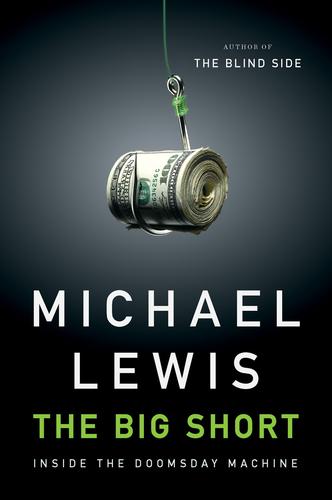
The Big Short
by Michael Lewis
★ Top 25 book of 2010 · #23 on Best Books of 2010
This darkly funny, character-driven account explains how the American economy was pushed toward collapse. It follows the unlikely few who recognised the danger in the housing and derivatives markets, and profited, while colleagues dismissed them as alarmists.
Best for: Readers curious about the financial crisis who like narrative nonfiction with a wry tone
The Big Short is #23 on BookWard's Best Books of 2010, out of 43 2010 books that cleared our data bar.
What The Big Short is about
Michael Lewis tells the story of the U.S. housing bubble of the 2000s through the handful of people who saw it coming and bet against it. Most of them were outsiders and oddballs: a former neurologist who started his own fund, two founders who began a hedge fund in a garage with $110,000, and traders and analysts who refused to follow the crowd. Their wager was placed in the credit default swap market, against a bubble built on CDOs.
Lewis keeps the focus on character rather than jargon, and he writes with a dry, sharp humour about greed and systemic failure on Wall Street. The book also counts the cost on the other side, including a single trade that lost $9 billion. It suits readers who want to understand how the financial crisis happened without a finance degree, and anyone who enjoys watching stubborn contrarians turn out to be right.
The Big Short on the Best Books of 2010
The Big Short came out in 2010. Of the 43 books first published in 2010 that met BookWard's data bar, it ranks #23 on our Best Books of 2010 list.
Why it made the list: 219 readers have shelved it on Open Library; readers rate it 4.6 out of 5 (36 ratings). The list ranks each year’s books on how many readers have picked them up, how highly readers rate them, and how many are reading them right now.
It earns Reader favorite.
Nearby on the 2010 list
- The Scorch Trials James Dashner, #21
- The Passage Justin Cronin, #22
- Big Nate Strikes Again Lincoln Peirce, #24
See all Best Books of 2010 Best books by year
More years: Best Books of 2009 Best Books of 2011.
The numbers behind it
- Readers: 167 want to read it, 9 are reading it now and 43 have read it, according to Open Library.
- Ratings: 4.6 out of 5 from 36 Open Library ratings.
| Signal | This book (0 to 100) | Weight |
|---|---|---|
| Reach | 30 | 55% |
| Reader love | 95 | 25% |
| Being read right now | 23 | 20% |
Questions about The Big Short
When was The Big Short published?
The Big Short by Michael Lewis was first published in 2010.
Was The Big Short one of the best books of 2010?
The Big Short is #23 on BookWard's Best Books of 2010, out of 43 2010 books that cleared our data bar. 219 readers have shelved it on Open Library; readers rate it 4.6 out of 5 (36 ratings).
Why is The Big Short on the Best Books of 2010 list?
219 readers have shelved it on Open Library; readers rate it 4.6 out of 5 (36 ratings).
More of the best books of 2010
- The Lost Hero Rick Riordan, #1
- The Way of Kings Brandon Sanderson, #2
- Divergent Veronica Roth, #3
- The Personal MBA Josh Kaufman, #4
- It's Not Summer Without You Jenny Han, #5
- The Red Pyramid Rick Riordan, #6
See the full Best Books of 2010, the Top 100, or new books on Rising.
How we know
This page uses public data: Open Library reader counts and ratings, and Wikipedia page views for recent years. The description is paraphrased from real source text. Rankings reflect reading interest, not quality or sales, and can be affected by data gaps. Lists update monthly.
Suits adult and older teen readers curious about money, markets or recent history, with no prior finance knowledge required.
Depends on the edition you pick.
Financial catastrophe told through the oddballs who saw it coming. 66% taste match
 BookWard’s take
Financial catastrophe told through the oddballs who saw it coming
Michael Lewis turns the 2008 collapse into a character-driven story about the few people who bet against the housing market while everyone else dismissed them. It opens with its premise and keeps moving, hooking you right away. The pace stays brisk because each chapter hands you a new eccentric: an ex-neurologist, a loud-mouthed hedge fund manager, two garage-startup investors. The authorial voice is the real draw, wry and indignant without losing its footing. The rigor is solid for a story this readable, though it is narrative first and analytical second, so the book leans toward storytelling over explanation. The tone runs warmer than restrained, since Lewis plainly roots for his outsiders.
A mid-sized narrative that moves through its cast without bloat, though it is not as lean as BookWard's ideal.
Each chapter introduces a new player and a new twist in the story, so it rarely lingers.
Telling a financial crisis as a character story about contrarians was a fresh angle on a dry subject.
Clear, conversational and punchy, aimed at making a hard subject easy to follow.
Individual personalities propel events as much as the mechanics of the market do.
The outcome is a global financial crash caused by greed and blindness, with little redemption on offer.
A conventional journalistic structure built around a series of linked portraits.
Dark humor runs throughout, aimed at absurd decisions and the people making them.
The subject is grim, but the tone stays sardonic instead of bleak for its own sake.
Anger and disbelief run beneath the humor, but it is not a tearjerker.
See all 50 dialsEvery position, side by side with this book
Where it lines up
- PaceBookWard 8 · book 8
- Authorial voiceBookWard 9 · book 9
- OriginalityBookWard 9 · book 8
Where it pulls apart
- ExpositionBookWard 2 · book 7
- LengthBookWard 1 · book 4
- Familiar tropesBookWard 10 · book 7
A mid-sized narrative that moves through its cast without bloat, though it is not as lean as BookWard's ideal.
It drops you into a world of bets against the housing market almost immediately, which is exactly what BookWard wants.
Its heroes are genuinely odd and the subject is told through people, not the usual finance-book formulas.
The case for how the bubble inflated and burst is laid out step by step and holds together.
Each chapter introduces a new player and a new twist in the story, so it rarely lingers.
Telling a financial crisis as a character story about contrarians was a fresh angle on a dry subject.
The investors are vivid and strange, though drawn quickly and mostly through their professional obsessions.
The bets pay off and the consequences are laid out, giving a clear sense of how it all landed.
Lewis is plainly sympathetic to his outsiders, so it is less restrained than BookWard prefers.
The darkness comes from what actually happened, not from manufactured drama, which BookWard respects.
It explains complex instruments and real events in detail, even when it favors story over exhaustive analysis.
Lewis's dry, indignant, darkly funny narration is unmistakable and carries the whole book.
People drive the narrative, but the argument about a broken system is always close behind.
Complicated financial products get explained outright, often through analogy, rather than left to scenes.
The parade of new characters and deals keeps the middle moving instead of settling into a lull.
Clear, conversational and punchy, aimed at making a hard subject easy to follow.
Individual personalities propel events as much as the mechanics of the market do.
The outcome is a global financial crash caused by greed and blindness, with little redemption on offer.
A conventional journalistic structure built around a series of linked portraits.
Dark humor runs throughout, aimed at absurd decisions and the people making them.
Dense subject matter, but Lewis explains it so well that the reading itself stays accessible.
It moves between many investors, traders and bankers on both sides of the bet.
It follows the build-up to the crash in broadly chronological fashion, with some backstory.
Entirely grounded in real people, real markets and real losses.
A sizable roster of traders, managers and executives passes through, though the focus stays on a core few.
It captures a global financial collapse, yet keeps the camera on a handful of individuals.
It weighs the investors' temperaments and obsessions against the deals and events they set in motion.
Conversations and quoted exchanges appear regularly but do not dominate the narration.
Romance is not part of this story.
Bond markets and derivatives are unfamiliar territory to most readers, which is part of the appeal.
Set in the 2000s, recent enough to feel connected to the present.
The specifics are tied to 2008, but the lessons about greed and herd behavior have lasting relevance.
Lewis tells it as a straightforward journalist, with a clear stance but no tricks.
The book clearly blames a reckless system, even as its heroes profit from the fallout.
Sharp portraits of people and places, but it is more about ideas and events than scenery.
It reads as a story told through characters, not a detached analysis of the market.
Lewis keeps himself out of the frame and tells it as an observer.
A standalone book, though it pairs naturally with Lewis's earlier Wall Street writing.
The big reveals are real events, but the way the bets play out still surprises.
It unsettles comfortable assumptions about how the financial system works and who protects it.
The subject is grim, but the tone stays sardonic instead of bleak for its own sake.
Anger and disbelief run beneath the humor, but it is not a tearjerker.
Mostly dry and sardonic, with a few broader comic moments.
No physical violence; the harm is economic.
Sexual content is not a feature of this book.
Regulators, banks and institutions are under scrutiny, though it is more reportage than polemic.
Financial jargon appears but is translated into plain language.
Lewis's outrage and amusement shape how every scene is framed.
It looks back at what went wrong, with a warning that carries forward.
A cynical view of finance, with admiration reserved for the few who saw clearly.
Review written by BookWard, dial version 1, November 2026.
Who is The Big Short right for?
Suits adult and older teen readers curious about money, markets or recent history, with no prior finance knowledge required. It deals with financial ruin and strong language about institutions, but contains no graphic content.
Dense subject matter, but Lewis explains it so well that the reading itself stays accessible.
The subject is grim, but the tone stays sardonic instead of bleak for its own sake.
Anger and disbelief run beneath the humor, but it is not a tearjerker.
No physical violence; the harm is economic.
Book CompanionThe Big Short: ideas, characters, themes
A handful of misfit investors saw that the housing market was built on bad mortgages, and profited while the financial system they bet against collapsed.
- The contrarians. The book follows people like Steve Eisman, Michael Burry and the founders of Cornwall Capital, who believed the bubble would burst.
- A market few understood. Credit default swaps and collateralized debt obligations let investors bet against the housing market, and Lewis walks through how they worked.
- The cost of the crash. It highlights those on the losing side, including Howie Hubler's huge loss and the heavy losses at AIG Financial Products.
- Character as theme. Lewis asks what kind of person goes against the grain when colleagues call them Chicken Littles.
- From book to film. It spent 28 weeks on the New York Times best-seller list and became the basis for the 2015 film of the same name.
Characters
Michael Burry
Ex-neurologist turned investor
He created Scion Capital and was among those betting against the housing market.
Steve Eisman
Outspoken hedge fund manager
One of the book's central figures who saw the bubble for what it was.
Greg Lippmann
Deutsche Bank trader
A trader who sought to bet against the CDO bubble.
Meredith Whitney
Analyst
She predicted the demise of Citigroup and Bear Stearns.
Howie Hubler
Trader on the losing side
Known as the person who lost $9 billion in one trade.
Themes
The cost and reward of being right when everyone around you disagrees.
How whole institutions can ignore obvious risks when profits keep rolling in.
How impenetrable financial products hid the true danger from regulators and buyers.
How the pursuit of profit damaged ordinary borrowers and the wider economy.
The uneasy fact that being right about disaster can make you rich.
Discussion questions
- Were the investors who bet against the market heroes, opportunists, or both?
- Why did so many smart people on Wall Street miss or ignore the warning signs?
- How does Lewis's focus on personalities shape your understanding of the crisis?
- Does humor make a story of widespread harm easier to take in, or does it soften the blame?
- What, if anything, has changed since the events the book describes?
Personalize your Book Companion
This is the general edition. In BookWard, the Companion is written for you: your reading profile, your notes, and spoiler-safe to the page you are on.
Buy, listen or borrow The Big Short
Each link opens a search for this book on that store, in a new tab.
Read on a device
Borrow
Reviews and community
If you liked The Big Short
A Cold War spy story told with a novelist's grip
The Right StuffTom WolfeWolfe turns test pilots and astronauts into a living, argumentative culture
How to Win an Information WarPeter PomerantsevA wartime propagandist's story, read against Ukraine's information war
Down and Out in Paris and LondonGeorge OrwellOrwell's first book, and a clear-eyed look at poverty
Find your own best books
Add what you have read, rate it, and BookWard will recommend what to read next.
Free to start. No credit card needed.