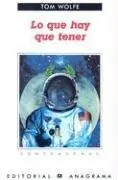
It suits mature teens and adults interested in aviation and history.
436 pages, about 7 to 10 hours.
Wolfe turns test pilots and astronauts into a living, argumentative culture. 61% taste match
What it covers
The Right Stuff is a work of narrative nonfiction by Tom Wolfe, first published in 1973. It belongs to the biography and memoir shelf and also sits within the history of the United States in the twentieth century, with a focus on astronautics and the people who flew in it.
The book follows the pilots and astronauts of the early space program, with scenes set at Edwards Air Force Base and Cape Canaveral. It opens with a telephone call, as a woman is rung by three others within minutes of one another, each asking whether she has heard that something happened out there. From that moment, Wolfe moves between the test pilots who flew at the edge of aeronautics and the men chosen to travel into space, covering the technology, the training and the culture that surrounded them.
Readers interested in spaceflight, aviation and the history of the United States in the middle of the twentieth century will find it a fit. Across its 436 pages, in a median edition, it has appeared in 41 editions since its first publication.
Within five minutes, or ten minutes, no more than that three of the others had called her on the telephone to ask her if she had heard that something had happened out there.
Setting
United StatesEdwards Air Force BaseCape Canaveral
Themes
AstronauticsAstronautsHISTORY / United States / 20th CenturyRuimtevaartBiography
- Want to read 63
- Reading now 6
- Read 21
Most people shelving it are saving it for later.
Of 90 readers who put it on a shelf, 70% want to read it, 7% are reading it now, 23% have finished it and 0% stopped before the end.
By the numbers
- The median edition runs 436 pages. Counting about 275 words a page and an adult reading pace of 250 words a minute, that is about 8.0 hours of reading.
- Open Library tracks 41 editions from 27 publishers, the earliest dated 1973 and the latest 2024, across 4 languages.
- On reader demand it ranks in the top 13% of the classic books in our catalog (8,749 of them).
- Libraries shelve it under Dewey 629.40973 and Library of Congress class TL-0789.80000000.U5 W64 1979.
 BookWard’s take
Wolfe turns test pilots and astronauts into a living, argumentative culture
Tom Wolfe's 1973 account of the early space program opens with a ringing telephone and never lets the tension go. The voice is unmistakable from the first sentence, which pulls you straight into a woman's phone call and the dread behind it. It is also one of the most opinionated narrations in nonfiction, with Wolfe's wit setting the tone of every scene. For a reader who values rigor and a middle that holds its momentum, the book delivers across its 436 pages, moving between Edwards Air Force Base and Cape Canaveral without sagging. The prose runs more ornate and playful than I usually like, and the exposition leans on Wolfe explaining the pilots' unspoken code outright. If you want spaceflight history told as a story of character and pride, this is the one.
At 436 pages it is a long book, well above BookWard's preference for tight and short.
Scenes move briskly between test flights and the space program, close to BookWard's fast preference even at length.
Narrative nonfiction with a novelist's energy applied to the space program was a fresh approach, and it still feels distinctive.
Wolfe's prose is showy and rhythmic, noticeably more ornate than BookWard's mid-range taste.
The story is led by the temperaments and rivalries of the men, so character drives it more than events.
It balances danger and loss with pride and achievement, landing a little above the middle.
The narrative is mostly chronological with some detours, so the structure is fairly conventional.
Wolfe's irony and satirical eye give it frequent humor despite the serious subject, close to BookWard's taste.
Crashes and deaths appear, but the tone is energetic rather than grim.
Pride, fear and rivalry run through the book, producing moderate emotional heat.
See all 50 dialsEvery position, side by side with this book
Where it lines up
- Sagging middleBookWard 8 · book 8
- OpeningBookWard 10 · book 9
- PaceBookWard 8 · book 7
Where it pulls apart
- LengthBookWard 1 · book 7
- ExpositionBookWard 2 · book 7
- Familiar tropesBookWard 10 · book 8
At 436 pages it is a long book, well above BookWard's preference for tight and short.
It opens on a telephone call and a rumor that something happened out there, which fits BookWard's love of an immediate hook.
Wolfe avoids the standard hero-worship line on astronauts and builds his own framing of the pilot culture, which BookWard rewards.
The account of how pilots and astronauts were ranked and chosen holds together tightly, which BookWard values.
Scenes move briskly between test flights and the space program, close to BookWard's fast preference even at length.
Narrative nonfiction with a novelist's energy applied to the space program was a fresh approach, and it still feels distinctive.
The pilots and astronauts are drawn as people with codes, rivalries and pride, matching BookWard's taste for depth.
The story closes out the arc of the early program with a sense of resolution rather than leaving threads loose.
Wolfe has real admiration for his subjects but undercuts sentiment with irony, sitting a little softer than BookWard's restraint.
Dangerous flights and deaths are part of the story, but they are told as part of the culture rather than for effect.
It is built on the real history of the program and the people in it, close to BookWard's rigorous preference.
Wolfe's voice is unmistakable and one of the main reasons to read, far beyond generic, as BookWard likes.
It carries a big idea about what the right stuff means, but delivers it through story, so it sits just above BookWard's story-led lean.
Wolfe often stops to explain the pilots' unwritten code directly, more than BookWard's show-in-scene preference.
The energy holds across its length as the focus moves from Edwards to Cape Canaveral, which suits BookWard.
Wolfe's prose is showy and rhythmic, noticeably more ornate than BookWard's mid-range taste.
The story is led by the temperaments and rivalries of the men, so character drives it more than events.
It balances danger and loss with pride and achievement, landing a little above the middle.
The narrative is mostly chronological with some detours, so the structure is fairly conventional.
Wolfe's irony and satirical eye give it frequent humor despite the serious subject, close to BookWard's taste.
It reads as an energetic narrative, easier than its length suggests, with some period detail to absorb.
Wolfe moves between several pilots, astronauts and wives, giving a moderate spread of viewpoints.
The story moves mainly forward through the years of the early space program.
This is real history with no invention beyond the real events.
A sizable group of pilots, astronauts and their families appears across the pages.
It covers a national program and a whole culture of flight, which gives it an epic sweep.
It covers both flights and the inner motives of the men, with a slight lean toward action and events.
Scenes and reported speech appear, but narration carries most of the book.
Marriages and wives appear, but romance is a minor thread.
The world of test pilots, flight lines and the early space program is unfamiliar to most readers.
It is set in the mid-twentieth century, so far from the present day.
Its portrait of ambition, danger and status has outlasted the moment it covers.
Wolfe's narrator is a consistent, opinionated guide rather than a hidden or deceiving one.
Courage, pride and the cost of risk are presented with some nuance rather than a single verdict.
Wolfe renders flights, bases and rituals vividly, with a lot of sensory detail.
It reads as narrative nonfiction first, far from analytical in approach.
Wolfe's own presence and attitude are strong, so it feels more personal than detached.
It is a single stand-alone work.
As nonfiction it holds a few reveals, but the history is known so surprises are few.
It entertains more than it unsettles, though it questions heroic myths.
Crashes and deaths appear, but the tone is energetic rather than grim.
Pride, fear and rivalry run through the book, producing moderate emotional heat.
The humor is knowing and satirical, with a broad streak in Wolfe's exaggeration.
Flight accidents and deaths appear but are not dwelt on in graphic detail.
Sexual content is minimal and incidental.
The space race and its institutions are central context, though the book is not partisan.
Pilot slang and Wolfe's stylized rhythms add some density but remain readable.
Wolfe's judgments and wit are a defining feature of the narration.
It looks back at a past era and its legends.
It honors courage while teasing the vanity around it, landing near the middle.
Review written by BookWard, dial version 1, November 2026.
Who is The Right Stuff right for?
It suits mature teens and adults interested in aviation and history. It includes deaths in flight accidents and some mature themes, but nothing graphic.
It reads as an energetic narrative, easier than its length suggests, with some period detail to absorb.
Crashes and deaths appear, but the tone is energetic rather than grim.
Pride, fear and rivalry run through the book, producing moderate emotional heat.
Flight accidents and deaths appear but are not dwelt on in graphic detail.
Book CompanionThe Right Stuff: ideas, characters, themes
Wolfe explores the unspoken code of the test pilot and astronaut, the right stuff, and how it shaped who rose and who was forgotten.
- A telephone call opens it. The book starts with a woman being called by three others within minutes, each asking whether she has heard that something happened out there.
- Two worlds of flight. Wolfe moves between the test pilots at Edwards Air Force Base and the astronauts chosen for space.
- A culture, not just a program. Technology and training matter, but the book is chiefly about the culture that surrounded these men.
- Cape Canaveral as a setting. The story follows the program to Cape Canaveral, where the space effort takes public shape.
- History as narrative. First published in 1973, it treats twentieth-century American history as a story driven by people.
Themes
An unspoken measure of courage and worth among pilots.
The constant danger that comes with pushing flight to its limits.
How rank and reputation shape the men's behavior.
The gap between public heroism and the real people involved.
How machines and human nerve depend on each other.
Discussion questions
- What does the right stuff mean, and who gets to decide?
- How does Wolfe's voice shape your view of the pilots and astronauts?
- Why open with a phone call instead of a flight?
- How does the book separate test pilots from astronauts?
- Does the book celebrate its subjects, question them, or both?
Personalize your Book Companion
This is the general edition. In BookWard, the Companion is written for you: your reading profile, your notes, and spoiler-safe to the page you are on.
Buy, listen or borrow The Right Stuff
Each link opens a search for this book on that store, in a new tab.
Read on a device
Borrow
Reviews and community
If you liked The Right Stuff
Financial catastrophe told through the oddballs who saw it coming
MarshaTourmalineA full-color biography of Marsha P. Johnson, by Tourmaline
Hell's AngelsHunter S. ThompsonThompson rides with the Angels and files a gonzo classic
The botany of desireMichael PollanA plant's-eye view of us, one apple at a time
Sources: Open Library.
Track The Right Stuff and find your next favorite
Add it to your shelf, rate what you have read, and BookWard will recommend what fits you.
Free to start. No credit card needed.