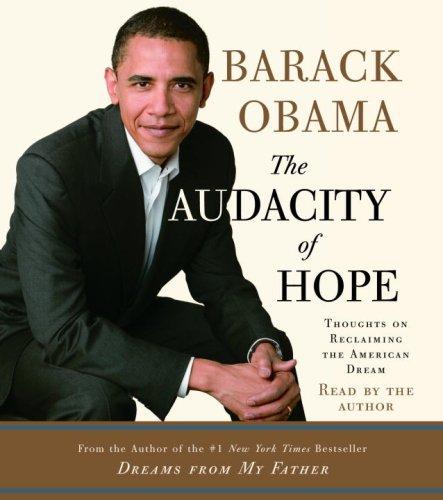
The Audacity of Hope
by Barack Obama
★ Top 25 book of 2006 · #21 on Best Books of 2006
Barack Obama calls for a politics that moves beyond bitter partisanship and rests on faith, inclusiveness and a noble spirit. He examines money, media, economic insecurity, racial and religious tension, and global threats, urging a return to Constitutional principles.
Best for: Readers weary of partisan politics who want a hopeful look at American democracy
The Audacity of Hope is #21 on BookWard's Best Books of 2006, out of 47 2006 books that cleared our data bar.
What The Audacity of Hope is about
The book lays out Barack Obama's political and spiritual beliefs and his views on American life. He calls for a politics that serves people tired of bitter partisanship and the constant clash in Congress and on the campaign trail. He explains what holds well-meaning politicians back, including fear of losing, the endless need to raise money and the power of the media.
He also looks at the growing economic insecurity of families, racial and religious tensions, threats such as terrorism and pandemic, and the place of faith in a democracy. His argument is that Americans can repair a broken political process by returning to the principles behind the Constitution. It suits readers who want a reflective, hopeful look at how the country might talk to itself again.
The Audacity of Hope on the Best Books of 2006
The Audacity of Hope came out in 2006. Of the 47 books first published in 2006 that met BookWard's data bar, it ranks #21 on our Best Books of 2006 list.
Why it made the list: 337 readers have shelved it on Open Library; readers rate it 3.5 out of 5 (22 ratings); 20 are reading it right now. The list ranks each year’s books on how many readers have picked them up, how highly readers rate them, and how many are reading them right now.
Nearby on the 2006 list
- Aloha-Ha-Ha! Barbara Park, #19
- Don't Let the Pigeon Stay up Late! Mo Willems, #20
- The Innocent Man John Grisham, #22
- Wintersmith Terry Pratchett, #23
See all Best Books of 2006 Best books by year
More years: Best Books of 2005 Best Books of 2007.
The numbers behind it
- Readers: 288 want to read it, 20 are reading it now and 29 have read it, according to Open Library.
- Ratings: 3.5 out of 5 from 22 Open Library ratings.
| Signal | This book (0 to 100) | Weight |
|---|---|---|
| Reach | 66 | 55% |
| Reader love | 6 | 25% |
| Being read right now | 66 | 20% |
Questions about The Audacity of Hope
When was The Audacity of Hope published?
The Audacity of Hope by Barack Obama was first published in 2006.
Was The Audacity of Hope one of the best books of 2006?
The Audacity of Hope is #21 on BookWard's Best Books of 2006, out of 47 2006 books that cleared our data bar. 337 readers have shelved it on Open Library; readers rate it 3.5 out of 5 (22 ratings); 20 are reading it right now.
Why is The Audacity of Hope on the Best Books of 2006 list?
337 readers have shelved it on Open Library; readers rate it 3.5 out of 5 (22 ratings); 20 are reading it right now.
More of the best books of 2006
- The Sea of Monsters Rick Riordan, #1
- The Book Thief Markus Zusak, #2
- Half of a Yellow Sun Chimamanda Ngozi Adichie, #3
- The Boy in the Striped Pyjamas John Boyne, #4
- The Secret Rhonda Byrne, #5
- Mindset Carol S. Dweck, #6
See the full Best Books of 2006, the Top 100, or new books on Rising.
How we know
This page uses public data: Open Library reader counts and ratings, and Wikipedia page views for recent years. The description is paraphrased from real source text. Rankings reflect reading interest, not quality or sales, and can be affected by data gaps. Lists update monthly.
Suited to older teens and adults interested in politics and civic life.
Depends on the edition you pick.
Obama's 2006 case for a less partisan, more principled politics. 39% taste match
 BookWard’s take
Obama's 2006 case for a less partisan, more principled politics
This is a senator's book, written before the presidential run, and it reads like one: a politician explaining his beliefs, his frustrations with Washington, and what he thinks a healthier democracy needs. Politics sits front and center, and Obama's own voice and opinions carry every chapter, which makes the book distinctive even when the arguments are familiar. It is personal rather than detached, mixing memoir with policy and faith. Idealism and hope run strong, yet this is more argument than story, and ideas clearly win out over narrative. Nine chapters cover the economy, race, religion and security. A reader who wants rigor will find framing more than hard data, and the pace is steady rather than gripping.
A nine-chapter political book of moderate heft; BookWard prefers tighter, so it lands in the middle.
Chapters move steadily through topics without much urgency, a bit slower than BookWard prefers.
The call for less partisan politics was a common refrain, so the core ideas feel familiar.
The writing is clear and polished without ornament, sitting near the plain-to-moderate middle.
There is no plot, but the author's own character and convictions shape the book more than events.
The title says it all: it argues for faith in democratic renewal and is strongly hopeful.
Nine conventional thematic chapters give it a standard, expected shape.
Occasional wry asides lighten it, but it stays serious overall.
Despite serious subjects, the tone stays civil and gentle.
It is earnest and moved at times, but mostly measured.
See all 50 dialsEvery position, side by side with this book
Where it lines up
- Shock for effectBookWard 9 · book 9
- Authorial voiceBookWard 9 · book 8
- EndingBookWard 8 · book 6
Where it pulls apart
- Familiar tropesBookWard 10 · book 4
- OpeningBookWard 10 · book 5
- ExpositionBookWard 2 · book 9
A nine-chapter political book of moderate heft; BookWard prefers tighter, so it lands in the middle.
Campaign-era themes of unity and renewal are well-worn American political ground, so it leans familiar.
Each chapter builds an argument from stated principles, and the reasoning holds together reasonably well.
Chapters move steadily through topics without much urgency, a bit slower than BookWard prefers.
The call for less partisan politics was a common refrain, so the core ideas feel familiar.
It is not a character study, though the author does reveal himself and his upbringing along the way.
It closes on a reaffirmed outlook rather than a loose end, and the argument comes to rest.
Hopeful and sometimes warm in tone, but it holds back from heavy sentimentality.
There is nothing sensational here; any darkness is earned through real policy stakes.
It draws on real issues and experience but is more reflective than data-heavy, so it is only moderately rigorous.
The author's cadence, candor and measured tone make it recognizably his own.
This is an argument-led book about governance, values and the American Dream, not a narrative.
Positions and beliefs are explained outright, which runs against BookWard's liking for showing in scene.
Chapters vary in energy, and the policy-heavy stretches can drag a little.
The writing is clear and polished without ornament, sitting near the plain-to-moderate middle.
There is no plot, but the author's own character and convictions shape the book more than events.
The title says it all: it argues for faith in democratic renewal and is strongly hopeful.
Nine conventional thematic chapters give it a standard, expected shape.
Occasional wry asides lighten it, but it stays serious overall.
Accessible to general readers, though the policy detail takes some attention.
It is mostly one author's view, though it engages opposing positions fairly.
The argument moves forward topic by topic, with only light backward glances.
It is entirely grounded in real politics and public life.
A few figures and anecdotes appear, but it is not populated by a large cast.
It addresses a whole nation's direction, economy and place in the world.
It centers on reflection, belief and argument more than on action.
Little is rendered as conversation; it is mostly the author's direct narration.
Romance is not a concern of this book.
The American political world it describes is familiar to most readers.
It is rooted in the mid-2000s, so it reads as somewhat dated to the present.
Its themes of civic faith endure, but many specifics belong to its moment.
The author speaks plainly in his own voice, so he reads as reliable.
It argues from clear values, though it admits complexity on contested issues.
Descriptions are functional and brief, serving the argument rather than painting scenes.
It blends personal narrative with policy analysis, leaning slightly toward the narrative side.
The author draws openly on his own experience, so the perspective is personal.
It stands alone as a single book.
An argumentative work has no plot twists to offer.
It nudges readers to rethink partisanship but mostly reassures and persuades.
Despite serious subjects, the tone stays civil and gentle.
It is earnest and moved at times, but mostly measured.
Humor, where it appears, is dry and light.
Violence appears only in passing references to security and conflict.
There is no sexual content.
Politics is the whole subject of the book.
The language is plain and readable throughout.
The author states his views and convictions openly and often.
It looks ahead to renewal and the country's next chapter.
Its faith in democracy and common ground is openly idealistic.
Review written by BookWard, dial version 1, November 2026.
Who is The Audacity of Hope right for?
Suited to older teens and adults interested in politics and civic life. It contains no explicit content, though it discusses contested topics such as race, religion and security.
Accessible to general readers, though the policy detail takes some attention.
Despite serious subjects, the tone stays civil and gentle.
It is earnest and moved at times, but mostly measured.
Violence appears only in passing references to security and conflict.
Book CompanionThe Audacity of Hope: ideas, characters, themes
Obama argues that Americans can move past bitter partisanship and rebuild politics on shared values, faith in democracy and constitutional principles.
- A different politics. He calls for a politics that is less combative and more rooted in inclusiveness and common purpose.
- What stifles politicians. He examines pressures such as fear of losing, constant fundraising and media power that limit even well-meaning officials.
- Economic insecurity. He looks at growing financial anxiety among American families and what it demands of government.
- Race and religion. He addresses the racial and religious tensions running through the body politic.
- Faith in a democracy. He grapples with the role that faith plays in public life while honoring a pluralist society.
Themes
Belief that civic renewal is possible despite division.
The entrenched clash between political camps that he wants to ease.
The promise of opportunity and security he wants to reclaim.
How religion fits within a pluralist public life.
The founding ideals he says can repair a broken process.
Discussion questions
- Does the call for a less partisan politics still feel achievable today?
- Which pressures on politicians does he identify, and do they still apply?
- How well does he balance personal story with policy argument?
- What role should faith play in a democracy, according to the book?
- Which of his concerns about economic insecurity have grown or faded since 2006?
Personalize your Book Companion
This is the general edition. In BookWard, the Companion is written for you: your reading profile, your notes, and spoiler-safe to the page you are on.
Buy, listen or borrow The Audacity of Hope
Each link opens a search for this book on that store, in a new tab.
Read on a device
Borrow
Reviews and community
If you liked The Audacity of Hope
Goleman's case that emotional skill can outweigh IQ, and can be taught
Feminism Is for Everybodybell hooksA short, plain-spoken primer on feminism meant for everyone
ScatteredGabor MatéA physician's personal, environment-first case about attention deficit disorder
The Beauty MythNaomi WolfA landmark argument that beauty standards police women as they gain power
Find your own best books
Add what you have read, rate it, and BookWard will recommend what to read next.
Free to start. No credit card needed.