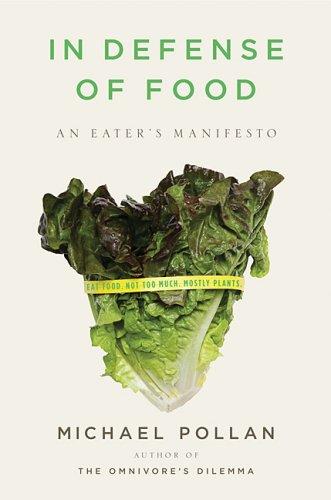
In Defense of Food
by Michael Pollan
★ Top 25 book of 2008 · #13 on Best Books of 2008
Michael Pollan tackles what to eat, what to avoid, and how to think about health. His core advice is compact: eat food, not too much of it, and mostly plants.
Best for: Readers wanting simple guidance on what to eat and how to think about health
In Defense of Food is #13 on BookWard's Best Books of 2008, out of 46 2008 books that cleared our data bar.
What In Defense of Food is about
Michael Pollan wrote this book because readers of The Omnivore's Dilemma kept asking him what they should actually eat. His answer: "Eat food. Not too much. Mostly plants." The rest of the book explains why that advice is harder to follow than it sounds.
Pollan argues that nutritionism, the habit of judging food by its individual nutrients, has overcomplicated and damaged American eating. He separates real food from what he calls edible foodlike substances, and says much of the Western diet is made up of imitations of food. His alternative is to eat what your ancestors would recognize, spend more time and money on food, and buy locally. Conversational and skeptical, it will help anyone confused by shifting diet advice and looking for a simpler way to think about what goes on the plate.
In Defense of Food on the Best Books of 2008
In Defense of Food came out in 2008. Of the 46 books first published in 2008 that met BookWard's data bar, it ranks #13 on our Best Books of 2008 list.
Why it made the list: 385 readers have shelved it on Open Library; readers rate it 4 out of 5 (37 ratings). The list ranks each year’s books on how many readers have picked them up, how highly readers rate them, and how many are reading them right now.
Nearby on the 2008 list
- Just After Sunset Stephen King, #11
- What Every BODY Is Saying Joe Navarro, #12
- Predictably Irrational Dan Ariely, #14
- The Knife of Never Letting Go Patrick Ness, #15
See all Best Books of 2008 Best books by year
More years: Best Books of 2007 Best Books of 2009.
The numbers behind it
- Readers: 323 want to read it, 15 are reading it now and 47 have read it, according to Open Library.
- Ratings: 4 out of 5 from 37 Open Library ratings.
| Signal | This book (0 to 100) | Weight |
|---|---|---|
| Reach | 70 | 55% |
| Reader love | 48 | 25% |
| Being read right now | 65 | 20% |
Questions about In Defense of Food
When was In Defense of Food published?
In Defense of Food by Michael Pollan was first published in 2008.
Was In Defense of Food one of the best books of 2008?
In Defense of Food is #13 on BookWard's Best Books of 2008, out of 46 2008 books that cleared our data bar. 385 readers have shelved it on Open Library; readers rate it 4 out of 5 (37 ratings).
Why is In Defense of Food on the Best Books of 2008 list?
385 readers have shelved it on Open Library; readers rate it 4 out of 5 (37 ratings).
More of the best books of 2008
- The Hunger Games Suzanne Collins, #1
- End of Days Sylvia Browne, #2
- The Last Straw Jeff Kinney, #3
- Amulet Kazu Kibuishi, #4
- Outliers Malcolm Gladwell, #5
- Michelle Obama in Her Own Words Michelle Obama, #6
See the full Best Books of 2008, the Top 100, or new books on Rising.
How we know
This page uses public data: Open Library reader counts and ratings, and Wikipedia page views for recent years. The description is paraphrased from real source text. Rankings reflect reading interest, not quality or sales, and can be affected by data gaps. Lists update monthly.
Suits adults and mature teens interested in food, health and how we eat.
Depends on the edition you pick.
Michael Pollan's short, argued case for eating real food again. 54% taste match
 BookWard’s take
Michael Pollan's short, argued case for eating real food again
Pollan builds In Defense of Food around one memorable line, "Eat food. Not too much. Mostly plants.", then spends the book earning it. It grew out of his 2007 essay Unhappy Meals and answers the question readers kept asking after The Omnivore's Dilemma: so what should I eat? Its central target is nutritionism, the habit of judging food by isolated nutrients rather than as food. The voice is distinctive, a confident, conversational essayist's stance with strong opinions on display. This is an idea-led book, and the argument is the whole engine. Nothing is left implied; the ideas are laid out plainly, which is the point of a manifesto. The reasoning is careful, but it's worth remembering that this is an argued position rather than a neutral survey, and it has drawn pushback.
A compact manifesto that makes its case without sprawl, which suits BookWard's liking for tight books.
Short sections and a steady forward argument keep it moving, a little slower than BookWard likes.
Nutritionism as an ideology was a fresh lens at the time, though much of the advice is familiar.
Clear, plain, conversational prose that stays out of the way of the argument.
It is optimistic that ordinary eaters can fix their diets by following a few simple habits.
Built in thematic stages that lead to practical rules, a little more shaped than a standard essay.
Dry asides lighten a serious subject, but this is not a funny book.
Gentle in tone, even when criticizing the food industry.
Controlled and argumentative rather than emotionally charged.
See all 50 dialsEvery position, side by side with this book
Where it lines up
- EndingBookWard 8 · book 8
- SentimentBookWard 8 · book 8
- PaceBookWard 8 · book 7
Where it pulls apart
- ExpositionBookWard 2 · book 9
- Familiar tropesBookWard 10 · book 6
- Story or ideasBookWard 3 · book 9
A compact manifesto that makes its case without sprawl, which suits BookWard's liking for tight books.
The anti-processed-food message is now well worn, though the nutritionism framing keeps it from feeling stock.
The argument runs step by step toward its famous summary line, though some claims rest on contested science.
Short sections and a steady forward argument keep it moving, a little slower than BookWard likes.
Nutritionism as an ideology was a fresh lens at the time, though much of the advice is familiar.
It lands on a plain, actionable set of rules, which BookWard's taste for resolved endings welcomes.
Pollan argues with conviction and a little nostalgia for ancestral eating, but stays mostly brisk and practical.
It persuades through argument and evidence rather than by shocking the reader.
It is well reasoned and informed, yet an author's argued view rather than a neutral survey, and critics have said so.
Pollan's calm, wry, opinionated essay voice is unmistakable and a real strength.
The argument is the whole book, far from BookWard's usual lean toward story.
Ideas are explained outright, which fits a manifesto but sits against BookWard's preference for showing in scene.
Short, purposeful parts keep the argument from drifting, though the middle leans on repetition of its core point.
Clear, plain, conversational prose that stays out of the way of the argument.
It is optimistic that ordinary eaters can fix their diets by following a few simple habits.
Built in thematic stages that lead to practical rules, a little more shaped than a standard essay.
Dry asides lighten a serious subject, but this is not a funny book.
Easy to read, aimed at general readers with no nutrition background.
It is argued from Pollan's single perspective, with scientists cited mainly to be weighed.
The argument moves forward, with history used as supporting context.
Entirely real-world argument.
It is an argument rather than a cast-driven story, with only a few cited figures.
It ranges across a food system and a culture's eating habits while staying tied to the individual plate.
It turns on practical outward habits like shopping and eating, more than on inner reflection.
Almost no dialogue, as is usual for an essay-style argument.
No romance.
It deals with everyday food and supermarkets, which will feel familiar to most readers.
Rooted in modern American eating and the debates of its 2008 moment.
The core advice endures, though its science and targets are tied to its moment.
Pollan speaks plainly as himself with no tricks of reliability.
It takes a clear side on what to eat and why, though how to eat well is arguable.
Descriptions of food and its history serve the argument without lingering.
It reads as an argued essay with some narrative texture, more than a cold analysis.
Pollan keeps himself in view as an engaged guide rather than a detached observer.
A standalone, though it follows on from The Omnivore's Dilemma.
An argument with few surprises beyond its reframing of nutrition.
It asks readers to rethink everyday habits and distrust nutrition advice.
Gentle in tone, even when criticizing the food industry.
Controlled and argumentative rather than emotionally charged.
Humor is dry and incidental.
No violence.
No sexual content.
Food policy, industry and agriculture are in play, though it stops short of partisan fight.
Plain, accessible language.
A manifesto by design, with Pollan's view stated openly throughout.
It prizes the wisdom of how earlier generations ate, while pointing toward better habits today.
It holds that eaters can reclaim healthier habits, an optimistic view of the individual.
Review written by BookWard, dial version 1, November 2026.
Who is In Defense of Food right for?
Suits adults and mature teens interested in food, health and how we eat. Nothing graphic, though it discusses diet and health in ways that may be unhelpful for readers with disordered-eating concerns.
Easy to read, aimed at general readers with no nutrition background.
Gentle in tone, even when criticizing the food industry.
Controlled and argumentative rather than emotionally charged.
No violence.
Book CompanionIn Defense of Food: ideas, characters, themes
Real food, eaten in moderation and mostly plants, serves people better than a diet built on nutrients and processed products.
- Eat food. Pollan separates real food from edible foodlike substances, urging readers to favor what earlier generations would recognize.
- Not too much. The second part of his rule asks eaters to watch quantity as well as quality.
- Mostly plants. He steers eaters toward a plant-heavy diet as the simplest guide to healthier eating.
- Nutritionism as ideology. He argues that judging food by isolated nutrients has overcomplicated and harmed eating habits.
- Spend more time and money on food. He recommends valuing food more, spending more on it and buying locally.
Themes
The belief that food is best understood and judged by its individual nutrients.
The gap between whole, recognizable food and processed foodlike substances.
How modern American eating habits shape health.
The claim that nutrition science has not yet identified every nutrient or effect.
The idea that ancestral habits hold wisdom about how to eat.
Discussion questions
- Is judging food by its nutrients really the problem Pollan says it is?
- What counts as real food, and where would you draw the line?
- How persuasive is an argued position compared with a neutral summary of the evidence?
- Is spending more time and money on food realistic for most people?
- Does the book's advice hold up after more than a decade of new nutrition research?
Personalize your Book Companion
This is the general edition. In BookWard, the Companion is written for you: your reading profile, your notes, and spoiler-safe to the page you are on.
Buy, listen or borrow In Defense of Food
Each link opens a search for this book on that store, in a new tab.
Read on a device
Borrow
Reviews and community
If you liked In Defense of Food
A lively case that autonomy, mastery and purpose beat carrots and sticks
Slow ProductivityCal NewportA calm, idea-led case against busyness as proof of work
The AI ConEmily M. BenderA witty, pointed takedown of AI hype and who profits
The Anxious GenerationJonathan HaidtA data-driven case against smartphone childhood, and what to do
Find your own best books
Add what you have read, rate it, and BookWard will recommend what to read next.
Free to start. No credit card needed.