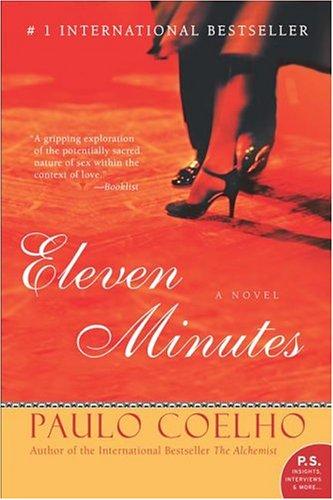
Eleven Minutes
by Paulo Coelho
★ Top 25 book of 2003 · #14 on Best Books of 2003
The story of Maria, a young girl from a Brazilian village whose first brushes with love leave her heartbroken. She becomes convinced she will never find true love and believes that love is a terrible thing.
Best for: Readers of Paulo Coelho who like stories about love and self-discovery.
Eleven Minutes is #14 on BookWard's Best Books of 2003, out of 52 2003 books that cleared our data bar.
What Eleven Minutes is about
Maria grows up in a small Brazilian village, where her first innocent brushes with love leave her heartbroken. She decides that love only brings suffering and that she will never find the real thing. A chance meeting in Rio carries her to Geneva, where she dreams of fame and fortune.
Then she meets a handsome young painter, who challenges her bleak view of love. The story asks whether sex can be only a transaction or something closer to the sacred. Maria must choose between pleasure for its own sake and the risk of seeking her inner light. The tone is reflective and sensual, and it suits readers who enjoy philosophical fiction about love. The P.S. edition adds author interviews and recommended reading.
Eleven Minutes on the Best Books of 2003
Eleven Minutes came out in 2003. Of the 52 books first published in 2003 that met BookWard's data bar, it ranks #14 on our Best Books of 2003 list.
Why it made the list: 484 readers have shelved it on Open Library; readers rate it 3.8 out of 5 (26 ratings); 45 are reading it right now. The list ranks each year’s books on how many readers have picked them up, how highly readers rate them, and how many are reading them right now.
Nearby on the 2003 list
- The Devil in the White City Erik Larson, #12
- Thomas and Friends Reverend W. Awdry, #13
- Fire and Ice Erin Hunter, #15
- The Five People You Meet in Heaven Mitch Albom, #16
See all Best Books of 2003 Best books by year
More years: Best Books of 2002 Best Books of 2004.
The numbers behind it
- Readers: 396 want to read it, 45 are reading it now and 43 have read it, according to Open Library.
- Ratings: 3.8 out of 5 from 26 Open Library ratings.
| Signal | This book (0 to 100) | Weight |
|---|---|---|
| Reach | 77 | 55% |
| Reader love | 17 | 25% |
| Being read right now | 87 | 20% |
Questions about Eleven Minutes
When was Eleven Minutes published?
Eleven Minutes by Paulo Coelho was first published in 2003.
Was Eleven Minutes one of the best books of 2003?
Eleven Minutes is #14 on BookWard's Best Books of 2003, out of 52 2003 books that cleared our data bar. 484 readers have shelved it on Open Library; readers rate it 3.8 out of 5 (26 ratings); 45 are reading it right now.
Why is Eleven Minutes on the Best Books of 2003 list?
484 readers have shelved it on Open Library; readers rate it 3.8 out of 5 (26 ratings); 45 are reading it right now.
More of the best books of 2003
- Harry Potter and the Order of the Phoenix J. K. Rowling, #1
- Into the Wild Erin Hunter, #2
- The Kite Runner Khaled Hosseini, #3
- Don't Let the Pigeon Drive the Bus! Mo Willems, #4
- A Short History of Nearly Everything Bill Bryson, #5
- The Da Vinci Code Dan Brown, #6
See the full Best Books of 2003, the Top 100, or new books on Rising.
How we know
This page uses public data: Open Library reader counts and ratings, and Wikipedia page views for recent years. The description is paraphrased from real source text. Rankings reflect reading interest, not quality or sales, and can be affected by data gaps. Lists update monthly.
Suits adult readers.
Depends on the edition you pick.
A prostitute's search for love, told in plain, earnest prose. 46% taste match
 BookWard’s take
A prostitute's search for love, told in plain, earnest prose
Eleven Minutes follows Maria, a young woman from a Brazilian village who ends up in Geneva, and uses her story to argue that sex and love belong together. It is a short, quick read with a clear opening and a plain, fable-like voice. The brisk pace and the resolved ending are points in its favour. Where it loses me is the sentiment: Coelho leans toward the earnest and the inspirational, and I would have preferred more restraint. It also leans heavily on familiar tropes, the wounded heart and the spiritual awakening. It is driven by ideas, with the author's philosophy of love shaping the book more than any tightly drawn plot. Worth trying if you like parable-style novels; less so if you want subtlety.
A compact novel that moves briskly, close to BookWard's preference for tight books.
Short chapters and a clear sequence of events keep it moving, in line with BookWard's taste.
The premise is distinctive, but the journey from heartbreak to sacred love follows a well-worn shape.
The language is simple and clear, and it is reasonably plain by design.
Maria's inner change carries the book more than any outward plot.
Maria's story bends toward redemption and the promise of sacred love, a hopeful outlook BookWard shares.
A straightforward telling of one woman's journey, conventional in form.
This is a serious, searching book with little room for humour.
Prostitution and heartbreak bring real shadow, tempered by a redemptive turn.
Maria's longing and pain are felt, though the telling stays measured.
See all 50 dialsEvery position, side by side with this book
Where it lines up
- EndingBookWard 8 · book 8
- LengthBookWard 1 · book 2
- PaceBookWard 8 · book 7
Where it pulls apart
- Familiar tropesBookWard 10 · book 3
- Internal logicBookWard 10 · book 5
- ExpositionBookWard 2 · book 8
A compact novel that moves briskly, close to BookWard's preference for tight books.
It opens straight on Maria's story and her early heartbreak, a good fit for BookWard's liking for an immediate start.
The fallen woman, the heartbroken innocent and the redeeming love all lean on familiar tropes, which BookWard marks down.
Maria's choices follow a clear emotional line, though the story bends toward its message more than strict cause and effect.
Short chapters and a clear sequence of events keep it moving, in line with BookWard's taste.
The premise is distinctive, but the journey from heartbreak to sacred love follows a well-worn shape.
Maria is given real interior life, though the supporting figures serve the book's argument more than their own stories.
The story resolves her search for love and meaning clearly, matching BookWard's fondness for resolved endings.
The book is openly earnest and inspirational, which sits well away from BookWard's preference for restraint.
The subject matter is frank, but it serves Maria's journey and is not there only to jolt.
Coelho's plain, parable-like voice is recognisable, and that distinctiveness is a plus for BookWard.
The book exists to argue a view of love and sex, so ideas lead, further toward ideas than BookWard usually goes.
Themes and Maria's realisations are often stated outright, the opposite of BookWard's preference for showing in scene.
With a short length and a steady line of events, the middle holds its momentum.
The language is simple and clear, and it is reasonably plain by design.
Maria's inner change carries the book more than any outward plot.
Maria's story bends toward redemption and the promise of sacred love, a hopeful outlook BookWard shares.
A straightforward telling of one woman's journey, conventional in form.
This is a serious, searching book with little room for humour.
Easy to read, with simple language and an accessible message.
It stays closely with Maria, so the perspective is narrow.
The world is grounded, set in Brazil and Switzerland.
A small circle of people surrounds Maria.
An intimate, personal story with a small canvas.
Maria's feelings and self-understanding take priority over outward action.
Conversations carry some of the book's ideas, balanced with narration.
The question of love and her meeting with the painter sit at the heart of the book.
Rio, Geneva and the world of paid sex are likely new territory for most readers.
The questions about love and desire are lasting, though the treatment may feel of its moment.
The narration is straightforward and can be taken at face value.
The book has a clear view of what is shallow and what is sacred in love.
Setting and sensation are present but kept spare and functional.
A standalone novel.
The story follows an expected arc with few surprises.
The subject is frank, but the message is reassuring more than unsettling.
Prostitution and heartbreak bring real shadow, tempered by a redemptive turn.
Maria's longing and pain are felt, though the telling stays measured.
Some difficult episodes appear, but violence is not a focus.
Sex is central to the premise and discussed openly and often.
The concerns are personal and spiritual, not political.
The language is plain and easy.
The author's philosophy comes through strongly in the telling.
Neither strongly nostalgic nor futuristic, resting on Maria's present and her hopes.
The book holds that love and sacred sex can redeem, a strongly idealistic stance.
Review written by BookWard, dial version 1, November 2026.
Who is Eleven Minutes right for?
Suits adult readers. It deals openly with prostitution and sexual experience, so it is not intended for younger teens.
Easy to read, with simple language and an accessible message.
Prostitution and heartbreak bring real shadow, tempered by a redemptive turn.
Maria's longing and pain are felt, though the telling stays measured.
Some difficult episodes appear, but violence is not a focus.
Book CompanionEleven Minutes: ideas, characters, themes
A young Brazilian woman's passage through sex work toward the idea that physical pleasure and love can be joined as something sacred.
- Maria's disillusionment. Early heartbreak leaves Maria convinced that love brings suffering, and that belief shapes her choices.
- The move to Geneva. A chance meeting in Rio carries her to Switzerland, where she hopes to find fame and fortune.
- The painter. Meeting a handsome young painter tests her despairing view of love.
- Two paths. She must choose between sex for its own sake and the risk of finding her own inner light.
- Sacred sex. The book's central proposal is that sex within love can be a spiritual experience.
Characters
Maria
Protagonist
A young woman from a Brazilian village whose search for love and self-realisation drives the story.
The painter
Love interest
A handsome young man whose arrival challenges Maria's belief that love only brings pain.
Themes
Whether opening your heart is worth the pain it can bring.
Coming to know yourself through experience.
The idea that sex joined with love can be a spiritual act.
The dream that takes Maria abroad and the cost of chasing it.
Discussion questions
- Does Maria's early heartbreak explain the choices she makes later?
- Is the book's contrast between sex for pleasure and sacred sex convincing?
- How does the painter change Maria's view of love?
- What does the book suggest about the price of chasing fame and fortune?
- Does the author's plain, direct style help or limit the story?
Personalize your Book Companion
This is the general edition. In BookWard, the Companion is written for you: your reading profile, your notes, and spoiler-safe to the page you are on.
Buy, listen or borrow Eleven Minutes
Each link opens a search for this book on that store, in a new tab.
Read on a device
Borrow
Reviews and community
If you liked Eleven Minutes
A short spiritual quest where ideas outweigh the story
The Sun and Her FlowersRupi KaurShort poems on wilting and blooming, sentimental by design and unfussy to read
Pretty Rings and Broken ThingsKat SingletonA billionaire arranged-marriage romance that leans hard on familiar pleasures
ConfessColleen HooverA secrets-driven Dallas romance that favors feeling over surprise
Find your own best books
Add what you have read, rate it, and BookWard will recommend what to read next.
Free to start. No credit card needed.