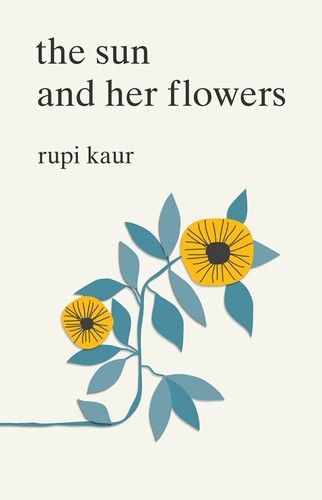
The Sun and Her Flowers
by Rupi Kaur
★ Top 10 book of 2017 · #9 on Best Books of 2017
Kaur's second poetry collection moves through five chapters: wilting, falling, rooting, rising and blooming. Illustrated by the author, it explores healing, ancestry, finding a home within yourself, and love in all its forms.
Best for: Poetry lovers seeking illustrated verse about healing, heritage, growth and self-belonging
The Sun and Her Flowers is #9 on BookWard's Best Books of 2017, out of 73 2017 books that cleared our data bar.
What The Sun and Her Flowers is about
Rupi Kaur's second poetry collection, after milk and honey, is built from five chapters with her own illustrations: wilting, falling, rooting, rising, and blooming. Those titles trace a path of growth and healing, and the publisher's description quotes a poem in which a mother compares people to garden flowers that must wilt, fall, root, and rise in order to bloom.
Along the way the poems turn to ancestry and the honoring of one's roots, and to expatriation, including the work of rising up to find a home within yourself. The book also celebrates love in all its forms. It will appeal to readers who like short, spare poems they can return to in small moments, especially anyone going through a hard season and looking for words about starting again.
The Sun and Her Flowers on the Best Books of 2017
The Sun and Her Flowers came out in 2017. Of the 73 books first published in 2017 that met BookWard's data bar, it ranks #9 on our Best Books of 2017 list.
Why it made the list: 1,128 readers have shelved it on Open Library; readers rate it 4 out of 5 (45 ratings); 42 are reading it right now. The list ranks each year’s books on how many readers have picked them up, how highly readers rate them, and how many are reading them right now.
It earns Being read right now.
Nearby on the 2017 list
- Becoming Supernatural Joe Dispenza, #7
- Turtles All the Way Down John Green, #8
- Dog Man and Cat Kid Dav Pilkey, #10
- Norse Mythology Neil Gaiman, #11
See all Best Books of 2017 Best books by year
More years: Best Books of 2016 Best Books of 2018.
The numbers behind it
- Readers: 1,042 want to read it, 42 are reading it now and 44 have read it, according to Open Library.
- Ratings: 4 out of 5 from 45 Open Library ratings.
| Signal | This book (0 to 100) | Weight |
|---|---|---|
| Reach | 93 | 55% |
| Reader love | 55 | 25% |
| Being read right now | 92 | 20% |
Questions about The Sun and Her Flowers
When was The Sun and Her Flowers published?
The Sun and Her Flowers by Rupi Kaur was first published in 2017.
Was The Sun and Her Flowers one of the best books of 2017?
The Sun and Her Flowers is #9 on BookWard's Best Books of 2017, out of 73 2017 books that cleared our data bar. 1,128 readers have shelved it on Open Library; readers rate it 4 out of 5 (45 ratings); 42 are reading it right now.
Why is The Sun and Her Flowers on the Best Books of 2017 list?
1,128 readers have shelved it on Open Library; readers rate it 4 out of 5 (45 ratings); 42 are reading it right now.
More of the best books of 2017
- The Hate U Give Angie Thomas, #1
- The Seven Husbands of Evelyn Hugo Taylor Jenkins Reid, #2
- A Court of Wings and Ruin Sarah J. Maas, #3
- One of Us Is Lying Karen M. McManus, #4
- Why We Sleep Matthew P. Walker, #5
- The Dark Prophecy Rick Riordan, #6
See the full Best Books of 2017, the Top 100, or new books on Rising.
How we know
This page uses public data: Open Library reader counts and ratings, and Wikipedia page views for recent years. The description is paraphrased from real source text. Rankings reflect reading interest, not quality or sales, and can be affected by data gaps. Lists update monthly.
Suits older teens and adults, and it is short enough to share.
Depends on the edition you pick.
Short poems on wilting and blooming, sentimental by design and unfussy to read. 46% taste match
 BookWard’s take
Short poems on wilting and blooming, sentimental by design and unfussy to read
The Sun and Her Flowers is Rupi Kaur's second poetry collection, split into five chapters (wilting, falling, rooting, rising, blooming) and illustrated by the author. It is short and quick to get through, which is a point in its favor. The opening is immediate, since each poem lands in a few lines, though the familiar imagery is where I part ways with it: flowers, healing and self-worth are well-worn territory, and the feeling runs openly warm rather than restrained. Where it earns credit is in the voice, because the lowercase style and line drawings are unmistakably hers. The outlook is hopeful, a journey toward finding a home within yourself. It is a book to dip into rather than study, and whether it moves you depends on how much you want feeling stated plainly.
A slim collection of short poems that can be read in an afternoon, matching BookWard's taste for brevity.
Short poems and white space make it move quickly from page to page, in line with BookWard's pace.
The themes are common in contemporary poetry, with the lowercase style and drawings the main distinctive touches.
The language is deliberately plain and spare, a bit plainer than BookWard's middle-ground taste.
With no plot, everything rests on the speaker's inner life, which suits BookWard's lean toward character.
The journey from wilting to blooming ends on growth and self-belief, a hopeful outlook BookWard shares.
Five themed chapters and drawings give a clear frame, more shaped than a conventional poetry run but not experimental.
The tone is earnest and tender, with little humor.
It touches painful experiences but frames them within healing, so it is moderate rather than dark.
Feeling is the point of the book and it is expressed with real intensity.
See all 50 dialsEvery position, side by side with this book
Where it lines up
- LengthBookWard 1 · book 1
- PaceBookWard 8 · book 8
- Authorial voiceBookWard 9 · book 9
Where it pulls apart
- Familiar tropesBookWard 10 · book 3
- Internal logicBookWard 10 · book 6
- SentimentBookWard 8 · book 2
A slim collection of short poems that can be read in an afternoon, matching BookWard's taste for brevity.
Each poem opens straight on its feeling, so there is no warm-up, which suits BookWard well.
Flowers, roots, healing and self-love are familiar poetic ground, which sits against BookWard's wish to avoid well-worn imagery.
The five-chapter arc of wilting to blooming gives a clear, coherent frame, though poems are not built on strict logic.
Short poems and white space make it move quickly from page to page, in line with BookWard's pace.
The themes are common in contemporary poetry, with the lowercase style and drawings the main distinctive touches.
Poems speak from a single emotional position rather than building a cast, so there is little character depth to measure.
The arc closes on blooming, a resolved and hopeful finish that BookWard appreciates.
Feelings are stated openly and warmly, the opposite of the restraint BookWard prefers.
Hard subjects appear, but they are tied to a healing journey rather than used for effect.
This is a poetry collection, so rigor does not apply.
The lowercase style, plain diction and the author's own illustrations make it instantly recognizable.
Poems carry feelings and ideas about growth rather than telling a story, which leans away from BookWard's story preference.
Emotions are named and explained outright in short lines rather than left to scenes, unlike BookWard's taste for showing.
The five chapters keep a steady shape, though a long run of similar poems can blur together.
The language is deliberately plain and spare, a bit plainer than BookWard's middle-ground taste.
With no plot, everything rests on the speaker's inner life, which suits BookWard's lean toward character.
The journey from wilting to blooming ends on growth and self-belief, a hopeful outlook BookWard shares.
Five themed chapters and drawings give a clear frame, more shaped than a conventional poetry run but not experimental.
The tone is earnest and tender, with little humor.
The poems are short and direct, making this an easy read next to BookWard's moderate appetite for effort.
The collection speaks largely from one voice and one perspective.
It follows the progression of its chapters rather than jumping around in time.
The poems are rooted in real emotion and everyday imagery.
A single speaker with a few family figures glimpsed makes for a very small cast.
The focus is personal feeling, home and healing rather than sweeping events.
Almost everything is interior, feeling and reflection rather than action.
Poems are written as statements, not conversations, so dialogue is almost absent.
Love in all its forms is a main theme, with romantic love sitting alongside family and self-love.
The settings are everyday and emotional, familiar rather than unfamiliar.
It is a contemporary work from 2017, with present-day concerns.
Its themes of healing are enduring, though the style is tied to a recent moment in poetry.
The speaker is direct and sincere, with no sign of unreliability.
The poems offer clear encouragement toward healing and self-worth rather than moral puzzles.
Imagery is brief and spare, with few lingering descriptions.
Written in an intimate first-person voice, it is personal rather than detached.
It is the author's second collection, but it stands alone.
Poems offer no plot, so there are no surprises of that kind.
The collection mostly offers comfort and encouragement over provocation.
It touches painful experiences but frames them within healing, so it is moderate rather than dark.
Feeling is the point of the book and it is expressed with real intensity.
Hard experiences are referenced rather than shown, so violence on the page is low.
Intimacy and the body come up as themes, though the treatment is brief.
Ancestry, expatriation and belonging touch on social themes without being a political argument.
The language is plain and readily understood.
The speaker states feelings and convictions openly rather than staying neutral.
The arc moves toward growth and renewal while honoring ancestry, so it looks ahead more than back.
The book believes in healing and bloom, a clearly idealistic stance.
Review written by BookWard, dial version 1, November 2026.
Who is The Sun and Her Flowers right for?
Suits older teens and adults, and it is short enough to share. Some poems touch on painful experiences, so readers sensitive to those themes may want to browse first.
The poems are short and direct, making this an easy read next to BookWard's moderate appetite for effort.
It touches painful experiences but frames them within healing, so it is moderate rather than dark.
Feeling is the point of the book and it is expressed with real intensity.
Hard experiences are referenced rather than shown, so violence on the page is low.
Book CompanionThe Sun and Her Flowers: ideas, characters, themes
The Sun and Her Flowers follows a life through five stages, wilting, falling, rooting, rising and blooming, treating growth and healing as a natural cycle like a garden's.
- Five-chapter arc. The collection is organized into wilting, falling, rooting, rising and blooming, giving the poems a clear emotional progression.
- Illustrated by the author. Rupi Kaur supplies her own illustrations, which sit alongside the poems and add to the book's recognizable look.
- The garden metaphor. A mother's lesson that people, like plants, must wilt and fall and root and rise in order to bloom frames the whole book.
- Ancestry and roots. The collection reflects on family, honoring where you come from and the idea of expatriation.
- Finding home within yourself. A recurring thread is rising up to build a sense of home inside yourself rather than in a place.
Themes
Recovery is treated as a cycle of wilting and blooming rather than a single event.
Honoring family history and where you come from as part of who you are.
Finding a home within yourself when place feels uncertain.
Romantic, familial and self-love are all celebrated.
The idea that falling and rising again are necessary to flourish.
Discussion questions
- How does the wilting-to-blooming structure shape the way you read the poems?
- What does the garden metaphor add compared with saying the same thing directly?
- How do the author's illustrations change your experience of the words?
- Which poems about roots and ancestry stayed with you most, and why?
- Does stating feeling plainly make a poem stronger or weaker for you?
Personalize your Book Companion
This is the general edition. In BookWard, the Companion is written for you: your reading profile, your notes, and spoiler-safe to the page you are on.
Buy, listen or borrow The Sun and Her Flowers
Each link opens a search for this book on that store, in a new tab.
Read on a device
Borrow
Reviews and community
If you liked The Sun and Her Flowers
Short, plainspoken poems on hurt, love, loss and healing
Eleven MinutesPaulo CoelhoA prostitute's search for love, told in plain, earnest prose
The Art of Racing in the RainGarth SteinA philosophizing dog narrates a family's hardest years, tenderly and plainly
A Gentle ReminderBianca SparacinoShort, soft notes of comfort for tender days, built to be dipped into
Find your own best books
Add what you have read, rate it, and BookWard will recommend what to read next.
Free to start. No credit card needed.