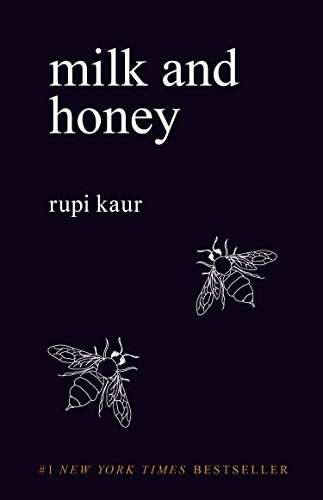
Milk and Honey
by Rupi Kaur
★ Top 10 book of 2014 · #8 on Best Books of 2014
This poetry collection is organized into four chapters, each tackling a different kind of pain and heartache. It guides readers through life's bitterest moments while insisting that sweetness can be found everywhere if you look.
Best for: Readers seeking poetry about pain and healing that finds sweetness in hard moments
Milk and Honey is #8 on BookWard's Best Books of 2014, out of 66 2014 books that cleared our data bar.
What Milk and Honey is about
Rupi Kaur's book gathers poems and short prose pieces into four sections: the hurting, the loving, the breaking and the healing. The first deals with sexual assault, abuse and trouble within families. The second turns lighter, following the pleasures of falling in love. The third returns to a dark place after a breakup, and even includes a break-up to-do list. The last section offers comfort, telling women they are valuable and should embrace who they are.
Kaur writes entirely in lowercase with little punctuation, a choice she says honors Punjabi, and some poems sit beside her simple line drawings. The language is plain and direct, and it deals openly with sexual themes, so it is recommended for readers 18 and older. Some critics find the style too simple, and the label "Instapoetry" follows her work because she built her audience on Instagram. It suits readers who want short, intimate poems about hurt and recovery, and who are new to poetry.
Milk and Honey on the Best Books of 2014
Milk and Honey came out in 2014. Of the 66 books first published in 2014 that met BookWard's data bar, it ranks #8 on our Best Books of 2014 list.
Why it made the list: 2,400 readers have shelved it on Open Library; readers rate it 4 out of 5 (121 ratings); 113 are reading it right now. The list ranks each year’s books on how many readers have picked them up, how highly readers rate them, and how many are reading them right now.
It earns Being read right now.
Nearby on the 2014 list
- Ugly Love Colleen Hoover, #6
- All the Light We Cannot See Anthony Doerr, #7
- The Body Keeps the Score Bessel van der Kolk, #9
- Ignite Me Tahereh Mafi, #10
See all Best Books of 2014 Best books by year
More years: Best Books of 2013 Best Books of 2015.
The numbers behind it
- Readers: 2,075 want to read it, 113 are reading it now and 212 have read it, according to Open Library.
- Ratings: 4 out of 5 from 121 Open Library ratings.
| Signal | This book (0 to 100) | Weight |
|---|---|---|
| Reach | 95 | 55% |
| Reader love | 52 | 25% |
| Being read right now | 94 | 20% |
Questions about Milk and Honey
When was Milk and Honey published?
Milk and Honey by Rupi Kaur was first published in 2014.
Was Milk and Honey one of the best books of 2014?
Milk and Honey is #8 on BookWard's Best Books of 2014, out of 66 2014 books that cleared our data bar. 2,400 readers have shelved it on Open Library; readers rate it 4 out of 5 (121 ratings); 113 are reading it right now.
Why is Milk and Honey on the Best Books of 2014 list?
2,400 readers have shelved it on Open Library; readers rate it 4 out of 5 (121 ratings); 113 are reading it right now.
More of the best books of 2014
- To All the Boys I've Loved Before Jenny Han, #1
- The Long Haul Jeff Kinney, #2
- Zero to One Peter A. Thiel, #3
- Surrounded by Idiots Thomas Erikson, #4
- After (After Series, Book 1) Anna Todd, #5
- Ugly Love Colleen Hoover, #6
See the full Best Books of 2014, the Top 100, or new books on Rising.
How we know
This page uses public data: Open Library reader counts and ratings, and Wikipedia page views for recent years. The description is paraphrased from real source text. Rankings reflect reading interest, not quality or sales, and can be affected by data gaps. Lists update monthly.
Best suited to adult readers, and it is recommended for ages 18 and up.
Depends on the edition you pick.
Short, plainspoken poems on hurt, love, loss and healing. 48% taste match
 BookWard’s take
Short, plainspoken poems on hurt, love, loss and healing
Milk and Honey is a collection of poetry and prose in four sections: the hurting, the loving, the breaking, the healing. It is very short, and the language is deliberately plain, so you are in immediately. Poems arrive in lowercase with almost no punctuation, which gives the book an unmistakable voice, and nearly every page works as a way in. Where it strains is familiarity: heartbreak and self-worth are well-worn ground, and I'd have liked fresher angles on them. The writing stays plain rather than ornate, and the final section resolves toward comfort. It is an honest, quick read that rewards taking a few pages at a time and sitting with them.
A slim collection of short poems and drawings that you can finish in one sitting, which matches BookWard's love of tight books.
Poems are short and move quickly, so the pages turn fast, close to BookWard's preferred pace.
The lowercase, minimal-punctuation style stands out, but the subjects themselves are common, so it sits below BookWard's high bar.
The language is deliberately simple and unadorned, plainer than BookWard's slight lean toward the ornate.
With no plot to drive it, the book rests on one speaker's emotional experience, in line with BookWard's lean toward character.
It starts in dark places but ends by encouraging women to embrace their worth, so it lands on the hopeful side.
The four-part arc and breaking of poetic convention are formal choices, though the shape stays easy to follow.
The collection is earnest and emotional throughout, with little room for humor.
The hurting and breaking sections go into abuse, assault and heartbreak, making the content fairly dark overall.
Emotion is the whole point of the book, delivered openly and intensely.
See all 50 dialsEvery position, side by side with this book
Where it lines up
- LengthBookWard 1 · book 1
- PaceBookWard 8 · book 8
- EndingBookWard 8 · book 8
Where it pulls apart
- Familiar tropesBookWard 10 · book 3
- Internal logicBookWard 10 · book 6
- OriginalityBookWard 9 · book 4
A slim collection of short poems and drawings that you can finish in one sitting, which matches BookWard's love of tight books.
Each poem is brief and direct, so the book pulls you in from the first page, just as BookWard likes.
Heartbreak, healing and self-worth are familiar territory, so it leans on well-worn themes more than BookWard prefers.
As poetry it does not build a plot to test, but the four sections follow a coherent emotional order from hurt to healing.
Poems are short and move quickly, so the pages turn fast, close to BookWard's preferred pace.
The lowercase, minimal-punctuation style stands out, but the subjects themselves are common, so it sits below BookWard's high bar.
One speaker's experience runs through the book, but it is sketched in brief moments rather than fully drawn.
The final section, the healing, resolves toward comfort and self-worth, giving a clear sense of closure that BookWard values.
It speaks openly and warmly about feeling, which leans sentimental where BookWard prefers restraint.
The first section deals with abuse and assault in a serious way, but the darkness serves the book's arc of recovery.
This is poetry rather than nonfiction, so the dial does not apply.
The lowercase style, sparse punctuation and plain address make the voice instantly recognizable.
It is built around themes and feelings more than a plot, which is more idea-led than BookWard's story-first taste.
Poems tend to state feelings outright rather than dramatize them in scene, which runs against BookWard's preference for showing.
The collection is short and organized into four clear parts, so it stays steady from start to finish.
The language is deliberately simple and unadorned, plainer than BookWard's slight lean toward the ornate.
With no plot to drive it, the book rests on one speaker's emotional experience, in line with BookWard's lean toward character.
It starts in dark places but ends by encouraging women to embrace their worth, so it lands on the hopeful side.
The four-part arc and breaking of poetic convention are formal choices, though the shape stays easy to follow.
The collection is earnest and emotional throughout, with little room for humor.
Plain language and short pieces make it quick going, easier than BookWard's usual reading effort.
A single speaker carries the book, shifting between first and second person but staying one perspective.
The sections follow a rough path from hurt to healing, so the progression reads as largely linear.
Everything is grounded in lived emotional experience, with nothing fantastical.
The book centers on the speaker and the people in her life, which keeps the cast tiny.
It is a small, personal book about private experience, the opposite of epic.
Almost all of it is inner feeling and reflection rather than outward action, well below BookWard's balance.
Poems are spoken in the speaker's own voice, with essentially no dialogue.
Love and its loss drive two of the four sections, so romance is a major thread without being the only one.
Settings are everyday and relatable, far from the unfamiliar worlds BookWard enjoys.
A contemporary book from 2014 that speaks to present-day relationships and social media age readers.
The themes of love, loss and healing last, though the style ties it to a particular moment.
The speaker is open and direct about her experience, a reliable voice rather than an unreliable one.
The book takes a clear stance on survival, self-worth and femininity, leaving little moral ambiguity.
Imagery is spare and brief, supported by simple line art, so it is sparse rather than rich.
It is poetry and prose rather than nonfiction narrative, so the dial does not apply.
It is drawn from Kaur's own experiences, so the perspective is very personal rather than detached.
It stands alone as a single collection.
Poems do not build toward surprises, so there are essentially none.
It is gentle to read but asks the reader to sit with abuse and loss, so it is mildly challenging.
The hurting and breaking sections go into abuse, assault and heartbreak, making the content fairly dark overall.
Emotion is the whole point of the book, delivered openly and intensely.
The tone is earnest throughout, so humor style does not really apply.
Sexual assault and abuse are referenced, though through brief poems rather than graphic scenes.
The book uses sexual terminology and addresses sexual assault and intimacy, which is why it is recommended for ages 18 and up.
Feminism is a stated theme, so it carries a clear social viewpoint without being a political treatise.
The language is plain and accessible, easy to read throughout.
The speaker states feelings and convictions directly, so the narration is strongly opinionated.
It moves from painful past toward healing and self-acceptance, tilting toward the future.
The closing message that you are valuable no matter what you endured is openly idealistic.
Review written by BookWard, dial version 1, November 2026.
Who is Milk and Honey right for?
Best suited to adult readers, and it is recommended for ages 18 and up. It deals directly with sexual assault, abuse and heartbreak, and uses sexual terminology.
Plain language and short pieces make it quick going, easier than BookWard's usual reading effort.
The hurting and breaking sections go into abuse, assault and heartbreak, making the content fairly dark overall.
Emotion is the whole point of the book, delivered openly and intensely.
Sexual assault and abuse are referenced, though through brief poems rather than graphic scenes.
Book CompanionMilk and Honey: ideas, characters, themes
Milk and Honey follows one speaker from pain through love and loss to healing, finding sweetness even in bitter moments.
- Four sections. The book is divided into the hurting, the loving, the breaking and the healing, each with a different purpose.
- Plain, accessible language. Kaur writes simply to make the book approachable for a wide range of readers.
- Lowercase and little punctuation. This style honors Punjabi, the language of her birthplace, and breaks traditional poetry conventions.
- Line art. Some poems are paired with simple drawings by Kaur.
- Social media roots. Kaur used Instagram to share her work, which is why critics often label it Instapoetry.
Themes
Living through abuse and pain and continuing forward.
Affirming women's worth and voice.
The joy of falling in love and the ache when it ends.
Coping with a breakup and what is left behind.
Embracing your emotions and valuing yourself after hardship.
Discussion questions
- How does the order of the four sections shape the emotional journey of the book?
- What does the lowercase, minimally punctuated style add to the poems?
- Do the simple line drawings change how you read the poems they accompany?
- Why do you think this style of poetry resonated with so many readers online?
- Which poem or section felt most honest to you, and why?
Personalize your Book Companion
This is the general edition. In BookWard, the Companion is written for you: your reading profile, your notes, and spoiler-safe to the page you are on.
Buy, listen or borrow Milk and Honey
Each link opens a search for this book on that store, in a new tab.
Read on a device
Borrow
Reviews and community
If you liked Milk and Honey
Short poems on wilting and blooming, sentimental by design and unfussy to read
Eleven MinutesPaulo CoelhoA prostitute's search for love, told in plain, earnest prose
The Art of Racing in the RainGarth SteinA philosophizing dog narrates a family's hardest years, tenderly and plainly
The Woman in MeBritney SpearsA pop star's memoir in her own plain, wry words
Find your own best books
Add what you have read, rate it, and BookWard will recommend what to read next.
Free to start. No credit card needed.