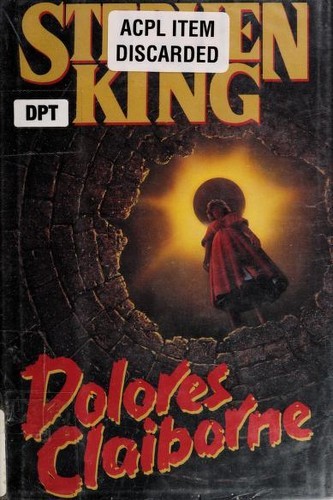
Dolores Claiborne
by Stephen King
★ Top 25 book of 1992 · #21 on Best Books of 1992
Dolores Claiborne, suspected of killing her wealthy employer Vera Donovan, tells police her life story. She recalls her failing marriage, her violent husband's suspicious death decades ago, and her loyalty to a demanding employer.
Best for: Readers who like suspense told through a suspect's own confessional account
Dolores Claiborne is #21 on BookWard's Best Books of 1992, out of 43 1992 books that cleared our data bar.
What Dolores Claiborne is about
Dolores Claiborne, a 65-year-old widow on Little Tall Island, Maine, sits down with a local constable and a stenographer to give her statement. She is suspected of killing Vera Donovan, the wealthy, elderly woman she has cared for as a live-in helper. Dolores insists she did not do it, but she is ready to confess to something else: arranging the death of her husband, Joe St. George, nearly thirty years ago.
The whole novel is her voice, plain-spoken and unsparing, telling a story of an abusive marriage, a fierce wish to protect her children, and a long, uneasy bond with a woman whose mind is slipping away. Stephen King builds a gritty, confessional psychological thriller about class, endurance, and the secrets two women keep. It will appeal to readers who value strong character voice over shocks.
Dolores Claiborne on the Best Books of 1992
Dolores Claiborne came out in 1992. Of the 43 books first published in 1992 that met BookWard's data bar, it ranks #21 on our Best Books of 1992 list.
Why it made the list: 315 readers have shelved it on Open Library; readers rate it 3.3 out of 5 (30 ratings). The list ranks each year’s books on how many readers have picked them up, how highly readers rate them, and how many are reading them right now.
Nearby on the 1992 list
- The Pelican Brief John Grisham, #19
- Dragonfly in Amber Diana Gabaldon, #20
- Jazz Toni Morrison, #22
See all Best Books of 1992 Best books by year
More years: Best Books of 1991 Best Books of 1993.
The numbers behind it
- Readers: 230 want to read it, 6 are reading it now and 79 have read it, according to Open Library.
- Ratings: 3.3 out of 5 from 30 Open Library ratings.
| Signal | This book (0 to 100) | Weight |
|---|---|---|
| Reach | 79 | 55% |
| Reader love | 2 | 25% |
| Being read right now | 23 | 20% |
Questions about Dolores Claiborne
When was Dolores Claiborne published?
Dolores Claiborne by Stephen King was first published in 1992.
Was Dolores Claiborne one of the best books of 1992?
Dolores Claiborne is #21 on BookWard's Best Books of 1992, out of 43 1992 books that cleared our data bar. 315 readers have shelved it on Open Library; readers rate it 3.3 out of 5 (30 ratings).
Why is Dolores Claiborne on the Best Books of 1992 list?
315 readers have shelved it on Open Library; readers rate it 3.3 out of 5 (30 ratings).
More of the best books of 1992
- Welcome to Dead House Robert Lawrence Stine, #1
- The Secret History Donna Tartt, #2
- Snow Crash Neal Stephenson, #3
- The Indispensable Calvin and Hobbes Bill Watterson, #4
- The Shadow Rising Robert Jordan, #5
- The Artist's Way Julia Cameron, #6
See the full Best Books of 1992, the Top 100, or new books on Rising.
How we know
This page uses public data: Open Library reader counts and ratings, and Wikipedia page views for recent years. The description is paraphrased from real source text. Rankings reflect reading interest, not quality or sales, and can be affected by data gaps. Lists update monthly.
Best suited to adult readers and mature older teens.
Depends on the edition you pick.
One woman's single-breath confession, told in a voice you won't forget. 65% taste match
 BookWard’s take
One woman's single-breath confession, told in a voice you won't forget
Dolores Claiborne is a short, driven novel built as one long statement given to a Maine constable. The hook is immediate: she is suspected of killing her employer, and she wants to set the record straight. That framing keeps the pace brisk and the voice distinctive, a plain-spoken island idiom that carries real depth of character without ornament. The logic is tight, since everything flows from her telling. It leans on familiar thriller bones, which counts against it a little, but the voice lifts it well past formula. Its darkness is earned rather than shocking, and the ending resolves. Readers who want story-led, character-driven crime in a confined, intimate frame will find a lot to admire here.
A compact novel delivered as one continuous statement, close to BookWard's preference for tight and short.
The monologue moves steadily without stalling, a touch quicker than BookWard's own mid-range preference.
The transcript-as-novel device gives it a fresh shape, though the underlying story is conventional; a notch below BookWard's bar.
The language is plain, colloquial and unadorned, close to BookWard's own lean toward plainness.
The events matter, but it is her personality and history that drive the book, slightly more character-led than BookWard.
Abuse, decline and death weigh heavily, so the outlook skews bleak, lower than BookWard's gently hopeful lean.
A transcript framing with life story folded inside is a mildly unusual shape, a bit more experimental than BookWard's norm.
There is dry, grim wit in Dolores's asides, but this is a serious book overall, below BookWard's lightly funny lean.
Domestic violence, dementia and murder make it dark, though handled with purpose, above BookWard's middle.
Anger, grief and tough loyalty run strong under a hard exterior, a little more intense than BookWard's middle.
See all 50 dialsEvery position, side by side with this book
Where it lines up
- EndingBookWard 8 · book 8
- Sagging middleBookWard 8 · book 8
- LengthBookWard 1 · book 2
Where it pulls apart
- Familiar tropesBookWard 10 · book 5
- Internal logicBookWard 10 · book 8
- OriginalityBookWard 9 · book 6
A compact novel delivered as one continuous statement, close to BookWard's preference for tight and short.
A widow announces she did not kill her employer and starts talking; the pull is immediate, matching BookWard's love of fast openings.
The murder-confession frame is familiar territory, though the execution avoids the usual shortcuts; slightly below what BookWard prefers.
Everything is anchored in one narrator's account, so events and motives hang together cleanly, which BookWard rewards.
The monologue moves steadily without stalling, a touch quicker than BookWard's own mid-range preference.
The transcript-as-novel device gives it a fresh shape, though the underlying story is conventional; a notch below BookWard's bar.
Dolores is drawn through her own words, habits and grudges in full, squarely what BookWard values.
The confession reaches a firm conclusion rather than trailing off, in line with BookWard's taste for resolution.
Feeling is expressed in blunt, unadorned terms rather than syrup, leaning restrained though not entirely so.
The darkness comes from the marriage and its consequences, built into the story rather than added for effect.
This is fiction, so the rigor dial does not apply.
Dolores's island speech is the book's greatest strength and as distinctive as voices get, exactly what BookWard prizes.
This is firmly story-led, a life told in sequence rather than an argument in disguise, more story than BookWard's own lean.
Because she narrates, much is explained outright in her words, which sits more explanatory than BookWard's show-it preference.
The single-voice structure keeps tension running and avoids a flabby middle, which BookWard appreciates.
The language is plain, colloquial and unadorned, close to BookWard's own lean toward plainness.
The events matter, but it is her personality and history that drive the book, slightly more character-led than BookWard.
Abuse, decline and death weigh heavily, so the outlook skews bleak, lower than BookWard's gently hopeful lean.
A transcript framing with life story folded inside is a mildly unusual shape, a bit more experimental than BookWard's norm.
There is dry, grim wit in Dolores's asides, but this is a serious book overall, below BookWard's lightly funny lean.
The voice is easy to follow and the story is clear, so it reads more easily than BookWard's mid-range effort.
One narrator tells everything, so a single viewpoint, below BookWard's appetite for several perspectives.
She moves between the present statement and decades-old events, a fair amount of shifting, slightly more than BookWard.
This is a grounded psychological thriller set in the real world, more realistic than BookWard's middle position.
Dolores, her employer, her husband and her children make a small cast, smaller than BookWard's midpoint.
A small island, a few households and a handful of lives make it very intimate, tighter than BookWard's middle.
Voice and memory carry the book more than action does, so it favors inner life over BookWard's balanced middle.
Told as spoken testimony it has plenty of talk, though in monologue rather than exchanges, a touch below BookWard.
Her marriage matters but as a source of conflict, not a love story, so romance stays minor, below BookWard's midpoint.
A tiny Maine island community is a specific, somewhat closed world, a little less alien than BookWard's lean.
It spans from 1949 to the early 1990s, so it reads as the recent past, lower than BookWard's present-day lean.
A strong voice and universal themes of loyalty and survival give it lasting appeal, close to BookWard's lean.
Dolores is candid but telling her own story with her own agenda, mildly unreliable, below BookWard's higher lean.
Right and wrong are not tidy once abuse and loyalty enter the picture, keeping it close to BookWard's ambiguity.
The island and its houses are sketched in passing through her eyes, sparser than BookWard's balanced middle.
This is fiction, so the nonfiction style dial does not apply.
First-person confession is as personal as perspective gets, well below BookWard's balanced middle.
It stands alone as a story, though it shares a setting with other King works, so more standalone than BookWard.
The confession unfolds with reveals but not constant reversals, a touch below BookWard's appetite for surprises.
It deals with abuse and moral compromise without comfort, a bit less demanding than BookWard's lean.
Domestic violence, dementia and murder make it dark, though handled with purpose, above BookWard's middle.
Anger, grief and tough loyalty run strong under a hard exterior, a little more intense than BookWard's middle.
What humor exists is bone-dry and sardonic rather than broad, drier than BookWard's midpoint.
The abuse and killing are present on the page but not exploited, a bit above BookWard's middle.
Sexual content is minimal and not a focus, below BookWard's midpoint.
Class and power between employer and employee matter, but politics is not a driving theme, below BookWard's middle.
Her Maine speech is rendered phonetically in places, adding some density, a little above BookWard's middle.
Dolores is forthright with judgments on everyone and everything, more opinionated than BookWard's lean.
She is looking back over her life and its reckonings, so it faces the past more than BookWard.
Survival and hard-won pragmatism dominate over lofty hopes, a more cynical outlook than BookWard's lean.
Review written by BookWard, dial version 1, November 2026.
Who is Dolores Claiborne right for?
Best suited to adult readers and mature older teens. It deals with domestic abuse, violence and death, which may be difficult for some.
The voice is easy to follow and the story is clear, so it reads more easily than BookWard's mid-range effort.
Domestic violence, dementia and murder make it dark, though handled with purpose, above BookWard's middle.
Anger, grief and tough loyalty run strong under a hard exterior, a little more intense than BookWard's middle.
The abuse and killing are present on the page but not exploited, a bit above BookWard's middle.
Book CompanionDolores Claiborne: ideas, characters, themes
A Maine housekeeper sits down with the police to clear herself of one death and ends up confessing to another, telling the story of her whole life along the way.
- Told as a statement. The whole novel is presented as Dolores's transcript given to the local constable and a stenographer.
- Two deaths, one story. She denies killing her employer Vera Donovan but admits to arranging her husband Joe St. George's death decades earlier.
- A long working bond. Dolores moves from maid to housekeeper to live-in caretaker for Vera, whose health and mind decline.
- A troubled marriage. Her husband's drinking and abuse shape the household and the choices she makes.
- Little Tall Island. The novel introduces this fictional Maine community, which King later used in another work.
Characters
Dolores Claiborne
Narrator and protagonist
A 65-year-old widow giving her account of her life to the police.
Vera Donovan
Dolores's wealthy employer
An exacting older woman whose death is the reason Dolores is under suspicion.
Joe St. George
Dolores's husband
An alcoholic whose abuse drives much of the story's central conflict.
Selena
Dolores's daughter
One of the three children who are unaware of the abuse at home.
Themes
What a person will do to protect themselves and their children.
The odd, binding relationship between Dolores and Vera despite power games.
How harm is hidden inside a family and a small community.
The imbalance between a wealthy employer and the woman who works for her.
Dementia and illness reshaping a formidable person.
Discussion questions
- Why do you think King chose to tell the whole novel as a transcript rather than a conventional narration?
- Does Dolores's voice make you trust her, and how much do you take on her word alone?
- How does the relationship between Dolores and Vera change once Vera's health fails?
- Is Dolores's choice about her husband understandable, justified, or both?
- What does the small-island setting add to what people notice and what they ignore?
Personalize your Book Companion
This is the general edition. In BookWard, the Companion is written for you: your reading profile, your notes, and spoiler-safe to the page you are on.
Buy, listen or borrow Dolores Claiborne
Each link opens a search for this book on that store, in a new tab.
Read on a device
Borrow
Reviews and community
If you liked Dolores Claiborne
Jack London's candid, argumentative memoir of drink and his long struggle
Full Dark, No StarsStephen KingFour tight novellas about retribution, with no comfort offered
Sharp ObjectsGillian FlynnA journalist goes home to Wind Gap and her own wounds
Flowers for AlgernonDaniel KeyesA mind opens up in progress reports, and the cost comes with it
Find your own best books
Add what you have read, rate it, and BookWard will recommend what to read next.
Free to start. No credit card needed.