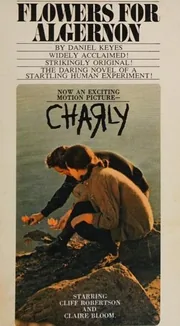
Flowers for Algernon
by Daniel Keyes · 1959
Suits mature teens and adults, and it is widely read in schools.
274 pages, about 4.5 to 6.5 hours.
A mind opens up in progress reports, and the cost comes with it. 65% taste match
The story
Flowers for Algernon is a science fiction novel by American author Daniel Keyes. It began as a novelette written in 1958 and printed in The Magazine of Fantasy & Science Fiction in April 1959. That version took the Hugo Award for Best Short Fiction in 1960. Keyes later expanded it into a full-length book, published in 1966, which shared the Nebula Award for Best Novel that year with Babel-17. The story has since been adapted for film and other media, and the book has appeared in 79 editions, with a median length of about 274 pages.
The central figure is Charlie Gordon, a man in his thirties with an intellectual disability who works through his days with limited reading and writing skills. A laboratory mouse named Algernon has been changed by a surgical procedure on the brain, and the researchers, Dr. Strauss and Dr. Nemur, propose the same operation for Charlie. At their request he begins keeping written progress reports, and the book is told through those entries. Alice Kinnian and Norma Gordon also figure in the story, which moves between Brooklyn, the Warren Home School, and Beekman College Center for Retarded Adults. It touches on institutional care, brain surgery, and what it means to be considered gifted.
Dr Strauss says I shoud rite down what I think and remembir and evrey thing that happins to me from now on.
Characters
Charlie GordonAlice KinnianDr. NemurDr. StraussNorma GordonAlgernon
Setting
United StatesBrooklynWarren Home School
Themes
institutionalizationdementiaphenylketonuriaBrainSurgeryPeople with mental disabilitiesGifted personsRetrasados mentales
- Want to read 1,004
- Reading now 45
- Read 235
Most people shelving it are saving it for later.
Of 1284 readers who put it on a shelf, 78% want to read it, 4% are reading it now, 18% have finished it and 0% stopped before the end.
By the numbers
- The median edition runs 274 pages. Counting about 275 words a page and an adult reading pace of 250 words a minute, that is about 5.0 hours of reading.
- Open Library tracks 79 editions from 64 publishers, the earliest dated 1966 and the latest 2022, across 9 languages.
- On reader demand it ranks in the top 1% of the classic books in our catalog (8,749 of them).
- Libraries shelve it under Dewey [Fic] and Library of Congress class PZ-0007.00000000.K522 Fl 1988.
 BookWard’s take
A mind opens up in progress reports, and the cost comes with it
Flowers for Algernon is told entirely through Charlie Gordon's written progress reports, and that choice is the book's great trick: the spelling, syntax and thinking on the page change as Charlie does, so the voice is unmistakable from the first entry. It earns that hook right away, then holds its length with no sag across 274 pages. The premise is a familiar science fiction setup, but the execution is original and restrained rather than sentimental, which is the right call for a story that could so easily have pushed for tears. What matters most here is the depth of the character: Charlie is deeply drawn, and the book is driven by who he is rather than by plot. It won the Nebula Award for Best Novel in 1966, and it feels timeless because its central question about intelligence and kindness has not aged.
At 274 pages it is compact for a novel, and nothing in it feels padded, which suits BookWard well.
Short entries keep the story moving at a brisk, readable clip.
Telling a whole novel through one changing voice was fresh in its day and still reads as inventive.
The prose is deliberately plain at the start and sharpens with Charlie, never showy.
What happens matters because of what it does to Charlie, so character drives the book.
The story leans toward loss and sorrow, which is a darker outlook than BookWard's hopeful lean.
The progress-report format is an unconventional frame, though easy to follow.
The tone is mostly serious and tender, with little room for comedy.
It deals with institutionalization and loss, so it is serious in content without being relentless.
Charlie's journey lands with strong, sustained feeling.
See all 50 dialsEvery position, side by side with this book
Where it lines up
- LengthBookWard 1 · book 2
- OpeningBookWard 10 · book 9
- PaceBookWard 8 · book 7
Where it pulls apart
- Familiar tropesBookWard 10 · book 7
- Internal logicBookWard 10 · book 8
- ToneBookWard 7 · book 2
At 274 pages it is compact for a novel, and nothing in it feels padded, which suits BookWard well.
The first progress report pulls you in immediately through Charlie's voice, matching BookWard's wish for an opening that grabs.
The experimental-surgery setup is a known science fiction shape, though the diary treatment keeps it from feeling stock.
Charlie's rise and the research around it follow a clear cause and effect, which BookWard values.
Short entries keep the story moving at a brisk, readable clip.
Telling a whole novel through one changing voice was fresh in its day and still reads as inventive.
Charlie is drawn from the inside with real care, which is exactly what BookWard prizes.
The story reaches a clear conclusion for Charlie, in line with BookWard's liking for resolution.
It aims straight at the heart, but the plain diary form keeps it from turning syrupy.
Its hard moments come from the premise itself rather than from cheap effect, which BookWard rewards.
This is fiction, so rigor does not apply.
The diary voice is the book's signature and shifts as Charlie does, the strongest distinctiveness BookWard looks for.
It carries real ideas about intelligence, but they arrive through Charlie's story rather than argument.
Events and feelings are shown through Charlie's own entries instead of being explained by an outside narrator.
The arc of change keeps tension steady from start to finish, with no slack middle.
The prose is deliberately plain at the start and sharpens with Charlie, never showy.
What happens matters because of what it does to Charlie, so character drives the book.
The story leans toward loss and sorrow, which is a darker outlook than BookWard's hopeful lean.
The progress-report format is an unconventional frame, though easy to follow.
The tone is mostly serious and tender, with little room for comedy.
The writing is simple on the surface, and the book is easy to get into despite its heavy themes.
We see everything through Charlie alone, a single viewpoint throughout.
Entries run in order as dated reports, so the timeline moves forward in a straight line.
One speculative surgery drives the plot, while the world around it stays everyday.
A handful of people matter, including Dr. Strauss, Dr. Nemur and Alice Kinnian, so the cast is small.
The story stays close to one man's life and relationships, which keeps it intimate.
The book lives in Charlie's thoughts and feelings far more than in outward action.
Conversation appears inside the reports but does not dominate the telling.
Relationships matter to Charlie, though romance is one thread rather than the whole story.
Brooklyn, a school and a college center are ordinary, recognizable places.
It is set in the mid twentieth century, so it reads as a look back rather than the present day.
Its questions about intelligence, dignity and kindness keep it fresh well after publication.
Charlie reports honestly as he understands things, so he is largely reliable, if limited at first.
The book asks hard questions about how people with disabilities are treated and refuses easy answers.
Scenes are told through Charlie's plain eye, with sparse scene-setting.
This is fiction, so the nonfiction style dial does not apply.
This is fiction, so the nonfiction perspective dial does not apply.
It stands alone as a single, complete story.
Change comes through the arc of Charlie's growth, not through a string of plot reversals.
It asks the reader to sit with uncomfortable questions about how we value minds.
It deals with institutionalization and loss, so it is serious in content without being relentless.
Charlie's journey lands with strong, sustained feeling.
What humor exists is gentle and dry rather than broad.
Violence is not a feature of the story.
Intimacy appears as part of Charlie's growth but is not a focus.
Social attitudes toward disability matter, but the book is not a political argument.
The early reports use misspellings and simple phrasing, which are easy to read once you settle in.
Everything comes filtered through Charlie's own growing viewpoint.
It looks at what science might do to a person, with a lean toward the cautionary.
It values compassion but is clear-eyed about how people fall short.
Review written by BookWard, dial version 1, November 2026.
Who is Flowers for Algernon right for?
Suits mature teens and adults, and it is widely read in schools. It deals with disability, institutional care and loss, and includes some adult themes, so it may need a conversation for younger readers.
The writing is simple on the surface, and the book is easy to get into despite its heavy themes.
It deals with institutionalization and loss, so it is serious in content without being relentless.
Charlie's journey lands with strong, sustained feeling.
Violence is not a feature of the story.
Book CompanionFlowers for Algernon: ideas, characters, themes
A man with an intellectual disability undergoes an experimental brain operation and records, in his own progress reports, what gaining and then holding intelligence does to his life and his sense of himself.
- The diary form. Charlie writes progress reports at the researchers' request, and the whole book is told through them.
- Algernon as a preview. A laboratory mouse changed by the same surgery shows what the researchers hope Charlie's operation might achieve.
- Language as a mirror. The writing itself changes as Charlie changes, so the page shows his mind before it tells you.
- Two origins. It began as a novelette printed in 1959 and was expanded into a novel published in 1966.
- Recognition. The novelette won the 1960 Hugo Award for Best Short Fiction, and the novel shared the 1966 Nebula Award for Best Novel.
Characters
Charlie Gordon
Narrator and protagonist
A gentle, amiable man in his thirties who keeps the progress reports that make up the book.
Alice Kinnian
Figure in Charlie's life
Connected to Charlie through the Beekman College Center for Retarded Adults.
Dr. Nemur
Researcher
One of the scientists who proposes the operation for Charlie.
Dr. Strauss
Researcher
The other scientist behind the experiment on Charlie.
Algernon
Laboratory mouse
The first subject of the surgery, whose results shape the decision to operate on Charlie.
Themes
Whether a person's value depends on how clever they are.
How society houses and treats people with disabilities.
What researchers owe the people they experiment on.
Whether you remain yourself when your mind changes.
What compassion looks like when understanding comes unevenly.
Discussion questions
- How does the changing spelling and style of the reports shape your feelings about Charlie?
- What do Dr. Strauss and Dr. Nemur owe Charlie, and do they meet it?
- Is Charlie the same person before and after the operation?
- Why might Keyes have used a mouse as a first test subject?
- What does the book suggest about how we judge people by their intelligence?
Personalize your Book Companion
This is the general edition. In BookWard, the Companion is written for you: your reading profile, your notes, and spoiler-safe to the page you are on.
Buy, listen or borrow Flowers for Algernon
Each link opens a search for this book on that store, in a new tab.
Read on a device
Borrow
Reviews and community
If you liked Flowers for Algernon
A kidnapping told twice, by captor and captive
Out of the DustKaren HesseA Dust Bowl girl's grief, told in spare, searing verse
Giovanni's RoomJames BaldwinA short, devastating confession of love and denial in Paris
The Perks of Being a WallflowerStephen ChboskyLetters from a quiet freshman, tender and unflinching
Sources: Open Library.
Track Flowers for Algernon and find your next favorite
Add it to your shelf, rate what you have read, and BookWard will recommend what fits you.
Free to start. No credit card needed.