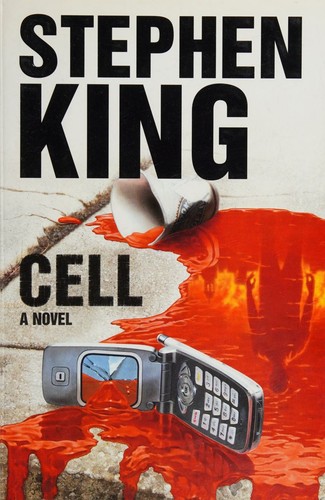
Cell
by Stephen King
★ Top 25 book of 2006 · #15 on Best Books of 2006
A mysterious signal sent over the global cell phone network turns most people into mindless, vicious animals. A New England artist struggles to reunite with his young son in this apocalyptic horror novel by Stephen King.
Best for: Horror fans who like apocalyptic stories driven by a man's struggle to reach his son
Cell is #15 on BookWard's Best Books of 2006, out of 47 2006 books that cleared our data bar.
What Cell is about
Clayton Riddell is a struggling artist from Maine who has just landed a graphic novel deal in Boston when a signal called the Pulse travels across the cell phone network. Anyone using a phone is turned into a zombie-like killer, and the city begins to burn around him. Clay escapes with Thomas McCourt and fifteen-year-old Alice Maxwell, and his one aim is to get home to his son, Johnny.
Their journey north takes them across a ruined New England, where the infected are changing into something stranger and more organized than mindless attackers. Along the way the group begins to share unsettling visions. Stephen King mixes a fast, grim pace with a father's fear of losing his child. It will appeal to readers who like apocalypse stories where survival and family matter as much as the danger.
Cell on the Best Books of 2006
Cell came out in 2006. Of the 47 books first published in 2006 that met BookWard's data bar, it ranks #15 on our Best Books of 2006 list.
Why it made the list: 842 readers have shelved it on Open Library; readers rate it 3.6 out of 5 (123 ratings); 33 are reading it right now. The list ranks each year’s books on how many readers have picked them up, how highly readers rate them, and how many are reading them right now.
Nearby on the 2006 list
- The Road Cormac McCarthy, #13
- Sharp Objects Gillian Flynn, #14
- Fablehaven Brandon Mull, #16
- Lisey's Story Stephen King, #17
See all Best Books of 2006 Best books by year
More years: Best Books of 2005 Best Books of 2007.
The numbers behind it
- Readers: 657 want to read it, 33 are reading it now and 152 have read it, according to Open Library.
- Ratings: 3.6 out of 5 from 123 Open Library ratings.
| Signal | This book (0 to 100) | Weight |
|---|---|---|
| Reach | 85 | 55% |
| Reader love | 9 | 25% |
| Being read right now | 81 | 20% |
Questions about Cell
When was Cell published?
Cell by Stephen King was first published in 2006.
Was Cell one of the best books of 2006?
Cell is #15 on BookWard's Best Books of 2006, out of 47 2006 books that cleared our data bar. 842 readers have shelved it on Open Library; readers rate it 3.6 out of 5 (123 ratings); 33 are reading it right now.
Why is Cell on the Best Books of 2006 list?
842 readers have shelved it on Open Library; readers rate it 3.6 out of 5 (123 ratings); 33 are reading it right now.
More of the best books of 2006
- The Sea of Monsters Rick Riordan, #1
- The Book Thief Markus Zusak, #2
- Half of a Yellow Sun Chimamanda Ngozi Adichie, #3
- The Boy in the Striped Pyjamas John Boyne, #4
- The Secret Rhonda Byrne, #5
- Mindset Carol S. Dweck, #6
See the full Best Books of 2006, the Top 100, or new books on Rising.
How we know
This page uses public data: Open Library reader counts and ratings, and Wikipedia page views for recent years. The description is paraphrased from real source text. Rankings reflect reading interest, not quality or sales, and can be affected by data gaps. Lists update monthly.
Best for adult readers and mature teens who are comfortable with horror.
Depends on the edition you pick.
King's zombie-adjacent road trip, powered by a phone signal. 51% taste match
 BookWard’s take
King's zombie-adjacent road trip, powered by a phone signal
Cell wastes no time. A signal hits the cell network, civilization collapses within the opening stretch, and an artist named Clay Riddell is left to cross a burning New England toward his son. The hook is about as strong as they come, and the pace stays fast as Clay's small group of survivors keeps moving north. The cost shows in the familiar tropes: the apocalypse road trip and its hive-minded infected are well-worn ground, so the originality is thinner than I'd like. The internal logic holds up better than the genre often manages, and the violence on the page is heavy and frequent. It is a story-led, plot-driven thriller more than a character study, and the prose is plain and propulsive rather than ornate.
A mid-sized novel that moves briskly, shorter in feel than King's biggest books, though not as lean as BookWard's taste for tight.
Clay's group is always on the move across New England, keeping the momentum high and close to BookWard's preference.
The cell-phone trigger is a fresh hook, but the apocalypse structure around it is familiar.
The prose is plain, quick and colloquial rather than ornate.
The plot of escape and pursuit drives events more than inner change does.
It is a bleak apocalypse with little comfort, tempered only by Clay's push to reach his son.
A conventional forward journey told in order, with no formal experiments.
The tone is grim, with only brief flashes of gallows humor.
Mass death, murder and collapse make for a dark read.
Fear and Clay's drive to find his son keep the feeling strong.
See all 50 dialsEvery position, side by side with this book
Where it lines up
- OpeningBookWard 10 · book 10
- Story or ideasBookWard 3 · book 3
- PaceBookWard 8 · book 9
Where it pulls apart
- Familiar tropesBookWard 10 · book 4
- LengthBookWard 1 · book 5
- Internal logicBookWard 10 · book 7
A mid-sized novel that moves briskly, shorter in feel than King's biggest books, though not as lean as BookWard's taste for tight.
The signal strikes early and civilization falls almost immediately, which is exactly the instant grab BookWard rewards.
Phone-borne zombies and a survivor road trip lean on familiar apocalypse conventions, which BookWard marks down.
The mechanism is simple and the group's choices follow from it, so the premise holds together well enough.
Clay's group is always on the move across New England, keeping the momentum high and close to BookWard's preference.
The cell-phone trigger is a fresh hook, but the apocalypse structure around it is familiar.
Clay, Tom and Alice are solidly drawn by genre standards, driven more by survival than by deep interior work.
The ending leans toward ambiguity, which sits below BookWard's preference for firm resolution.
Clay's longing for his son adds feeling, but the book stays mostly hard-edged rather than tender.
There is plenty of gore, and some of it feels leaned on, though the violence mostly serves the premise.
Not applicable to a novel.
King's conversational, plain-spoken narration is unmistakable and distinctive.
This is a story-led thriller, with the premise serving the chase rather than carrying a thesis.
Much of what the phoners are is pieced together in scene, though characters do talk through theories.
The journey keeps shifting settings and threats, though the middle stretches can slow when theorizing takes over.
The prose is plain, quick and colloquial rather than ornate.
The plot of escape and pursuit drives events more than inner change does.
It is a bleak apocalypse with little comfort, tempered only by Clay's push to reach his son.
A conventional forward journey told in order, with no formal experiments.
The tone is grim, with only brief flashes of gallows humor.
It reads easily and quickly, asking little beyond attention.
The story stays close to Clay's perspective rather than spreading across many.
Events unfold in a straight line as the group travels north.
The signal's psychic side effects tilt the story toward the supernatural, though the setting is ordinary.
A small core group travels together, with fleeting survivors passing through.
A global catastrophe is seen through one small group's trek, though the stakes read as wide.
Survival, fights and escapes dominate the action over reflection.
The survivors talk through their situation often, giving dialogue a steady presence.
Romance is not a focus; the emotional engine is a father's bond with his son.
Boston, suburban homes and New England roads are familiar ground made hostile.
A mid-2000s setting built on then-current cell phone culture.
The phone-panic premise is tied to its era, which limits staying power.
The narration is straightforward and trustworthy.
Survivors face hard calls, but right and wrong are mostly easy to read.
Descriptions are efficient and vivid in short bursts rather than richly layered.
Not applicable to a novel.
Not applicable to a novel.
Cell stands as a self-contained novel.
Psychic powers and shifting phoner behavior bring regular reversals along the way.
It offers thrills more than challenge, though it unsettles.
Mass death, murder and collapse make for a dark read.
Fear and Clay's drive to find his son keep the feeling strong.
What humor appears is dry and grim.
Phoner attacks and burning cities put violence at the center of the book.
Sexual content is minimal.
The book is about survival, with politics largely in the background.
The language is plain and easy to follow.
The narration mostly stays out of the way, with a few pointed asides.
The book is mostly about loss and what collapses, though the trek north points ahead.
The mood is cynical, with humans turning on each other.
Review written by BookWard, dial version 1, November 2026.
Who is Cell right for?
Best for adult readers and mature teens who are comfortable with horror. It contains graphic violence, mass death and the murder of a teenager.
It reads easily and quickly, asking little beyond attention.
Mass death, murder and collapse make for a dark read.
Fear and Clay's drive to find his son keep the feeling strong.
Phoner attacks and burning cities put violence at the center of the book.
Book CompanionCell: ideas, characters, themes
A signal over the cell network turns most of humanity into mindless killers, and one artist crosses a ruined New England to reach his son.
- The signal. A mysterious pulse sent across the global cell network turns phone users into vicious, zombie-like attackers.
- A trio forms. Clay, Tom and Alice are thrown together in Boston and escape to Tom's suburban home as the city burns.
- The long way north. Clay is determined to reach his son Johnny in Maine, and the others reluctantly join him.
- The flock. The phoners begin acting as a hive mind with psychic abilities, gathering and switching off at night.
- Gaiten Academy. At a prep school the group meets Headmaster Charles Ardai and a pupil named Jordan, who are both unaffected.
Characters
Clay Riddell
Protagonist
A struggling Maine artist who has just landed a graphic novel deal and is set on reuniting with his son.
Tom McCourt
Fellow survivor
A middle-aged man who joins Clay and Alice and reluctantly agrees to travel north with him.
Alice Maxwell
Fellow survivor
A fifteen-year-old who escapes Boston with Clay and Tom and joins their trek.
Charles Ardai
Headmaster
The unaffected headmaster of Gaiten Academy, whom the survivors refuse to abandon.
Themes
The book turns an everyday device into the source of collapse.
A father's pull toward his son drives every choice Clay makes.
Ordinary people are forced into hard, fast decisions to stay alive.
The phoners' hive behavior sets group will against individual identity.
The story watches society fall apart almost at once.
Discussion questions
- Why might King have chosen the cell phone as the trigger for the apocalypse?
- How does Clay's search for his son shape the choices he makes?
- What does the phoners' hive mind say about crowds and individuality?
- Did the survivors' decision to stay with Ardai seem wise or reckless?
- How does the book's pace affect the way you feel about its grim events?
Personalize your Book Companion
This is the general edition. In BookWard, the Companion is written for you: your reading profile, your notes, and spoiler-safe to the page you are on.
Buy, listen or borrow Cell
Each link opens a search for this book on that store, in a new tab.
Read on a device
Borrow
Reviews and community
If you liked Cell
Stephen King's short-story set: thirteen tales, mostly dark, mostly fast
Devils Kill DevilsJohnny ComptonA guardian angel turns killer in Compton's Southern gothic horror
The Dark HalfStephen KingKing's novelist-versus-pseudonym horror, sturdy and fast but familiar
FirestarterStephen KingA girl who can start fires, and the people hunting her
Find your own best books
Add what you have read, rate it, and BookWard will recommend what to read next.
Free to start. No credit card needed.