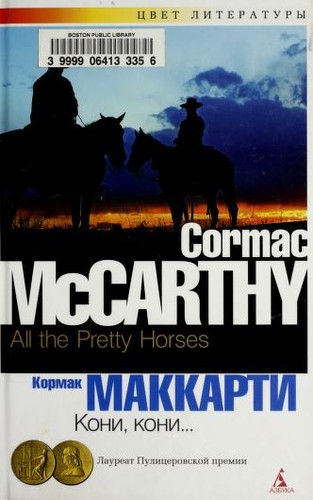
All the Pretty Horses
by Cormac McCarthy
★ Top 25 book of 1992 · #17 on Best Books of 1992
Cormac McCarthy's 1992 novel is more romantic than his earlier, bleaker work, and it won the National Book Award and the National Book Critics Circle Award. It opens his Border Trilogy, an elegy for the American Frontier, written without quotation marks.
Best for: Readers who like Hemingway-like prose and elegiac stories of the American Frontier
All the Pretty Horses is #17 on BookWard's Best Books of 1992, out of 43 1992 books that cleared our data bar.
What All the Pretty Horses is about
In 1949, sixteen-year-old John Grady Cole learns that the Texas ranch where he grew up, his grandfather's, is about to be sold. With nothing left to keep him there, he persuades his friend Lacey Rawlins to ride south with him into Mexico. A younger boy who calls himself Jimmy Blevins attaches himself to them, riding a horse far too good for someone like him. At a big ranch in Coahuila, Grady's skill with horses earns him work as a trainer, and he falls for the owner's daughter, Alejandra. Her great aunt warns him what a woman can lose in that society.
McCarthy writes in a lyrical, stark voice that treats the land and the animals with the same seriousness as the people. It is a story of growing up, of love tangled with honor, and of a frontier world fading out.
All the Pretty Horses on the Best Books of 1992
All the Pretty Horses came out in 1992. Of the 43 books first published in 1992 that met BookWard's data bar, it ranks #17 on our Best Books of 1992 list.
Why it made the list: 228 readers have shelved it on Open Library; readers rate it 4 out of 5 (27 ratings). The list ranks each year’s books on how many readers have picked them up, how highly readers rate them, and how many are reading them right now.
Nearby on the 1992 list
- Diana, Her True Story Andrew Morton, #15
- Poor Things Alasdair Gray, #16
- Red Mars Kim Stanley Robinson, #18
- The Pelican Brief John Grisham, #19
See all Best Books of 1992 Best books by year
More years: Best Books of 1991 Best Books of 1993.
The numbers behind it
- Readers: 178 want to read it, 10 are reading it now and 40 have read it, according to Open Library.
- Ratings: 4 out of 5 from 27 Open Library ratings.
| Signal | This book (0 to 100) | Weight |
|---|---|---|
| Reach | 51 | 55% |
| Reader love | 53 | 25% |
| Being read right now | 49 | 20% |
Questions about All the Pretty Horses
When was All the Pretty Horses published?
All the Pretty Horses by Cormac McCarthy was first published in 1992.
Was All the Pretty Horses one of the best books of 1992?
All the Pretty Horses is #17 on BookWard's Best Books of 1992, out of 43 1992 books that cleared our data bar. 228 readers have shelved it on Open Library; readers rate it 4 out of 5 (27 ratings).
Why is All the Pretty Horses on the Best Books of 1992 list?
228 readers have shelved it on Open Library; readers rate it 4 out of 5 (27 ratings).
More of the best books of 1992
- Welcome to Dead House Robert Lawrence Stine, #1
- The Secret History Donna Tartt, #2
- Snow Crash Neal Stephenson, #3
- The Indispensable Calvin and Hobbes Bill Watterson, #4
- The Shadow Rising Robert Jordan, #5
- The Artist's Way Julia Cameron, #6
See the full Best Books of 1992, the Top 100, or new books on Rising.
How we know
This page uses public data: Open Library reader counts and ratings, and Wikipedia page views for recent years. The description is paraphrased from real source text. Rankings reflect reading interest, not quality or sales, and can be affected by data gaps. Lists update monthly.
Best for mature teens and adults.
Depends on the edition you pick.
A rancher's son rides south into a beautiful, unforgiving Mexico. 61% taste match
 BookWard’s take
A rancher's son rides south into a beautiful, unforgiving Mexico
John Grady Cole is sixteen when he learns the family ranch will be sold, and instead of moving into town he rides south into Mexico with his friend Lacey Rawlins. McCarthy's 1992 novel won the National Book Award, and it earns its reputation through voice more than plot. The sentences run long and go without quotation marks, yet the story moves with real momentum once the pair meet young Jimmy Blevins. The opening wastes no time getting going. Few American novels sound this distinctive, and the voice is unmistakable from the first page. The outlook is romantic, but the delivery is restrained. It asks more of a reader than I usually want to give, but it pays that back in scene after scene.
A compact novel by epic standards, with a clean sweep from Texas into Mexico that never feels padded, which suits BookWard's taste for the tight.
Travel, work and trouble keep it moving, though some stretches settle into slow, deliberate description.
The unpunctuated, spare-yet-lyrical style makes a familiar frontier story feel new, which BookWard rewards.
Rich, rhythmic and heavily descriptive, it leans ornate even while using plain words, a little more than BookWard prefers.
The plot is simple and the pull comes mostly from who John Grady is and what he stubbornly values.
Romance and loyalty brighten it, but the book is largely an elegy for a vanishing way of life.
It follows a straight journey in order, and its experiments are in punctuation and syntax rather than form.
There is dry banter between the friends, but the overall register is serious and grave.
Violence and injustice darken the second half, set against warmth and beauty earlier on.
Feeling runs deep under a controlled surface, which makes it quietly powerful.
See all 50 dialsEvery position, side by side with this book
Where it lines up
- SentimentBookWard 8 · book 8
- Story or ideasBookWard 3 · book 3
- ExpositionBookWard 2 · book 2
Where it pulls apart
- Familiar tropesBookWard 10 · book 6
- LengthBookWard 1 · book 4
- OpeningBookWard 10 · book 8
A compact novel by epic standards, with a clean sweep from Texas into Mexico that never feels padded, which suits BookWard's taste for the tight.
A boy losing his family ranch and choosing to ride out is a strong, immediate start, close to what BookWard wants.
It works in Western territory with a runaway cowboy and a ranch romance, but McCarthy's treatment keeps it from feeling stock.
Events follow from character choices, especially the Blevins episode, so the cause and effect holds together well.
Travel, work and trouble keep it moving, though some stretches settle into slow, deliberate description.
The unpunctuated, spare-yet-lyrical style makes a familiar frontier story feel new, which BookWard rewards.
John Grady is drawn through his skill, loyalty and stubborn code more than through explanation, and that lands convincingly.
It resolves its main threads with finality, though with a reflective, elegiac edge that stops short of tidiness.
It is romantic in outlook yet keeps feeling under control, letting images and action carry the emotion.
Violence arrives as a consequence of the world the boys enter, not as decoration, which BookWard values.
This is fiction, so the dial does not apply.
McCarthy's long, flat, biblical sentences without quotation marks are unmistakable and sit at the very top for BookWard.
This is a story first, driven by a journey, a job and a love affair rather than by an argument.
Almost everything is shown through action and talk, with little explaining, which matches BookWard's preference exactly.
The long stretch on the ranch is slower, but it builds tension steadily rather than stalling.
Rich, rhythmic and heavily descriptive, it leans ornate even while using plain words, a little more than BookWard prefers.
The plot is simple and the pull comes mostly from who John Grady is and what he stubbornly values.
Romance and loyalty brighten it, but the book is largely an elegy for a vanishing way of life.
It follows a straight journey in order, and its experiments are in punctuation and syntax rather than form.
There is dry banter between the friends, but the overall register is serious and grave.
The unmarked dialogue, untranslated Spanish and long sentences take some adjusting to, then read smoothly.
The story stays close to John Grady, with little hopping between minds.
Events unfold forward from 1949 in a steady line.
The world is plainly realistic, grounded in horses, ranches and borderland towns.
The key figures are few: John Grady, Rawlins, Blevins, Alejandra and the ranch owner, with others in support.
Landscape is vast, yet the story stays focused on a few people, so it feels more personal than sweeping.
Work, travel and confrontation dominate, with inner life mostly implied through what characters do.
Conversation carries a lot of the book, and its unquoted, clipped exchanges are central to its texture.
John Grady's love for Alejandra is a major thread but sits beside the road story and the friendship.
Rural Mexico and cattle country of 1949 will be unfamiliar to most readers and is rendered in rich detail.
Set in 1949 and written in 1992, it looks firmly backward at a vanishing ranching world.
Its themes of loyalty, honor and loss, along with a distinctive style, give it lasting power.
The narration is steady and plain-spoken, with no sense of deception or hidden agenda.
John Grady's code is clear, but the world tests it in ways that leave real room for ambiguity.
Landscape, weather and horses are described in dense, vivid, deeply physical detail.
This is fiction, so the dial does not apply.
This is fiction, so the dial does not apply.
It opens McCarthy's Border Trilogy, followed by The Crossing and Cities of the Plain.
Events turn on trust and bad luck rather than on engineered reveals.
Its style and moral weight ask for attention without becoming punishing.
Violence and injustice darken the second half, set against warmth and beauty earlier on.
Feeling runs deep under a controlled surface, which makes it quietly powerful.
What humor there is stays dry and understated.
Brutality is present and unflinching when it arrives, though not constant.
A love story is central, but the book handles intimacy with restraint.
The setting carries social tension, but the book is about people, not argument.
Unquoted dialogue and passages of untranslated Spanish make the language denser than usual.
The narrator observes rather than editorializes, leaving judgment to the reader.
It mourns the end of an older frontier way of life and faces backward.
John Grady's loyalty and honor are idealistic, tested against a harsher world.
Review written by BookWard, dial version 1, November 2026.
Who is All the Pretty Horses right for?
Best for mature teens and adults. It contains intense violence, a love story, and some harsh treatment of prisoners and the vulnerable.
The unmarked dialogue, untranslated Spanish and long sentences take some adjusting to, then read smoothly.
Violence and injustice darken the second half, set against warmth and beauty earlier on.
Feeling runs deep under a controlled surface, which makes it quietly powerful.
Brutality is present and unflinching when it arrives, though not constant.
Book CompanionAll the Pretty Horses: ideas, characters, themes
A young Texan raised on horses and honor rides into Mexico seeking the life he believes is his, and finds that the code he carries is tested by a harder world.
- A runaway into Mexico. After his grandfather's death and the sale of the ranch, John Grady leaves with Lacey Rawlins to find work as cowboys south of the border.
- The Blevins complication. A young traveler on an impossibly fine horse joins them, and his recklessness sets the first real trouble in motion.
- Work on the ranch. In the Bolsón de Cuatro Ciénegas, John Grady's skill with horses earns the notice of the ranch owner.
- A love affair. He meets Alejandra, the owner's daughter, which sets the emotional stakes for the rest of the book.
- The Border Trilogy begins. This is the first volume of McCarthy's trilogy, an elegy for the American frontier.
Characters
John Grady Cole
Protagonist
A sixteen-year-old, fluent in Spanish and English, gifted with horses and driven by a stubborn sense of right.
Lacey Rawlins
Best friend
John Grady's friend and riding companion, who goes along on the journey south.
Jimmy Blevins
Young traveler
A boy of about thirteen with a horse too fine to be his, whose actions pull the others into danger.
Alejandra
Love interest
The ranch owner's daughter, who draws John Grady's devotion.
Themes
John Grady's loyalty and sense of right guide his choices, even when they cost him.
The book mourns a vanishing way of life tied to horses, ranches and open land.
His feelings for Alejandra run up against the standing of her family.
Two teenagers leave home and meet a world that does not play by their rules.
Fairness and law prove far more fragile in Mexico than the boys expect.
Discussion questions
- How does the lack of quotation marks change the way you hear the characters?
- Is John Grady admirable, naive, or both?
- What role does the Blevins episode play in shaping the story that follows?
- Does the book romanticize the frontier or mourn it?
- How does the landscape work as a character in the novel?
Personalize your Book Companion
This is the general edition. In BookWard, the Companion is written for you: your reading profile, your notes, and spoiler-safe to the page you are on.
Buy, listen or borrow All the Pretty Horses
Each link opens a search for this book on that store, in a new tab.
Read on a device
Borrow
Reviews and community
If you liked All the Pretty Horses
Hardy's pastoral love triangle, slow in the telling but sure-footed
The HunterTana FrenchA slow-burning Irish thriller about a retired cop and a girl's revenge
Angela's AshesFrank McCourtA Limerick childhood told with a child's eyes and no self-pity
Novels (Adventures of Huckleberry Finn / Adventures of Tom Sawyer)Mark TwainTwo Twain classics: a boy's summer, then a river escape
Find your own best books
Add what you have read, rate it, and BookWard will recommend what to read next.
Free to start. No credit card needed.