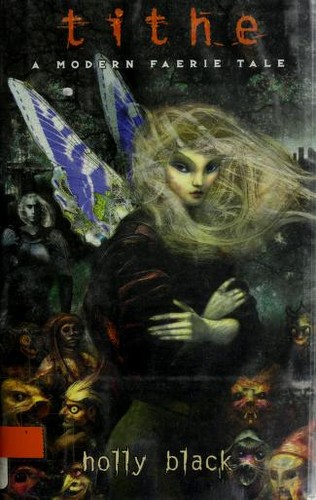
Tithe
by Holly Black
★ Top 10 book of 2002 · #10 on Best Books of 2002
In this young adult fantasy, a girl learns she is not human but a faerie. With that discovery, her life turns difficult and trouble begins to follow her.
Best for: Teen fantasy readers drawn to stories about faeries and hidden identity
Tithe is #10 on BookWard's Best Books of 2002, out of 32 2002 books that cleared our data bar.
What Tithe is about
Kaye Fierch is sixteen and used to life on the road with her mother's rock band, Stepping Razor. After an attack on her mother, they settle at Kaye's grandmother's house on the Jersey Shore, and Kaye finds that her old 'imaginary' friends were never imaginary. She pulls an iron-tipped arrow from the chest of a wounded faerie knight named Roiben, and he owes her three truthful answers. Soon she is pulled into the politics of the Unseelie Court, which has plans for her, and into a world where names carry power. Holly Black calls her setting 'suburban fantasy', and she keeps the magic close to ordinary teenage life. Recommended for ages 12 and up, it deals with identity, loneliness and trust. It is a young-adult fantasy novel by Holly Black, published in 2002 by Simon & Schuster.
Tithe on the Best Books of 2002
Tithe came out in 2002. Of the 32 books first published in 2002 that met BookWard's data bar, it ranks #10 on our Best Books of 2002 list.
Why it made the list: 262 readers have shelved it on Open Library; readers rate it 4 out of 5 (17 ratings). The list ranks each year’s books on how many readers have picked them up, how highly readers rate them, and how many are reading them right now.
Nearby on the 2002 list
- Fingersmith Sarah Waters, #8
- 2Nd Chance James Patterson, #9
- Dragon Ball Z; Thank You 鳥山 明 [Akira Toriyama], #11
- Middlesex Jeffrey Eugenides, #12
See all Best Books of 2002 Best books by year
More years: Best Books of 2001 Best Books of 2003.
The numbers behind it
- Readers: 210 want to read it, 14 are reading it now and 38 have read it, according to Open Library.
- Ratings: 4 out of 5 from 17 Open Library ratings.
| Signal | This book (0 to 100) | Weight |
|---|---|---|
| Reach | 63 | 55% |
| Reader love | 53 | 25% |
| Being read right now | 75 | 20% |
Questions about Tithe
When was Tithe published?
Tithe by Holly Black was first published in 2002.
Was Tithe one of the best books of 2002?
Tithe is #10 on BookWard's Best Books of 2002, out of 32 2002 books that cleared our data bar. 262 readers have shelved it on Open Library; readers rate it 4 out of 5 (17 ratings).
Why is Tithe on the Best Books of 2002 list?
262 readers have shelved it on Open Library; readers rate it 4 out of 5 (17 ratings).
More of the best books of 2002
- Romancing Mister Bridgerton Julia Quinn, #1
- Coraline Neil Gaiman, #2
- Why Does He Do That? Lundy Bancroft, #3
- Room on the Broom Julia Donaldson, #4
- Stories of Your Life and Others Ted Chiang, #5
- Everything's Eventual. 14 Dark Tales Stephen King, #6
See the full Best Books of 2002, the Top 100, or new books on Rising.
How we know
This page uses public data: Open Library reader counts and ratings, and Wikipedia page views for recent years. The description is paraphrased from real source text. Rankings reflect reading interest, not quality or sales, and can be affected by data gaps. Lists update monthly.
Published for ages twelve and up, it suits teens and adults who enjoy dark fantasy.
Depends on the edition you pick.
Suburban faerie dark fantasy with a punk edge and real teeth. 59% taste match
 BookWard’s take
Suburban faerie dark fantasy with a punk edge and real teeth
Tithe drops a sixteen-year-old who tours with her mother's rock band into a New Jersey town where the faerie courts are very real. It sets up its premise quickly: a bar fight, a move to Grandmother's house, and a wounded faerie knight within a few chapters, so the opening hooks at once. Black calls it suburban fantasy, and the setting is the freshest part, with courts and iron-tipped arrows living behind strip malls. The book is a mix of old and new: changelings and faerie bargains are familiar stock, but the Jersey Shore punk treatment and the book's bite give them new life. The characters have real depth for a YA novel, the pace is brisk, and the prose is plain but sharp. It suits readers who like dark, moody fantasy that keeps its plot moving.
A compact young-adult novel that moves briskly, which suits BookWard's liking for tight books.
Events follow each other quickly from the first chapter, close to BookWard's preference for speed.
The suburban-fantasy setting is distinctive, even where the underlying faerie lore is traditional.
The writing is clean and atmospheric without turning ornate.
Plot and character share the work, with Kaye's identity crisis driving the events.
The mood is dark and wary, with small flickers of hope rather than outright optimism.
It is told in a conventional linear way with a single storyline.
There is some wry teenage snark, but the book is mostly serious.
Faerie cruelty and a sacrificial ritual give it a dark, threatening edge.
Feelings run strong, though the tone is guarded.
See all 50 dialsEvery position, side by side with this book
Where it lines up
- PaceBookWard 8 · book 8
- OpeningBookWard 10 · book 9
- EndingBookWard 8 · book 7
Where it pulls apart
- Familiar tropesBookWard 10 · book 5
- Internal logicBookWard 10 · book 6
- LengthBookWard 1 · book 3
A compact young-adult novel that moves briskly, which suits BookWard's liking for tight books.
It opens with a stabbing attempt at a seedy gig, so it grabs attention immediately, just as BookWard likes.
Changelings, faerie courts and name-binding are well-worn, though the punk Jersey treatment freshens them somewhat.
Faerie rules about iron, true names and bargains give it a workable internal logic, though not an airtight one.
Events follow each other quickly from the first chapter, close to BookWard's preference for speed.
The suburban-fantasy setting is distinctive, even where the underlying faerie lore is traditional.
Kaye is drawn with an edgy, believable voice, though some of the cast stay closer to types.
The central plot reaches a real resolution, with the trilogy leaving room beyond it.
The tone is moody and unsentimental, though the romance adds some softness.
The darkness serves the faerie-court setting and feels part of the world rather than there for effect.
This is a novel, so the dial does not apply.
Black's gritty, atmospheric voice sets the book apart from softer faerie fantasy.
It is firmly story-led, driven by Kaye's discovery of what she is.
Faerie lore comes mostly through events and other characters, with some explaining along the way.
The plot keeps pushing forward with new revelations, so the middle holds up.
The writing is clean and atmospheric without turning ornate.
Plot and character share the work, with Kaye's identity crisis driving the events.
The mood is dark and wary, with small flickers of hope rather than outright optimism.
It is told in a conventional linear way with a single storyline.
There is some wry teenage snark, but the book is mostly serious.
It is an easy read, aimed at ages twelve and up.
The story stays with one main perspective, Kaye's.
Events unfold in straightforward chronological order.
Faeries, magic and courts are central to the story, even in a modern setting.
A handful of main characters plus faerie court figures make a moderate cast.
The stakes are personal and local, centred on one girl and a nearby court.
Action and faerie intrigue lead, with Kaye's inner doubts running alongside.
Conversations carry much of the lore and the relationships.
A romance with a faerie knight is a significant thread, though not the whole plot.
Faerie hidden inside Jersey suburbs feels fresh and unfamiliar.
The story is set in a contemporary world of rock bands and suburbs.
The faerie core endures, though the early-2000s details date it a little.
The narration is straightforward and trustworthy.
The faerie courts are morally murky, but the core conflicts are fairly legible.
Atmospheric details give the setting texture without heavy description.
This is fiction, so the dial does not apply.
This is fiction, so the dial does not apply.
It opens a trilogy, though the first book stands on its own reasonably well.
Revelations about Kaye's nature and the court's plans keep arriving.
It is an accessible, engaging read rather than a demanding one.
Faerie cruelty and a sacrificial ritual give it a dark, threatening edge.
Feelings run strong, though the tone is guarded.
The humor is dry and sardonic when it appears.
There are stabbings and arrows, but nothing sustained or lingering.
Romantic tension is present, with little explicit content.
Court intrigue is fantasy politics, with no real-world politics on the page.
The language is plain and easy to follow.
The narration mostly shows rather than editorializes.
It is rooted in old faerie lore, though set in the present.
The outlook is wary and guarded, with moments of loyalty and hope.
Review written by BookWard, dial version 1, November 2026.
Who is Tithe right for?
Published for ages twelve and up, it suits teens and adults who enjoy dark fantasy. It includes knife and arrow violence, faerie cruelty and a sacrificial ritual, so very young readers may want to wait.
It is an easy read, aimed at ages twelve and up.
Faerie cruelty and a sacrificial ritual give it a dark, threatening edge.
Feelings run strong, though the tone is guarded.
There are stabbings and arrows, but nothing sustained or lingering.
Book CompanionTithe: ideas, characters, themes
A teenage girl from a rock-and-roll life learns she is a faerie changeling, caught between the human world and a dangerous court.
- A road-weary start. Kaye travels with her mother's band, and a violent incident sends them to her grandmother's New Jersey home.
- Childhood friends return. Kaye searches for the faerie friends she thought she imagined as a child and finds they are real.
- A knight and a bargain. She saves the faerie knight Roiben, who owes her three truthful answers.
- Names have power. The story builds on the idea that knowing a faerie's true name gives control over them.
- The Tithe. Kaye learns the Unseelie Court wants to use a Tithe ritual that her true nature could upend.
Characters
Kaye Fierch
Protagonist
A sixteen-year-old who tours with her mother's band and discovers she is a changeling.
Roiben
Faerie knight
A knight whose life Kaye saves, creating a debt and a tense bond between them.
Spike
Faerie friend
One of Kaye's childhood faerie companions, who warns her about Roiben.
Lutie-Loo
Faerie friend
Another of Kaye's old faerie friends, who helps explain her nature.
Nicnevin
Queen of the Unseelie Court
The court's ruler, whose ritual plans drive the threat.
Themes
Kaye must reckon with being something other than the human she believed herself to be.
She is caught between the human world and the faerie courts, at home in neither.
True names give control, so knowing and guarding them matters.
Promises and favors carry real weight and consequence in faerie dealings.
Magic lives just out of sight in ordinary suburban places.
Discussion questions
- How does setting faeries in suburban New Jersey change the feel of familiar faerie lore?
- Why does Kaye find it easier to believe in her faerie friends once she sees proof?
- What does the idea of controlling someone by their true name say about power?
- Is Roiben a villain, a victim or something else, and what shapes your view?
- How does Kaye's life on the road with a band prepare her for the world she discovers?
Personalize your Book Companion
This is the general edition. In BookWard, the Companion is written for you: your reading profile, your notes, and spoiler-safe to the page you are on.
Buy, listen or borrow Tithe
Each link opens a search for this book on that store, in a new tab.
Read on a device
Borrow
Reviews and community
If you liked Tithe
A ticking-clock fantasy set in the hidden magic of Los Angeles
Vampire AcademyRichelle MeadBoarding-school vampires with a sharp-tongued bodyguard at the center
PhantasmaKaylie SmithA haunted-mansion death game where the heart is the real danger
The Sun and the StarRick RiordanNico and Will descend into Tartarus to rescue a friend
Find your own best books
Add what you have read, rate it, and BookWard will recommend what to read next.
Free to start. No credit card needed.