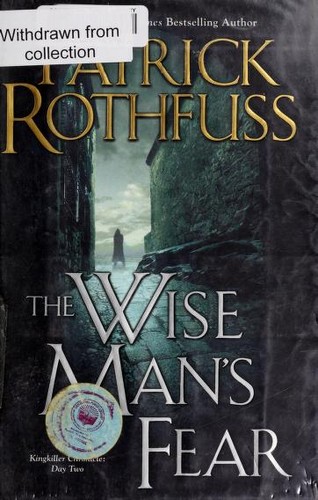
The Wise Man’s Fear
by Patrick Rothfuss
★ Top 25 book of 2011 · #18 on Best Books of 2011
Kvothe pursues the truth about the Amyr, the Chandrian and his parents' deaths. His path takes him through a trial before the Adem mercenaries and into the Fae realm, where fame begins to weigh on him.
Best for: Readers of epic fantasy who have finished The Name of the Wind
The Wise Man’s Fear is #18 on BookWard's Best Books of 2011, out of 53 2011 books that cleared our data bar.
What The Wise Man’s Fear is about
Kvothe continues his search for the truth in this book, which is preceded by The Name of the Wind. He wants answers about the mysterious Amyr, about the Chandrian, and about the death of his parents. Along the way he faces a trial at the hands of the legendary Adem mercenaries, and he must work to win back the honor of his family. His journey also leads into the Fae realm, where he meets Felurian, a faerie woman said to be irresistible and never survived by any man, until him. Kvothe takes his first steps along the hero's path and finds out how hard life becomes when a man turns into a legend while he is still living. Best suited to readers who have already begun the series.
The Wise Man’s Fear on the Best Books of 2011
The Wise Man’s Fear came out in 2011. Of the 53 books first published in 2011 that met BookWard's data bar, it ranks #18 on our Best Books of 2011 list.
Why it made the list: 556 readers have shelved it on Open Library; readers rate it 4.4 out of 5 (161 ratings); 21 are reading it right now. The list ranks each year’s books on how many readers have picked them up, how highly readers rate them, and how many are reading them right now.
It earns Reader favorite.
Nearby on the 2011 list
- The One and Only Ivan Katherine Applegate, #16
- The Art of Thinking Clearly Rolf Dobelli, #17
- Dotcom Secrets Russell Brunson, #19
- Insurgent Veronica Roth, #20
See all Best Books of 2011 Best books by year
More years: Best Books of 2010 Best Books of 2012.
The numbers behind it
- Readers: 311 want to read it, 21 are reading it now and 223 have read it, according to Open Library.
- Ratings: 4.4 out of 5 from 161 Open Library ratings.
| Signal | This book (0 to 100) | Weight |
|---|---|---|
| Reach | 57 | 55% |
| Reader love | 91 | 25% |
| Being read right now | 45 | 20% |
Questions about The Wise Man’s Fear
When was The Wise Man’s Fear published?
The Wise Man’s Fear by Patrick Rothfuss was first published in 2011.
Was The Wise Man’s Fear one of the best books of 2011?
The Wise Man’s Fear is #18 on BookWard's Best Books of 2011, out of 53 2011 books that cleared our data bar. 556 readers have shelved it on Open Library; readers rate it 4.4 out of 5 (161 ratings); 21 are reading it right now.
Why is The Wise Man’s Fear on the Best Books of 2011 list?
556 readers have shelved it on Open Library; readers rate it 4.4 out of 5 (161 ratings); 21 are reading it right now.
More of the best books of 2011
- Sapiens Yuval Noah Harari, #1
- The Song of Achilles Madeline Miller, #2
- Thinking, Fast and Slow Daniel Kahneman, #3
- Steve Jobs Walter Isaacson, #4
- The Son of Neptune Rick Riordan, #5
- Shatter Me Tahereh Mafi, #6
See the full Best Books of 2011, the Top 100, or new books on Rising.
How we know
This page uses public data: Open Library reader counts and ratings, and Wikipedia page views for recent years. The description is paraphrased from real source text. Rankings reflect reading interest, not quality or sales, and can be affected by data gaps. Lists update monthly.
Best suited to older teens and adults comfortable with a very long fantasy.
Depends on the edition you pick.
A sprawling, voice-rich fantasy middle volume that rewards patience over speed. 46% taste match
 BookWard’s take
A sprawling, voice-rich fantasy middle volume that rewards patience over speed
The Wise Man's Fear is the second book in the Kingkiller Chronicle, and it is long and sprawling by design. Kvothe's search for the Amyr, the Chandrian and the truth of his parents' deaths gives it a spine, but the book wanders widely: a trial before the Adem mercenaries, a trip into the Fae realm, a reckoning with his family's honor. Readers who like their stories tight and quick will struggle here, and the saggy middle is a real risk. Where it earns its keep is in the voice and the character work: Kvothe is vividly drawn, and the prose is lyrical. Those who prize originality will find plenty, though familiar tropes creep in around the legend-in-the-making arc.
A very long middle volume of a trilogy; BookWard prefers tight, so this is a real mismatch.
Episodic detours and long stretches of travel and study slow the drive toward the central mysteries.
Distinctive framing and voice lift familiar fantasy ingredients, a good if not total fit with BookWard's taste.
The language is lyrical and polished, somewhat more ornate than BookWard usually favors.
Kvothe's growth and reputation drive much of the book, though the central mysteries pull the plot too.
Triumph and loss are mixed, leaving the outlook balanced rather than clearly bright.
A story told within a frame gives it more structural play than conventional fantasy.
Wit and banter run through a mostly earnest story, a balance BookWard can enjoy.
Loss and cruelty appear, balanced by wonder, so it sits mid-range in darkness.
Grief, longing and pride run strong without tipping into melodrama.
See all 50 dialsEvery position, side by side with this book
Where it lines up
- Character depthBookWard 8 · book 8
- Authorial voiceBookWard 9 · book 9
- Story or ideasBookWard 3 · book 3
Where it pulls apart
- LengthBookWard 1 · book 10
- Familiar tropesBookWard 10 · book 5
- OpeningBookWard 10 · book 6
A very long middle volume of a trilogy; BookWard prefers tight, so this is a real mismatch.
It opens inside an established story, so momentum comes from the ongoing mystery more than a sharp new hook.
Legendary hero, hidden orders and faerie encounters are familiar fantasy territory, though handled with some freshness.
Its magic and world feel consistent in scene, but the sprawl leaves loose threads, short of BookWard's airtight standard.
Episodic detours and long stretches of travel and study slow the drive toward the central mysteries.
Distinctive framing and voice lift familiar fantasy ingredients, a good if not total fit with BookWard's taste.
Kvothe is drawn in rich, contradictory detail, which sits well with BookWard's love of deep characters.
As the middle of a series, it leaves its largest questions open, unlike BookWard's resolved preference.
It leans romantic and mythic in places, sitting somewhat softer than BookWard's restraint.
Darkness is present but mostly in service of the story, close to BookWard's taste.
Rothfuss's narration is confident and unmistakable, a strong match for BookWard's taste for distinctive voice.
This is firmly story-led, matching BookWard's lean toward narrative over argument.
Much of the world arrives through scene and tale, though some passages explain outright.
With so many episodes, energy dips between the big set pieces, a concern for BookWard.
The language is lyrical and polished, somewhat more ornate than BookWard usually favors.
Kvothe's growth and reputation drive much of the book, though the central mysteries pull the plot too.
Triumph and loss are mixed, leaving the outlook balanced rather than clearly bright.
A story told within a frame gives it more structural play than conventional fantasy.
Wit and banter run through a mostly earnest story, a balance BookWard can enjoy.
Dense with lore and names, but the prose stays inviting, so effort is moderate.
The tale is filtered through one central narrator, narrower than BookWard's taste for many viewpoints.
A story recounted from a later vantage, with a framing present and a past, shifts time more than linear tales.
Faerie realms, legendary beings and magic place it far on the fantastical side.
Many mentors, rivals and allies populate the book, a fairly broad cast.
The personal quest sits inside a larger world of orders, legends and old threats.
It balances Kvothe's interior life with travel, trial and action in about equal measure.
Conversation carries a lot of the teaching and tension, giving dialogue real weight.
The Felurian episode and other attachments make romance a notable though not central thread.
Its secondary world, with its own cultures and magic, is unfamiliar by design, as BookWard likes.
A secondary-world setting with no link to our present, firmly in the past and invented.
Its mythic, archetypal shape gives it durability beyond a single moment.
Kvothe tells his own legend, and the gap between myth and truth makes him a slippery guide.
Choices carry consequences without tidy verdicts, leaning toward ambiguity, a fair fit with BookWard.
Places, music and magic are rendered at length, richer than BookWard's usual preference.
It is the second of a planned trilogy and cannot stand alone, unlike BookWard's neutral stance on series.
Revelations land across the book but are spaced thinly relative to its length.
It rewards investment rather than comforting the reader, with some real ethical and emotional weight.
Loss and cruelty appear, balanced by wonder, so it sits mid-range in darkness.
Grief, longing and pride run strong without tipping into melodrama.
Humor tends to wry and dry rather than broad.
Combat and conflict feature, including a trial among warriors, but violence is not relentless.
Romantic and sensual encounters are part of the story, at a moderate level.
Power and honor matter, but the book is not driven by politics.
Names and lore take effort, but sentences stay clear and readable.
Kvothe's narration colors everything with his own take, so the voice is notably opinionated.
The framing and legend-making look back on events, so its gaze leans toward the past.
Idealism and disillusion pull against each other, leaving the worldview balanced.
Review written by BookWard, dial version 1, November 2026.
Who is The Wise Man’s Fear right for?
Best suited to older teens and adults comfortable with a very long fantasy. It includes violence and sensual content within the story.
Dense with lore and names, but the prose stays inviting, so effort is moderate.
Loss and cruelty appear, balanced by wonder, so it sits mid-range in darkness.
Grief, longing and pride run strong without tipping into melodrama.
Combat and conflict feature, including a trial among warriors, but violence is not relentless.
Book CompanionThe Wise Man’s Fear: ideas, characters, themes
A legendary figure's own account of how his reputation was built, and how hard it is to live up to a myth.
- A hero in the making. Kvothe takes further steps on the path of the hero while learning how hard it is to become a legend in his own time.
- Unanswered mysteries. He keeps searching for the truth about the Amyr, the Chandrian and the death of his parents.
- Trial among the Adem. He is put on trial by the legendary Adem mercenaries.
- Family honor. He is forced to reclaim the honor of his family.
- Into the Fae realm. His journey into the Fae realm brings him to Felurian, the faerie woman no man can resist.
Characters
Kvothe
Protagonist and narrator
A gifted young man pursuing answers about his family's fate while his legend grows.
Felurian
Faerie woman
A figure of the Fae realm whom no man has been known to resist or survive, until Kvothe.
Themes
The distance between the stories told about a person and who they really are.
What a person owes to their family and their own name.
The drive to uncover hidden histories and the cost of pursuing them.
How becoming a legend changes a person's life and burdens.
Discussion questions
- How does Kvothe's role as his own storyteller affect how much you trust him?
- Which episode felt essential to the larger mystery, and which felt like a detour?
- What does the book suggest about the price of becoming a legend?
- How does the Fae realm differ in tone from the rest of the story?
- Did the long middle-volume structure add to the book or slow it down?
Personalize your Book Companion
This is the general edition. In BookWard, the Companion is written for you: your reading profile, your notes, and spoiler-safe to the page you are on.
Buy, listen or borrow The Wise Man’s Fear
Each link opens a search for this book on that store, in a new tab.
Read on a device
Borrow
Reviews and community
If you liked The Wise Man’s Fear
A frame-narrated fantasy that trades pace for voice and craft
The Vampire LestatAnne RiceA rock-star vampire tells his own story, grandly and unapologetically
The Raven ScholarAntonia HodgsonA murder mystery inside a succession contest, narrated with a wink
LasherAnne RiceA long, lush Mayfair sequel where the supernatural gets a body
Find your own best books
Add what you have read, rate it, and BookWard will recommend what to read next.
Free to start. No credit card needed.