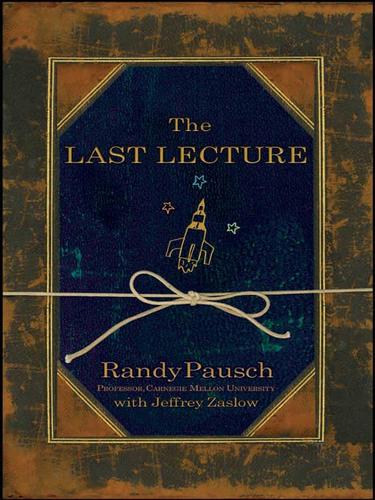
The Last Lecture
by Randy Pausch
★ Top 25 book of 2008 · #21 on Best Books of 2008
A computer science professor facing a terminal cancer diagnosis delivers a lecture that turns out to be about living, not dying. This book preserves its humor and wisdom on overcoming obstacles, helping others chase dreams, and seizing every moment.
Best for: Readers seeking inspiration about overcoming obstacles and making the most of limited time
The Last Lecture is #21 on BookWard's Best Books of 2008, out of 46 2008 books that cleared our data bar.
What The Last Lecture is about
Randy Pausch was a computer science professor at Carnegie Mellon University who was facing terminal pancreatic cancer. In September 2007 he gave a lecture titled 'Really Achieving Your Childhood Dreams,' and this book, written with Wall Street Journal reporter Jeffrey Zaslow, grows out of it. He wrote for his three young children, hoping to leave them something solid: his stories and his advice.
The nine chapters each pair an episode from his life with a lesson. He talks about the 'head fake,' where real skills are tucked inside other activities, and about the childhood dream of writing for an encyclopedia, which he eventually fulfilled with the virtual reality entry. He also credits his parents and tells the story of how he got onto NASA's 'Vomit Comet.' Though it is a farewell, the tone stays warm and often witty. Anyone facing a hard stretch, or wondering how to spend their time well, may find it steadying.
The Last Lecture on the Best Books of 2008
The Last Lecture came out in 2008. Of the 46 books first published in 2008 that met BookWard's data bar, it ranks #21 on our Best Books of 2008 list.
Why it made the list: 295 readers have shelved it on Open Library; readers rate it 4.1 out of 5 (18 ratings). The list ranks each year’s books on how many readers have picked them up, how highly readers rate them, and how many are reading them right now.
Nearby on the 2008 list
- I Love My New Toy! (Elephant and Piggie) Mo Willems, #19
- Fast Food Nation Eric Schlosser, #20
- Firefly Lane Kristin Hannah, #22
- The Art of Racing in the Rain Garth Stein, #23
See all Best Books of 2008 Best books by year
More years: Best Books of 2007 Best Books of 2009.
The numbers behind it
- Readers: 262 want to read it, 12 are reading it now and 21 have read it, according to Open Library.
- Ratings: 4.1 out of 5 from 18 Open Library ratings.
| Signal | This book (0 to 100) | Weight |
|---|---|---|
| Reach | 57 | 55% |
| Reader love | 52 | 25% |
| Being read right now | 57 | 20% |
Questions about The Last Lecture
When was The Last Lecture published?
The Last Lecture by Randy Pausch was first published in 2008.
Was The Last Lecture one of the best books of 2008?
The Last Lecture is #21 on BookWard's Best Books of 2008, out of 46 2008 books that cleared our data bar. 295 readers have shelved it on Open Library; readers rate it 4.1 out of 5 (18 ratings).
Why is The Last Lecture on the Best Books of 2008 list?
295 readers have shelved it on Open Library; readers rate it 4.1 out of 5 (18 ratings).
More of the best books of 2008
- The Hunger Games Suzanne Collins, #1
- End of Days Sylvia Browne, #2
- The Last Straw Jeff Kinney, #3
- Amulet Kazu Kibuishi, #4
- Outliers Malcolm Gladwell, #5
- Michelle Obama in Her Own Words Michelle Obama, #6
See the full Best Books of 2008, the Top 100, or new books on Rising.
How we know
This page uses public data: Open Library reader counts and ratings, and Wikipedia page views for recent years. The description is paraphrased from real source text. Rankings reflect reading interest, not quality or sales, and can be affected by data gaps. Lists update monthly.
Suits teens and adults, and it is a gentle read for most.
Depends on the edition you pick.
A dying professor's farewell, told with humor and a lot of heart. 51% taste match
 BookWard’s take
A dying professor's farewell, told with humor and a lot of heart
Randy Pausch built this book from his 2007 Carnegie Mellon lecture, written for his three young children after a terminal pancreatic cancer diagnosis. Each of its nine chapters pairs a memory from his life with a lesson drawn from it, so the structure is clean and the voice is unmistakably his. It is story-led, a run of personal anecdotes rather than an argument, and it leans sentimental, a real gap from my own preference for restraint. Still, the outlook stays hopeful and the humor dry, which softens the pull. The ending is resolved, since the whole thing is a goodbye. Familiar tropes show up often, as they do in many self-help-adjacent memoirs. Read it for the voice and the warmth, not for surprise.
Short chapters and anecdotes keep it moving, a little slower in the reflective stretches.
The framing is unusual, but the lessons themselves are familiar self-improvement fare.
The prose is plain and conversational, closer to speech than to literary writing.
There is no plot to speak of, so it runs on Pausch's personality and memories.
Despite the diagnosis, the book is about living well and is firmly hopeful.
The nine-chapter pattern is conventional, though anchored to a single real lecture.
Humor runs through it, but the subject keeps the tone mostly earnest.
Terminal cancer is the backdrop, but the treatment is gentle and not graphic.
Knowing it is a father's goodbye to his children makes it affecting.
See all 50 dialsEvery position, side by side with this book
Where it lines up
- Shock for effectBookWard 9 · book 9
- Authorial voiceBookWard 9 · book 9
- Story or ideasBookWard 3 · book 3
Where it pulls apart
- Familiar tropesBookWard 10 · book 3
- SentimentBookWard 8 · book 2
- Rigor (nonfiction)BookWard 9 · book 3
It opens on the dilemma of whether to give the lecture at all, which pulls you in quickly.
Life-lessons memoir leans on well-worn advice and inspirational phrasing, which sits against BookWard's wish to avoid the familiar.
Each chapter follows the same plan, an event then its lesson, so the book holds together even if the advice is loose.
Short chapters and anecdotes keep it moving, a little slower in the reflective stretches.
The framing is unusual, but the lessons themselves are familiar self-improvement fare.
Pausch comes through vividly, though other people appear mainly as supports for his lessons.
It is a farewell, so it closes with a settled sense of completion, which BookWard values.
It is openly sentimental about family and mortality, which is the main place it parts from BookWard's taste for restraint.
It treats a terminal illness gently and plainly, never using it for effect, which BookWard respects.
This is personal wisdom drawn from experience rather than evidence-based argument.
The warm, joking, direct voice of Pausch is the book's greatest strength.
The lessons are carried by personal stories, so it is firmly story-led.
Pausch states his lessons outright after each anecdote, which is more explaining than BookWard prefers.
The repeated structure of event then lesson keeps energy steady across all nine chapters.
The prose is plain and conversational, closer to speech than to literary writing.
There is no plot to speak of, so it runs on Pausch's personality and memories.
Despite the diagnosis, the book is about living well and is firmly hopeful.
The nine-chapter pattern is conventional, though anchored to a single real lecture.
Humor runs through it, but the subject keeps the tone mostly earnest.
It is a gentle, easy read that asks very little of you.
Everything is told from Pausch's own point of view.
It moves between childhood memories and the lecture's present, but remains easy to follow.
This is a grounded true account with no fantastical elements.
Family, mentors and friends appear, but the focus stays on one man.
It is an intimate book about one family and one man's final months.
Reflection and lessons dominate more than external events.
Quoted talk appears now and then, but it is mostly narration and reflection.
His marriage appears as part of his life, not as a central thread.
The settings of university life and a middle-class childhood are familiar.
It is set in the late 2000s, close to the present day.
The advice on dreams and time travels well, though its moment is tied to a famous lecture.
Pausch speaks as himself, openly and without evasion.
The book sets out its lessons clearly and has little ambiguity about its values.
Description is functional and brief, serving the anecdotes rather than painting scenes.
It is storytelling first, built from memories rather than analysis.
This is intensely personal, written by the man himself about his own life.
It stands entirely alone.
The structure is predictable, and there are few surprises beyond the stories themselves.
It is warm and encouraging rather than provocative or unsettling.
Terminal cancer is the backdrop, but the treatment is gentle and not graphic.
Knowing it is a father's goodbye to his children makes it affecting.
The humor is gentle and self-deprecating rather than broad.
There is no violence on the page.
There is essentially no sexual content.
Politics are absent, since the focus is personal values.
The language is plain, clear and everyday.
Pausch speaks freely about how to live, so the narration is strongly opinionated.
He looks back at his life while hoping to guide his children forward.
It is strongly idealistic, urging readers to chase dreams and help others chase theirs.
Review written by BookWard, dial version 1, November 2026.
Who is The Last Lecture right for?
Suits teens and adults, and it is a gentle read for most. It deals openly with terminal illness and a father's death, which may be tender for readers who have lost a parent.
It is a gentle, easy read that asks very little of you.
Terminal cancer is the backdrop, but the treatment is gentle and not graphic.
Knowing it is a father's goodbye to his children makes it affecting.
There is no violence on the page.
Book CompanionThe Last Lecture: ideas, characters, themes
Facing the end of his life, Pausch uses stories from his own past to teach his children, and anyone listening, how to pursue dreams and make the most of limited time.
- A lecture turned into a book. The book extends Pausch's 2007 Carnegie Mellon talk, 'Really Achieving Your Childhood Dreams.'
- Facing the elephant in the room. Pausch opens his lecture by addressing his terminal illness directly, even showing images of his tumors.
- Parents shape you. He credits his parents' values, including his mother's emphasis on compassion, for his success.
- Lessons from stories. Each chapter pairs a memory with the lesson it taught him.
- Writing for his children. His main aim is to leave advice and a lasting memory for his three young children.
Characters
Randy Pausch
Author and narrator
A Carnegie Mellon professor facing terminal pancreatic cancer who shares his life lessons.
Pausch's mother
Parent
She valued compassion for others over ordinary personal accomplishments.
Pausch's father
Parent
A storyteller who liked to make a moral point.
Pausch's sister
Sibling
She remarks that hearing his lecture was like hearing her father's voice from her brother.
Themes
Chasing the goals you set as a child and helping others reach theirs.
Facing death with honesty and humor.
What a parent leaves behind for children who will grow up without him.
Time as the one finite resource we all have.
How parents shape the people we become.
Discussion questions
- How does knowing the author's situation change the way you read his advice?
- Which lesson in the book would you most want to pass to someone younger?
- Why might Pausch have chosen humor as his main tone?
- Is the event-then-lesson pattern more helpful or limiting?
- What childhood dream of yours would you still like to pursue?
Personalize your Book Companion
This is the general edition. In BookWard, the Companion is written for you: your reading profile, your notes, and spoiler-safe to the page you are on.
Buy, listen or borrow The Last Lecture
Each link opens a search for this book on that store, in a new tab.
Read on a device
Borrow
Reviews and community
If you liked The Last Lecture
A philosophizing dog narrates a family's hardest years, tenderly and plainly
Tuesdays with MorrieMitch AlbomA short, plain-spoken memoir about learning how to live from a dying teacher
Big MagicElizabeth GilbertGilbert's warm, anecdotal pep talk on living a creative life
En Man Som Heter OveFredrik BackmanA grump, a flattened mailbox, and a heart worth the wait
Find your own best books
Add what you have read, rate it, and BookWard will recommend what to read next.
Free to start. No credit card needed.